•
1 min read
Liquid Fund Apps Ranked by AMC & SEBI Registration | Multipl

8 Liquid Fund Apps in India, Ranked by Which AMC Actually Holds Your Money (With SEBI Registration Numbers)
If your liquid fund app vanished from your phone tomorrow, the most important question is not, “What happened to the UI?” It is: where is my money actually held?
That is the right question to ask in 2026. Many platforms now package liquid funds as parking accounts, treasury accounts, cash management tools, or even spend-ready balances. The interface may look like an app wallet. Legally, though, your money should not be “inside the app” at all. It should be invested in a mutual fund scheme run by an asset management company, with units allotted in your own name.
That is why this guide focuses on liquid fund apps by AMC, not just app features. If you want to compare apps properly, start with the fund house, the regulator trail, the scheme disclosure, and whether you can independently verify what you own.
In other words: which AMC manages liquid fund apps, and how clearly does each platform tell you that?
If your liquid fund app disappeared tomorrow, where would your money still be?
In a proper mutual fund setup, your money is not supposed to sit on the app’s balance sheet. It is meant to move into a mutual fund scheme, and your ownership is reflected as units allotted in your name. Indian mutual funds are regulated under the SEBI mutual fund framework, while industry-wide NAV and fund data are published through AMFI. The app is usually the interface, the AMC manages the fund, and you remain the beneficial owner of the units. SEBI’s list of registered mutual funds also helps verify this.
So if an app changes branding, redesigns its flows, or shuts operations, your first line of protection is not app loyalty. It is whether the investment was actually made in a regulated scheme and credited to you correctly.
That is the core of any serious liquid fund app safety comparison.
Understanding legal ownership: app brand vs AMC vs mutual fund units in your name
A liquid fund app usually involves four moving parts:
The App Or Platform
This is what you download. It handles onboarding, KYC flow, order placement, portfolio display, and redemption instructions.The Intermediary Registration
The platform may operate as a broker, distributor, or investment adviser, depending on its model. This is where SEBI and AMFI registration numbers matter.The AMC
The asset management company runs the actual mutual fund scheme. This is the entity managing the portfolio of treasury bills, commercial paper, certificates of deposit, and other short-term money market instruments.The Units In Your Name
This is what matters most. If units are allotted correctly, you hold a claim on the scheme as an investor, not on the app as if it were a wallet issuer.
If you are new to this category, the meaning of liquid mutual funds in India and this complete guide to liquid funds for 2026 explain the structure in plain English.
Why this question matters more in 2026 as more apps package liquid funds as parking or spending accounts
The category has changed. Liquid funds are no longer discussed only as a mutual fund product for treasury-style cash parking. They are now wrapped into experiences built for salary parking, near-term savings, emergency funds, and even spend-ready balances. That convenience helps, but it can blur what the product actually is.
A liquid fund is still a debt mutual fund category that invests in instruments maturing in up to 91 days, as described by Groww’s liquid fund category explainer and ET Money’s liquid fund category page. It is low-risk, but not risk-free. It is liquid, but not identical to a bank savings account. It is regulated, but not insured like a bank deposit.
So readers searching for sebi registered liquid fund apps india should look beyond app-store polish. The real checks are simple: who is the intermediary, which scheme is used, which AMC holds the fund, and how quickly can you verify and redeem.
For a broader view of where liquid funds sit versus other short-term parking options, this comparison of liquid funds, savings accounts, fixed deposits, and HYSAs is a useful companion read.
The ranked list: 8 liquid fund apps in India by the AMC actually holding your money (with SEBI registration numbers)
How this ranking works: this is not a “best returns” list. It ranks platforms by how clearly they answer the ownership question: which AMC manages the scheme, how transparent the app is about the fund, and how easy it is for an investor to verify the setup.
1. Zerodha Coin
Why It Ranks #1: Very high clarity that Coin is a platform for direct mutual funds, while the actual scheme is run by the AMC you select.
Registration Clarity: Zerodha Broking Limited discloses SEBI Registration No. INZ000031633 on Coin’s official site.
AMC Ownership Clarity: Fund pages clearly show the specific AMC and scheme, such as SBI Liquid Fund Direct Growth on Coin.
Best For: Users who want direct mutual funds with explicit scheme-level visibility.
2. Kuvera
Why It Ranks #2: Strong transparency around direct plans and the intermediary/advisory layer rather than pretending the app itself is the fund holder.
Registration Clarity: Kuvera discloses Arevuk Advisory Services Private Limited as a SEBI-registered Non-Individual Investment Adviser with Registration No. INA200005166 on its official site.
AMC Ownership Clarity: Kuvera states in its terms of service that it offers access to direct plans of mutual funds and does not receive commissions for those transactions.
Best For: Investors who want a direct-plan-first experience and like seeing the fund house clearly.
3. INDmoney
Why It Ranks #3: Clear mutual fund distributor and BSE Star MF disclosure, plus straightforward mention of direct mutual funds.
Registration Clarity: INDstocks Private Limited discloses SEBI Registration No. INZ000305337 and AMFI Registration No. ARN-254564 on its mutual funds pages.
AMC Ownership Clarity: The platform clearly states in its mutual fund collection pages that users invest in direct plans of mutual funds.
Best For: Users who want a broad investment app but still need transparent mutual fund rails.
4. Groww
Why It Ranks #4: Strong scheme discovery and decent registration visibility, though many users may first experience Groww as a multi-product investing app rather than a clear “who holds my liquid fund” explainer.
Registration Clarity: Groww Invest Tech Pvt. Ltd. discloses SEBI Registration No. INZ000301838 and AMFI Registration No. ARN-111686 on Groww’s site.
AMC Ownership Clarity: Groww’s platform lets users invest in direct mutual funds and also shows scheme-level AMC pages, including liquid fund categories.
Best For: Beginners who want broad fund discovery with app simplicity.
5. Paytm Money
Why It Ranks #5: Clear that it offers direct mutual funds, but the “all-in-one wealth app” framing can overshadow the AMC-under-the-hood question for first-time users.
Registration Clarity: Paytm Money’s official site states that it is SEBI registered and offers direct mutual funds with zero commission.
AMC Ownership Clarity: Paytm Money’s platform is good at product access, but it is less explicit at first glance about “your liquid fund sits with AMC X” unless you drill into scheme details.
Best For: Existing Paytm ecosystem users wanting one app for multiple financial products.
6. ET Money
Why It Ranks #6: Strong research and goal-based presentation, but many users may need one extra step to focus on ownership structure rather than recommendations.
Registration Clarity: ET Money’s official site describes itself as a mutual fund investment app and lists extensive product and user information.
AMC Ownership Clarity: Its liquid fund pages show specific schemes, categories, and fund-level data, which helps you identify the actual AMC.
Best For: Users who want screening, fund reports, and decision support.
7. Multipl

Why It Ranks #7: Multipl is very clear that it uses liquid mutual funds under the hood for spend-ready money, but it is built around Spendvesting rather than a pure direct-fund marketplace.
Registration Clarity: Multipl Wealth Management Private Limited is a SEBI-Registered Investment Adviser, INA200014681, and an AMFI-Registered mutual fund distributor, ARN-319633.
AMC Ownership Clarity: Multipl’s model is explicit that mutual fund units are held in the name of the user at the respective AMC, while the app adds goal planning and spending-focused use cases. This Higher-Yield Spending Account explanation and this Spendvesting explanation explain the structure.
Best For: People who want to keep spend-ready money productive instead of idle, without treating the app like a black box.
8. AMC-Owned Apps Or AMC Portals
Why It Ranks #8: In one sense, these should be the simplest, because the AMC and fund manager are the same brand. But if your goal is comparing multiple AMCs and multiple liquid funds in one place, AMC-native apps can be narrower.
Registration Clarity: High at the scheme level because the fund house is itself the issuer, and AMCs are listed under SEBI’s registered mutual funds list.
AMC Ownership Clarity: Highest possible for a single fund house, lowest flexibility for cross-AMC comparison.
Best For: Investors already committed to one AMC.
For each app, what happens behind the scenes: onboarding, purchase, fund allotment, redemption and credit to bank
No matter which platform you use, the mechanics usually follow a similar path:
Onboarding
You complete KYC, PAN validation, bank mandate setup, and identity checks. Depending on the app, this may happen directly or through exchange-backed mutual fund infrastructure.
Purchase
You place a lump sum or SIP purchase order for a selected liquid fund. The app sends the order through its transaction rails to the relevant mutual fund processing system.
Fund Allotment
After cut-off processing and successful payment realization, units are allotted in the chosen scheme. This is the key moment: the legal exposure is now to the mutual fund scheme run by the AMC, not to the app’s UI.
Portfolio Display
The app shows your holdings, current value, and transaction history. This is convenience, not ownership in itself.
Redemption
You request withdrawal. The platform transmits the redemption request to the mutual fund system, subject to scheme rules, cut-off timing, and any instant-redemption limits where applicable.
Credit To Bank
Once processed, redemption proceeds are credited to your registered bank account.
If you want a deeper breakdown of timing realities, this guide to liquid fund withdrawal timelines and this guide to instant-redemption liquid funds in India cover the practical side.
How to read the rank: trust clarity, AMC disclosure, fund choice, and transparency of redemption rules
This ranking is not saying one app is “safe” and another is “unsafe.” It is saying some apps do a better job answering five investor questions:
Who Is The Regulated Intermediary?
You should be able to find the SEBI registration number easily.Is There An AMFI Trail?
If the platform distributes mutual funds, an ARN trail matters for disclosure and accountability. AMFI explains the role of AMFI Registration Numbers.Which AMC Actually Manages The Fund?
This should be visible at the scheme level, not hidden behind marketing labels.Are Redemption Rules Easy To Understand?
You want clear visibility on cut-off time, settlement timing, and instant redemption conditions.Can You Verify Ownership Outside The App?
The more independently verifiable your holding is, the better.
For an app-first comparison of user experience and liquidity, this comparison of liquid fund apps in India and these best mutual fund apps for parking money safely in 2026 add useful context.
Case-by-case use scenarios: best for emergency fund, best for idle salary, best for spend-ready money, best for direct mutual fund users
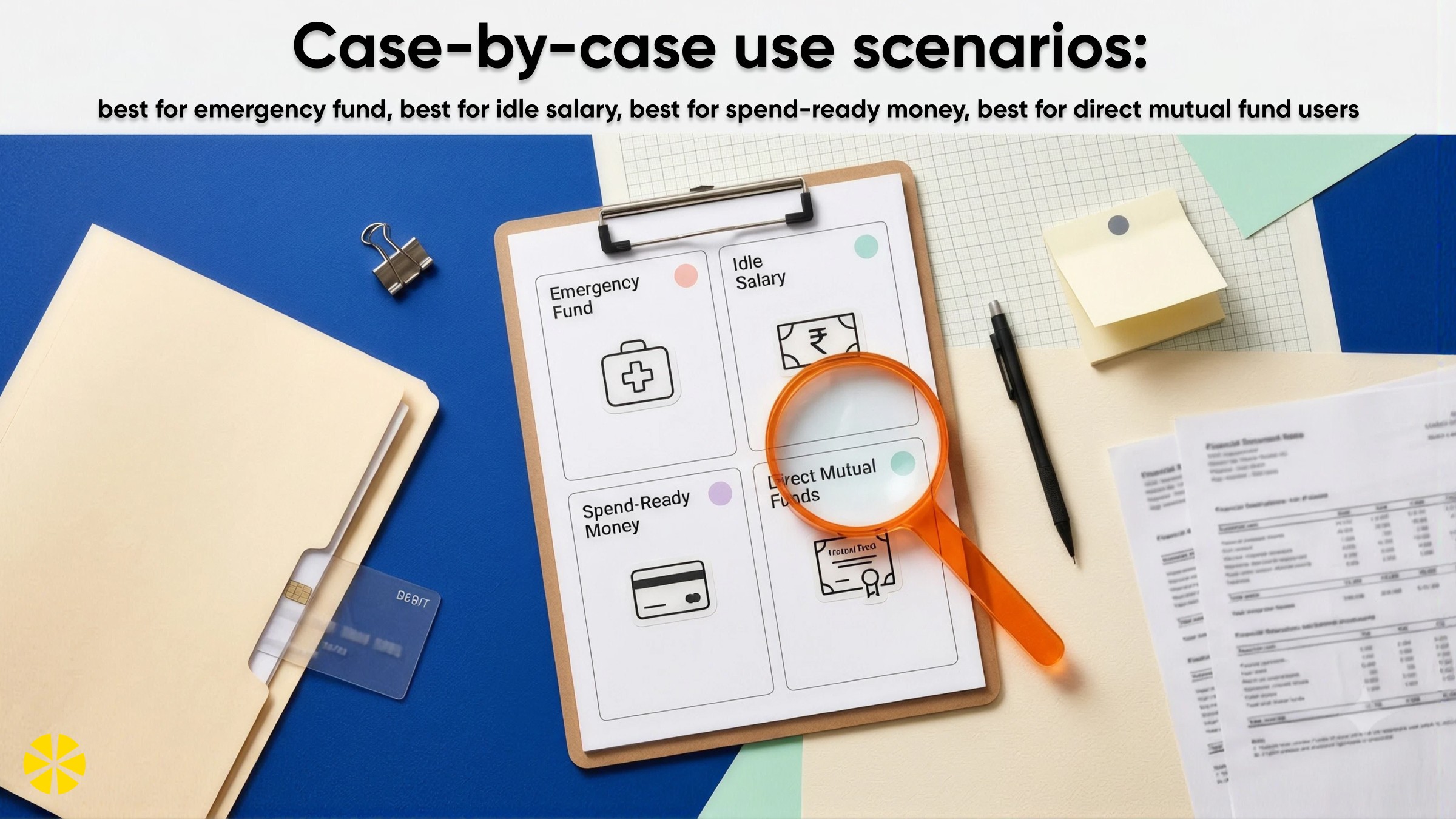
Different users need different kinds of clarity.
Best For Emergency Fund
If your emergency money needs low volatility, straightforward scheme visibility, and easy redemption checks, direct mutual fund platforms and simple liquid fund interfaces can work well. But keep in mind that even liquid funds are not zero-risk. This guide to using liquid funds for an emergency fund in India breaks down where they fit and where they do not.
Best For Idle Salary Between Payday And Bills
This is where convenience matters almost as much as fund quality. You need liquidity, low friction, and a realistic withdrawal timeline. This guide to where salaried Indians can keep money between payday and bill day and this 1-2 month cash parking framework for salary in liquid funds explore this use case.
Think of money meant for school fees, rent, Uber rides, or your next flight booking. If it is going to be used soon, access matters as much as return.
Best For Spend-Ready Money
If your goal is not just “parking” but also “using” that money for near-term spends without letting it lie idle, Multipl’s Spendvesting approach fits this category well. Instead of treating short-term money like dead cash, it frames it as a mutual-fund-powered spending balance. This HYSA strategy for spending money explains the logic.
This can suit Spendvesters saving for Swiggy and Zepto orders, a phone upgrade, a wedding payment, or annual school fees. The point is simple: let the money work until you spend it.
Best For Direct Mutual Fund Users
If you prefer direct plans, scheme-level choice, and more self-directed fund selection, platforms like Coin, Kuvera, Groww, and INDmoney are usually more natural fits.
What can still go wrong even with a reputed AMC: interest-rate risk, credit events, cut-off timing and payout delays
A reputed AMC helps, but it does not remove all risk.
Interest-Rate Risk Exists
Liquid funds generally have low duration risk because they hold very short-maturity instruments, but NAVs can still move modestly.Credit Events Can Happen
If an underlying issuer in the portfolio faces stress, the fund can be affected.Cut-Off Timing Matters
Same-day or next-day expectations depend on order timing, bank processing, and non-business days.Instant Redemption Is Not Universal
Not every scheme supports it, and limits may apply.Operational Delays Can Happen
Bank credit timing, transaction retries, and holidays can delay actual receipt.
If you want evidence-based context on downside scenarios, this 15-year NAV data check on whether liquid funds can lose money, this guide to liquid fund safety, and this guide to liquid funds during a market crash are worth reading.
The right way to evaluate safety: regulator, AMC, portfolio, process, and your own liquidity needs
A smart liquid fund app safety comparison should check five layers:
Regulator Layer
Is the intermediary properly registered with SEBI, and if relevant, AMFI?AMC Layer
Which fund house runs the scheme? Is it easy to identify?Portfolio Layer
What does the liquid fund actually hold? Quality matters as much as category label.Process Layer
How do purchase, allotment, and redemption work in practice?Personal Liquidity Layer
Do you need this money in hours, one day, one week, or one month?
That last point matters. The safest-looking app is not the right choice if your cash need is more immediate than the product structure allows. This short-term money parking guide for working professionals and these liquid fund alternatives help with that decision.
A practical checklist to verify your liquid fund app before your first ₹100
Before you invest even a small test amount, check these:
Find The SEBI Registration Number on the app website or legal footer.
Find The AMFI ARN, if the platform distributes mutual funds.
Open The Actual Scheme Page and note the AMC name.
Read The Scheme Type to confirm it is a liquid fund and not another debt category.
Check Redemption Timelines and instant-redemption limits.
Confirm The Registered Bank Account where redemption proceeds will be credited.
Verify Holdings Independently through your transaction confirmations and fund records.
Test With A Small Amount First before moving larger idle balances.
For a reader-friendly version of this process, this 6-point safety checklist for using a liquid fund app and this guide to starting liquid funds on an app in India are practical next steps.
How Multipl fits into this category: spendvesting with liquid mutual funds under the hood

Multipl belongs in this conversation because it answers the “where is my money actually held?” question clearly.
Multipl is not a bank account and not a fixed-return wallet. It is a mutual-fund-powered short-term money experience built around Spendvesting: putting money aside for future spends into mutual funds so it can grow until you actually use it. In Multipl’s Higher-Yield Spending Account, your spend-ready money is invested in expert-selected liquid mutual funds and can earn up to 7%* based on historical liquid-fund returns, instead of sitting idle in a low-yield savings balance. There is no lock-in, you can withdraw anytime, and the money moves through regulated mutual fund rails. Returns are market-linked and not guaranteed.
That matters for real life. Money for an iPhone, wedding shopping, school fees, flights, Swiggy weekends, or Zepto top-ups does not have to sit idle while you wait to spend it.
What makes Multipl different is the layer on top of the fund: goals, near-term planning, liquidity, and discounts with partner brands. The money remains invested through regulated mutual fund rails, and units are held in the user’s name at the respective AMC. Multipl Wealth Management Private Limited is a SEBI-Registered Investment Adviser, INA200014681, and an AMFI-Registered mutual fund distributor, ARN-319633.
It is still a mutual fund product underneath. So the usual caveats apply: mutual funds are subject to market risk, past performance is not indicative of future results, and no investment is zero-risk.
If your main use case is not just “investing” but “earning on money you plan to spend soon,” Multipl Wealth Management Pvt. Ltd., this comparison of cash management apps, and these best savings account alternatives in India for 2026 show where it fits.
Final takeaway
When comparing liquid fund apps by AMC, use a simple mental model:
Do not ask only which app you like. Ask which AMC holds the scheme, how the units are allotted, and how you can verify ownership without trusting the app blindly.
That one shift improves how you evaluate sebi registered liquid fund apps india.
A polished interface helps. Fast redemption helps. Good fund filters help. But if the app disappeared tomorrow, the thing that should still stand between you and chaos is this: your mutual fund units exist in a regulated scheme, with a real AMC, in your own name.
Mutual fund investments are subject to market risks. Read all scheme-related documents carefully. SEBI registration, AMFI registration, and NISM certification do not guarantee performance or assure returns. Mutual fund gains are taxable, and no investment is zero-risk.
FAQ
Is money in a liquid fund app held by the app itself?
Usually, no. In a proper mutual fund transaction, the app is the interface or intermediary, while your money is invested in a mutual fund scheme run by an AMC. Your protection depends on correct allotment of units in your name, not on the app brand alone.
Can I switch apps later and still keep the same mutual fund?
Often, yes in practical terms, because the underlying holding is the mutual fund scheme, not the app skin. But the exact experience depends on whether the platform supports importing or tracking existing holdings, and whether you invested in direct or regular plans.
How do I confirm which AMC manages my liquid fund app holding?
Open the exact scheme page inside the app, read the fund name, and check the AMC name there. Then cross-check the scheme and NAV through AMFI or the AMC’s official documents. If the app makes this hard to find, that is a transparency warning.
What is the difference between SEBI registration and AMC ownership?
SEBI registration tells you the intermediary is operating under a regulated framework. AMC ownership tells you which fund house actually manages the mutual fund scheme. Both matter, but they are not the same thing.
Are liquid fund apps safer than savings accounts?
Not in the same way. Savings accounts are bank products, while liquid funds are market-linked mutual funds. Liquid funds have historically offered better short-term return potential in many periods, but they are not guaranteed and not risk-free. If you want the nuance, this side-by-side comparison of savings accounts, liquid funds, and HYSAs in India for 2026 covers the trade-offs.
What should I verify before my first investment?
Check the platform’s SEBI registration, AMFI ARN where applicable, the exact scheme name, the AMC, the redemption process, and whether proceeds go back to your own registered bank account. A small test transaction is a smart first move.
Multipl is a AMFI registered Mutual Fund Distributor (ARN No. 319633).
*Based on historical returns of Liquid Fund category.
Disclaimer: Mutual Fund investments are subject to market risks, read all scheme related documents carefully.