•
1 min read
Cash Management Apps Compared: Which One Fits Your Money?
Not all cash management apps do the same job.
Some are built for payments. Some are built for savings discipline. Some are built for parking idle cash so it can stay accessible while potentially earning more than a plain savings account. That is why a generic “best app” list can be misleading.
TLDR
Cash management apps fall into five buckets: UPI-led payment apps, savings-account-led apps, fixed-return parking apps, liquid fund apps, and hybrid spending + returns apps.
Pick by the job the money is doing, not by app-store ratings. Rent due on Friday needs certainty. Salary float that gets spent over three weeks can work harder in the meantime.
UPI apps win on payment speed and do almost nothing for idle cash. Liquid fund apps are the reverse: good for parking, slower to spend from.
Hybrid or HYSA-style setups aim at the middle zone, money that will be spent soon but does not need to sit in a low-yield balance until then.
Most working professionals end up with a stack of two or three tools rather than one app that does everything.
If you are comparing cash management apps in India, the better question is this: what job is your money doing right now?
Is it your salary money between payday and bill day?
Is it your monthly expense float that will be spent gradually?
Is it emergency cash that must stay available?
Or is it planned spending money for travel, gadgets, festivals, or school fees?
That lens matters because the best app for QR payments is usually not the best app for idle cash. And the best app for earning returns on short-term money may not be ideal for instant daily spending.
India’s payment behavior has become deeply real-time. NPCI reports UPI handled 22,641.11 million transactions in March 2026, worth ₹29,52,542.05 crore, which shows just how fast money now moves in and out of consumer accounts. (npci.org.in) In that environment, choosing the right app is less about flashy features and more about balancing liquidity, returns, withdrawal speed, and spending readiness.
This guide takes a practical approach to cash management apps compared. Instead of ranking apps by app-store claims, we compare the major cash-management categories by use case: UPI-led apps, savings-led apps, fixed-income parking apps, liquid-fund-led apps, and hybrid spend-and-earn models.
Why “cash management” means different things to different people
For most working professionals, “cash management” is not treasury jargon. It simply means:
where salary lands,
where bills get paid from,
where short-term money sits,
and whether that money can earn something before it gets spent.
The mistake many people make is keeping all short-term money in one place just because it feels simpler. But every rupee does not need the same treatment.
For example:
Rent money due in 3 days needs certainty and instant access.
Monthly spending money needs access plus convenience.
Emergency money needs high liquidity, but not necessarily swipe-readiness.
Vacation money for 3 months later can often be optimized differently.
If this sounds familiar, you may also like Multipl’s broader guide to short-term money management: The Complete Guide to Managing Short-Term Money in India (2026): Savings Accounts, Liquid Mutual Funds, and Higher-Yield Spending Accounts-savings-accounts-liquid-mutual-funds-and-higher-yield-spending-accounts).
The 5 main categories in this cash management apps comparison
When people search for the best cash management apps India, they are usually comparing one of these five buckets:
UPI-led payment apps
Savings-account-led apps
Fixed-return parking apps
Liquid fund apps
Hybrid spending + returns apps
Let’s break down where each one fits.
1) UPI-led payment apps: best for movement, weakest for idle cash
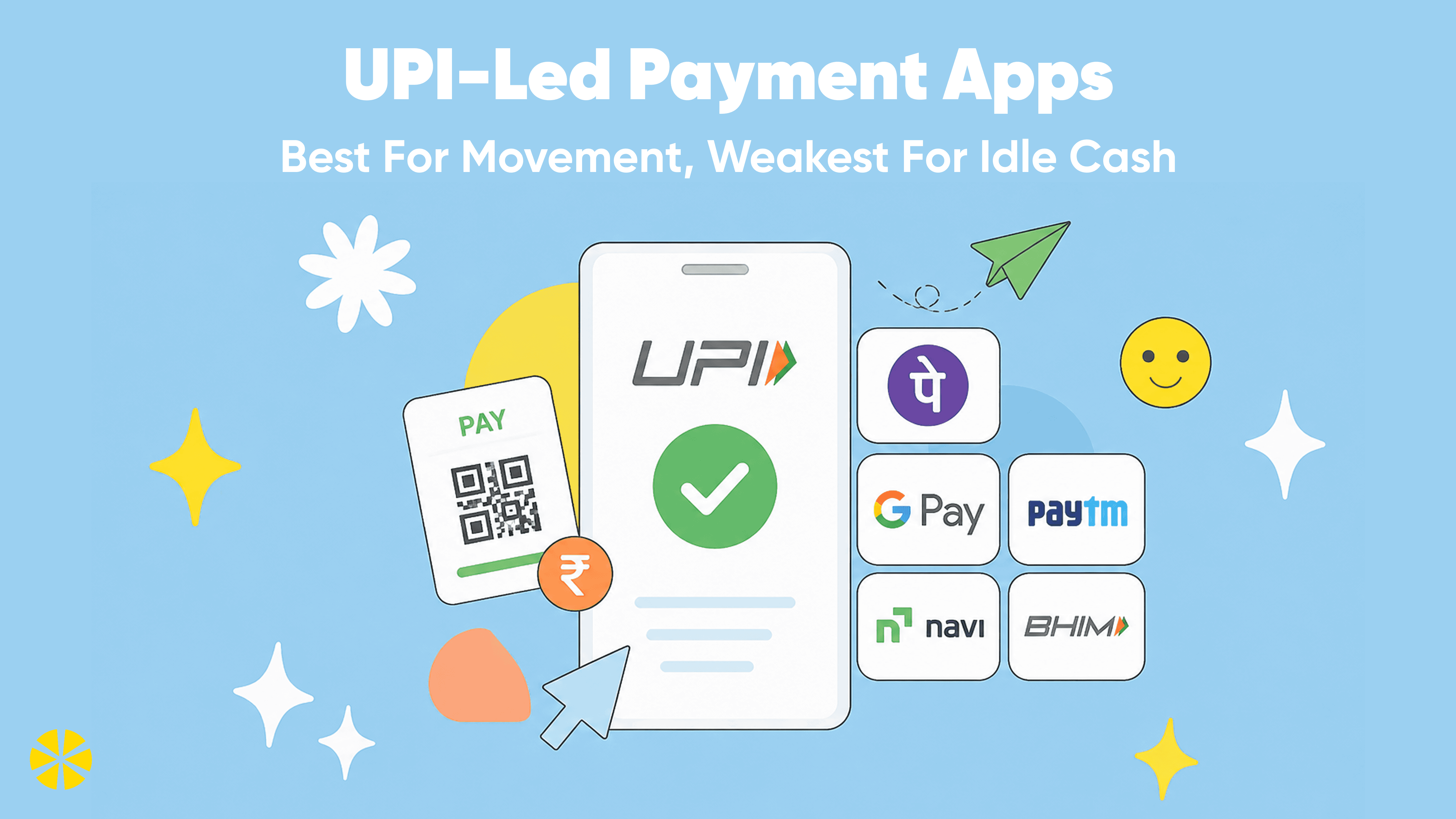
UPI-led apps are great at one thing: moving money instantly.
They make QR payments, merchant payments, P2P transfers, recurring bills, and account visibility feel effortless. That convenience is why they are often mistaken for full cash-management solutions.
But for salary money management, UPI-first apps are usually only the interface, not the yield engine. In most cases, your money still sits in a regular bank account unless the app layers on another product.
Best for
Daily payments
Bill handling
Fast transfers
Payment convenience
Not ideal for
Earning better returns on idle money
Segmenting short-term money by purpose
Parking money for a few weeks or months
Where they break down
A payment app solves spending friction, not necessarily idle cash drag. If your salary sits untouched for 10–20 days every month, a pure UPI workflow may leave that money underutilized.
This is exactly why many users start exploring alternatives beyond traditional balances, such as Best Savings Account Alternatives in India 2026: Higher-Yield Options That Actually Work.
2) Savings-account-led apps: simple and familiar, but often low on optimization
This category includes digital-first banking layers built around a savings account. They often offer spending insights, card controls, budgeting tools, and user-friendly interfaces.
For many users, this feels like the safest default because the money remains visibly “bank-like.” That familiarity matters. But simplicity can come with a trade-off: the convenience is high, while return optimization may remain limited depending on the account structure.
Best for
Salary credit
Daily spending
Autopay and bill management
Users who want banking familiarity
Not ideal for
Maximizing short-term returns
Separating spending float from idle surplus
Purpose-based cash allocation
Where they break down
If all your money sits in one operating account, it becomes harder to distinguish between:
money you must spend this week,
money you might need this month,
and money that could be parked smarter.
That is one reason comparisons such as Savings Account vs Liquid Fund vs HYSA in India 2026: A Side-by-Side Comparison for Working Professionals are becoming more relevant for salaried users.
3) Fixed-return parking apps: useful for known timelines, weak for flexible spending
Some apps are designed around deposits or fixed-income style parking products. These can appeal to users who want predictability and do not want to think too hard about market-linked fluctuations.
The trade-off is flexibility.
If the money is definitely not needed until a known date, fixed-return products may be worth evaluating. But if you are looking for apps for salary money management or spending money apps India that support fluid withdrawals and real-life cash flow, these may feel restrictive.
Best for
Money with a fixed timeline
Users who prefer predictability
Surplus cash not needed immediately
Not ideal for
Monthly spending float
Frequent access needs
Dynamic cash flow management
Where they break down
The moment your timeline becomes uncertain, lock-in constraints or withdrawal friction become painful. Cash management is not only about return rate; it is about how gracefully the product handles unpredictability.
If you are deciding between parking tools and traditional deposits, Mutual Funds vs Fixed Deposits: Where Should You Park Your Money? gives useful context.
4) Liquid fund apps: strong for idle cash, but not always spending-ready
This is where the idle cash apps comparison gets more serious.
Liquid funds are a debt mutual fund category defined under SEBI’s mutual fund categorization framework, and they sit within the ultra-short end of the spectrum. (sebi.gov.in) They are commonly considered by people who want a place for short-term surplus that is more productive than letting money sit idle, while still keeping relatively high liquidity. But they are still mutual funds, which means they are not guaranteed or assured return products, as AMFI notes in its investor education material. (amfiindia.com)
Best for
Idle cash for days to months
Emergency-fund layers
Salary overflow beyond near-term bills
Planned spending with a short horizon
Not ideal for
Instant tap-and-pay use
People who need all money to remain card-ready
Users unwilling to understand settlement and withdrawal timing
Where they shine
Liquid fund apps can be excellent when the job is parking idle money without long lock-ins. That is why searches around liquid fund app comparison India have become more common.
Where they break down
The key limitation is operational: money parked in a liquid fund is usually not the same as money sitting in your primary transactional balance. Access may still be fairly quick, but it may not feel as immediate as UPI-ready account cash.
To understand the mechanics better, read Liquid Mutual Fund Meaning: How It Works in India, Liquid Fund Withdrawal: When Can You Get Your Money?, and Liquid Fund Safety: Can Liquid Funds Lose Money?.
If you want a category-specific roundup, Multipl also has Liquid Fund Apps in India: Compare Liquidity, Returns and Minimums.
5) Hybrid spending + returns apps: built for money that is waiting to be spent
This is the most interesting category for modern cash behavior.
A hybrid spend-and-earn model is designed for money that is not long-term investment capital, but also not immediate swipe money every second of the day. Think of:
money waiting for bills,
planned spending over the next few weeks,
salary money that will be used gradually,
or savings for near-term lifestyle goals.
This category exists because real life has a middle zone between “invest for years” and “leave it idle.” That is where concepts like a **Higher-Yield Spending Account (HYSA)** or spend-linked short-term parking can make sense.
Best for
Spending money parked for near-term use
Planned expenses
Salary float
Users who want returns without thinking like full-time investors
Not ideal for
Long-term wealth creation by itself
Users who need every rupee in instant bank balance form
People who ignore product structure and withdrawal mechanics
Where they shine
The biggest advantage is behavioral fit. Instead of forcing users to choose between:
low-yield accessibility, and
higher-yield inconvenience,
these products try to bridge the two.
Multipl explains this idea in What Is a Higher-Yield Spending Account (HYSA) and How Does Multipl Work? A Complete 2026 Guide. You can also explore the practical use case in The Spending Money Hack: How to Use HYSA (Higher-Yield Spending account) to Earn While You Shop.
Cash management apps compared by actual use case
Here is the simplest way to think about fit.
Money job-to-be-done | Best-fit app category | Why |
|---|---|---|
Salary arrives today, bills due over next 2–3 weeks | Hybrid spending + returns app / liquid-fund-led setup | Helps reduce idle cash drag while retaining near-term usability |
Daily UPI spending and QR payments | UPI-led payment app | Fastest for transaction convenience |
Emergency cash | Liquid fund app + bank buffer | Better for layered liquidity rather than all-or-nothing idle balance |
Rent and EMI due within days | Savings-account-led setup | Highest certainty for immediate obligations |
Vacation, gadget, festive shopping in 1–6 months | Hybrid spending + returns / liquid fund app | Better aligned to planned short-term spending |
Fixed date, no withdrawal needed | Fixed-return parking app | Predictability matters more than flexibility |
This use-case view is more useful than app-store ratings because it reflects what cash actually needs to do.
What working professionals should check before choosing an app
If you are comparing the best cash management apps India, ignore marketing headlines for a minute and ask these six questions:
1. How quickly can I access the money?
Liquidity is not binary. “Can withdraw” is not the same as “can spend right now.”
2. Is this money for spending, buffering, or parking?
Do not use one product for all three unless the trade-offs are acceptable.
3. Are returns fixed, variable, or market-linked?
This changes expectations. Mutual fund-based products are market-linked and not guaranteed. (amfiindia.com)
4. What happens between withdrawal request and usable balance?
Settlement timing matters more than feature lists.
5. Does this app improve behavior or just provide another dashboard?
Good cash management is partly product design, partly habit formation.
6. Is the money losing purchasing power while sitting idle?
Even if nominal balances feel safe, idle cash has an opportunity cost. RBI continues to publish household financial savings data because where Indian households hold money meaningfully shapes outcomes over time. (rbi.org.in)
For a deeper look at this hidden cost, see Why Most People Lose Money Without Realising It - The Hidden Cost of Idle Cash and How Much Money Are You Losing by Keeping ₹1 Lakh in a Savings Account? (And 5 Apps That Fix It).
Exit loads, expense ratios and tax: the part most comparisons skip
Headline return numbers hide three costs that decide what you actually keep.
Exit load. SEBI requires liquid funds to charge a graded exit load on units redeemed within seven days, starting at 0.0070% on day one and tapering to 0.0045% by day six, with no load from day seven onward. It is small in rupee terms, but it exists, and very short holding periods are where it bites.
Expense ratio. Liquid fund expense ratios are among the lowest in the mutual fund universe, often well under 0.30% for direct plans, though the exact figure differs by scheme and plan type. Returns quoted on any app are usually after this cost, so check whether the number you are shown is direct or regular plan.
Tax. Gains on debt mutual funds bought on or after 1 April 2023 are added to your income and taxed at your slab rate, whatever the holding period. Savings account interest is taxed the same way, with a ₹10,000 deduction available under Section 80TTA if you are on the old regime. For a 30% slab taxpayer, a 6.5% pre-tax liquid fund return and a 3% savings account return narrow, but the gap does not disappear.
None of this changes the category ranking. It just means you should compare post-cost, post-tax outcomes rather than the biggest number on a landing page.
So, which cash management app fits your money?
Here is the short answer:
Choose a UPI-led app if your top priority is frictionless payments.
Choose a savings-account-led app if you value familiar banking operations over optimization.
Choose a fixed-return parking app if the money has a defined timeline and flexibility is not critical.
Choose a liquid fund app if the goal is to park idle cash more efficiently while keeping relatively high liquidity.
Choose a hybrid spending + returns app if your money is meant to be spent in the near future, but you do not want it lying dormant in the meantime.
For many working professionals, the real answer is not one app but a stack:
bank account for immediate obligations,
payment layer for transactions,
and a smarter parking layer for money waiting to be spent.
That is especially true for salary structuring. If you are exploring that workflow, Where Should Salaried Indians Keep Money Between Payday and Bill Day? 5 Smarter Parking Spots and Salary in Liquid Fund: How Much Should You Keep? are useful next reads.
Why this comparison matters more in 2026
As digital payments become default behavior, people are realizing that convenience alone is not a complete money strategy. UPI has made spending seamless, but it has also exposed how much money now sits in transit between earning and spending. (npci.org.in)
That middle period is where better cash management decisions compound. Not dramatically overnight, but meaningfully over years of salary cycles, bill cycles, and planned expenses.
The smartest users do not ask, “Which app has the coolest interface?” They ask, “What is this money for, how soon might I need it, and what is the least inefficient place to keep it until then?”
That is the right framework for cash management apps compared.
Conclusion
The best cash management app is not the one with the loudest promise. It is the one that matches your money’s job.
If the money is meant for instant spending, optimize for convenience.
If it is meant for short-term parking, optimize for liquidity plus better use of idle cash.
If it is meant for planned spending, choose a structure that keeps it working without creating unnecessary friction.
In other words: compare cash apps by use case, not by category labels alone.
If you want a practical starting point, explore Multipl or visit the blog for more guides on salary parking, liquid funds, smart spending, and HYSA-style money management.
FAQs
What are cash management apps in India?
Cash management apps are apps that help you handle short-term money better. Depending on the product, they may support payments, salary money management, bill planning, idle cash parking, or spending-linked returns.
Which is the best app for salary money management?
The best option depends on how long the money sits before you spend it. If it is needed immediately, a bank-linked setup may work best. If the money usually sits for days or weeks, a hybrid or liquid-fund-led setup may be more efficient.
Are liquid fund apps better than savings accounts?
Not always. Liquid fund apps may suit idle cash better, but savings accounts remain simpler for immediate transactions. The better option depends on liquidity needs, withdrawal timing, and comfort with market-linked products.
Is there any option where my money grows while I wait to spend it?
Yes. That is exactly why many users look at liquid-fund-led apps or HYSA-style solutions for short-term spending money rather than leaving everything in a low-yield operating balance.
What’s a better place than a savings account to park salary money temporarily?
For many working professionals, it can be a liquid-fund-based or hybrid spending-and-returns setup, especially when money sits between payday and bill day. But immediate dues should still remain in an instantly accessible balance.
How can I earn returns on cash without fixed deposits or lock-ins?
You can compare short-term, high-liquidity alternatives such as liquid funds or spending-linked cash management structures. Just remember that product type, withdrawal timelines, and risk characteristics matter more than headline returns.
How many cash management apps do I actually need?
Two or three usually covers it. A bank account for rent, EMIs and anything due within days. A payment app for daily UPI and card spends. One parking layer for the money that sits between payday and bill day. Adding more apps beyond that tends to fragment your view of your own balance without improving returns.
Do I pay tax on returns from a liquid fund app?
Yes. Gains from debt mutual funds purchased on or after 1 April 2023 are added to your total income and taxed at your slab rate, with no holding-period benefit. Tax is triggered when you redeem, not while the money sits invested, so the calculation only matters at withdrawal.
Multipl is a AMFI registered Mutual Fund Distributor (ARN No. 319633).
*Based on historical returns of Liquid Fund category.
Disclaimer: Mutual Fund investments are subject to market risks, read all scheme related documents carefully.