•
1 min read
6-Point Safety Checklist Before Using a Liquid Fund App

Your salary does not stay “short term” just because you plan to spend it soon. For a few days, weeks, or months, it is still your money at work, or your money sitting idle. That is why liquid fund apps have become popular among working professionals who want better outcomes than a traditional savings account while keeping access relatively easy.
But many people ask, “Do liquid funds give better returns?” before they ask the more important question: is the liquid fund app safe?
That is the wrong order.
A liquid fund itself may be a regulated product, but the app layer you use to access it still matters. The app determines how clearly it explains risk, which fund house it works with, how redemption works, how transparent it is about fees, and whether the user experience builds trust or hides important details.
So before you park your salary, emergency buffer, bill money, or short-term savings in any platform, use this liquid fund app safety checklist. It is a practical, user-side audit you can run in minutes. Two of the most important checks are the ones people usually skip.
If you are still comparing liquid funds with other short-term parking options, Multipl’s guides on what liquid funds are, liquid funds vs savings accounts and HYSA options, and where salaried Indians can keep money between payday and bill day can help frame the bigger picture.
Why a safety checklist matters before using any liquid fund app
Liquid funds are debt mutual funds that typically invest in short-maturity money market and debt instruments, which is why they are often discussed for short-term cash management. The category itself is defined and regulated within the mutual fund framework in India by the Securities and Exchange Board of India and the Association of Mutual Funds in India. That is the product side.
For users, though, safety is not only about the category. It is also about how the app gives you access to that category.
A trustworthy app should make it easy to verify:
who regulates the investment entity,
which AMC actually manages the fund,
what risks exist,
how fast redemption can happen,
what costs you bear,
and what operational safeguards exist if something goes wrong.
This matters even more if you are considering keeping part of your salary in a liquid fund framework, something Multipl has discussed in both its 1–2 month cash parking framework and its guide on how much salary to keep in a liquid fund.
The 6-point liquid fund app safety checklist
1. Verify whether the app is working with regulated entities — not just using “safe” language
This is the first and most basic check in any SEBI regulated liquid fund app review.
Many apps use reassuring words like “secure,” “smart,” “trusted,” or “bank-grade.” Those words are not enough. You need to verify the actual structure behind the product.
Ask:
Is the investment offered as a mutual fund, not an unregulated pooled product?
Is there a disclosed AMC or fund house?
Is the distributor or platform entity clearly identified?
Are the relevant registrations, disclosures, and legal pages visible?
In India, mutual funds operate through regulated layers. The AMC, trustee structure, custodian, registrar, and intermediaries all play distinct roles under the broader regulatory framework. The SEBI mutual fund regulations and AMFI investor resources make it easier to understand what a legitimate setup looks like.
Red flag: the app talks at length about returns and convenience but makes it hard to find who the actual regulated partners are.
What a better app does: it tells you plainly which fund you are investing in, which institution manages it, and what role the app itself plays.
If you are learning how to verify a mutual fund app, this single step eliminates a surprisingly large number of weak options.
2. Check the AMC and the exact liquid fund name — never trust a generic “liquid fund” label

This is the first commonly skipped check.
Many users stop after hearing, “your money goes into liquid funds.” But which liquid fund? Managed by which AMC? With what portfolio approach, expense ratio, track record, and operational process?
A legitimate app should disclose the exact scheme name. Once you have that, you can independently verify it through the AMC website, the scheme factsheet, and AMFI records. You do not need to be a market expert. You just need to confirm that the named fund actually exists and is what the platform says it is.
Why this matters:
not all liquid funds are operationally identical,
portfolio quality can differ,
exit processes can differ,
app marketing can oversimplify the underlying product.
If an app avoids naming the scheme clearly, that is one of the biggest liquid fund app red flags.
For readers who want a stronger foundation, Multipl’s explainers on liquid mutual fund meaning and liquid fund safety are useful starting points before judging any specific platform.
Simple user test: if you cannot identify the AMC and scheme within a few clicks, pause. Transparency should not require detective work.
3. Read how the app explains risk — especially credit risk, NAV movement, and “not guaranteed” language
This is where many people confuse “low risk” with “no risk.”
Liquid funds are generally considered lower risk than many longer-duration debt strategies because they invest in very short-term instruments. But they are still market-linked mutual funds, not guaranteed bank deposits. That means returns are not fixed, principal is not guaranteed by default, and there can be small NAV fluctuations.
SEBI and investor education sources consistently emphasize reading scheme-related documents and understanding risk before investing. A good app should not bury that reality under comforting UX copy.
Look for whether the app clearly states:
liquid funds are not the same as a savings account,
returns are not assured,
there can be mark-to-market impact,
underlying portfolio quality still matters,
suitability depends on time horizon and liquidity needs.
Red flag: the app presents the product like a “better savings account” without clearly explaining the differences.
Green flag: the app explains the trade-offs in plain language and helps you decide whether liquid funds fit your use case.
If you want a more nuanced take, Multipl has already explored can liquid funds lose money, can liquid funds be used like a bank account, and what to choose when a liquid fund is not the right fit. That context matters because the safest app is not always the right app for every purpose.
4. Verify redemption timelines and liquidity claims — because “withdraw anytime” is often oversimplified
This is the second major check people skip.
Users often assume that all liquid fund apps offer the same liquidity experience. They do not.
A platform may market quick withdrawals, but your actual experience depends on:
the cut-off timing,
whether the app supports instant redemption,
the fund’s own redemption rules,
transaction processing windows,
bank settlement timelines,
weekends and market holidays.
The Reserve Bank of India and the broader mutual fund system do not treat all cash-access mechanisms as identical, and neither should you. Even when a liquid fund is considered highly liquid, “highly liquid” does not always mean “instantly spendable in every scenario.”
So before trusting any app with short-term money, ask:
When exactly can I request withdrawal?
When does the money hit my bank?
Are there instant redemption limits?
Are some users or bank accounts excluded?
What happens during non-business hours?
An app that is vague about redemption is not being user-first.
Multipl’s explainers on liquid fund withdrawal timelines and instant redemption limits in India are particularly relevant here because liquidity assumptions are where many users get surprised.
5. Review all costs, especially expense ratio, and separate fund cost from app marketing
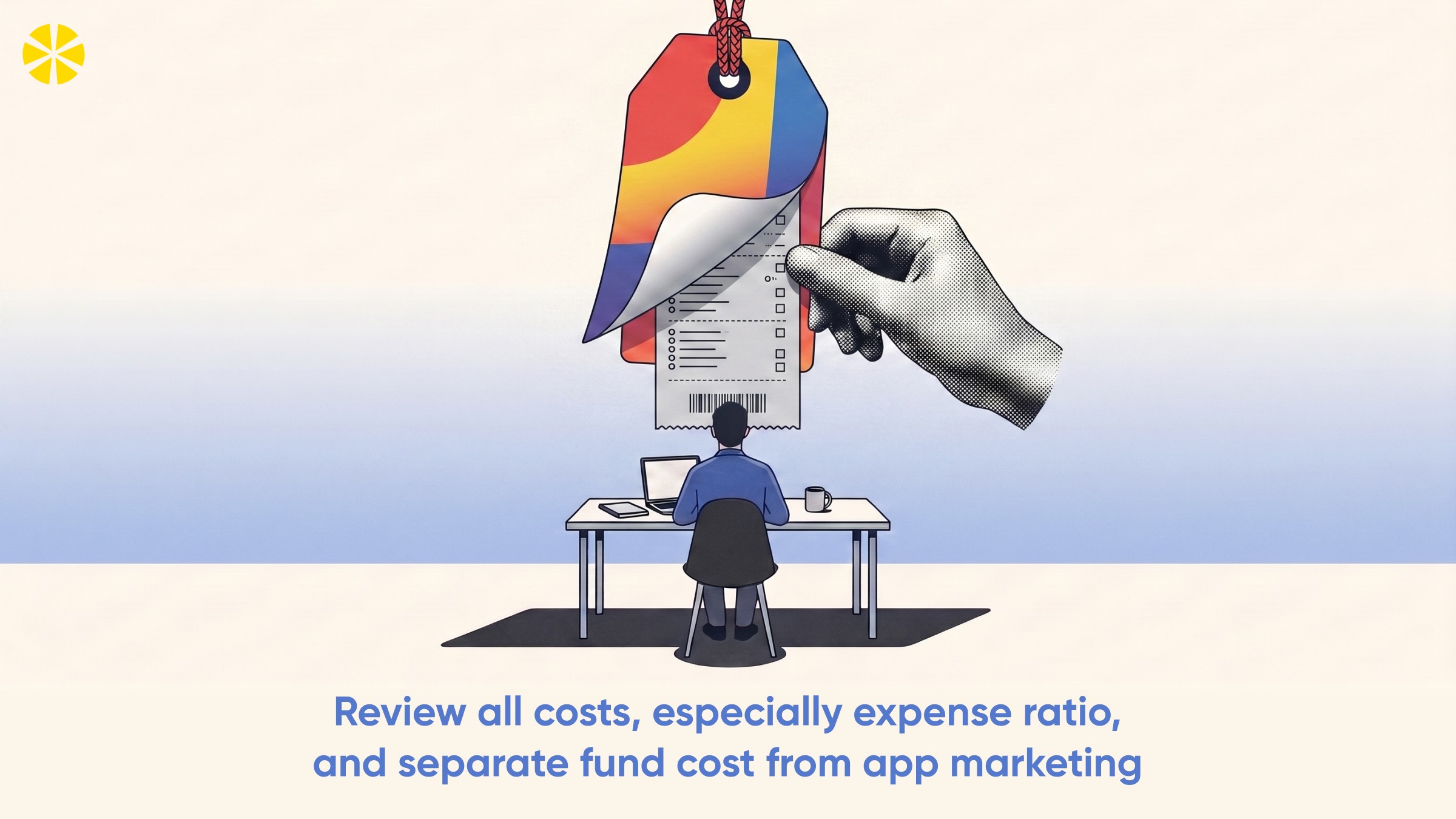
The phrase “no hidden fees” sounds good, but your job is to verify the actual economics.
With liquid fund apps, users often focus only on returns shown in the UI. That is incomplete. You should also understand:
the expense ratio of the underlying scheme,
whether you are accessing direct or regular plans,
whether any platform fee exists,
whether there are transaction-related conditions,
whether the app’s comparisons are pre-cost or post-cost.
The total expense ratio is a real drag on returns over time, and the SEBI framework on TER disclosures exists for a reason. Even in short-term products, cost transparency matters.
To be clear, a higher expense ratio does not automatically mean the app is unsafe. Poor disclosure is the trust issue.
Red flag: flashy return claims without a clear explanation of net returns, costs, or plan type.
Green flag: the app names the scheme, lets you inspect the cost structure, and avoids promising unrealistic outcomes.
For a broader comparison of short-term parking choices, Multipl’s pieces on liquid fund apps in India, liquid fund apps compared, and cash sweep vs liquid fund help users understand that convenience and transparency should be judged together.
6. Audit the app’s trust signals beyond investing: support, disclosures, use case fit, and operational clarity
This last point is where many experienced users make better decisions than casual users.
Even if the regulated product layer is sound, the operational experience still matters. You are trusting the app with onboarding, KYC, transaction flow, communication, and support.
Check for:
clear contact and support channels,
transparent FAQ and legal pages,
explanation of how the product works in normal language,
suitability guidance for different use cases,
realistic communication instead of hype,
a visible brand story and operating identity.
This matters even more if you plan to use the app for recurring real-world goals such as travel, festive spending, or short-term planned expenses instead of one-off investing. The app should feel designed around how users actually manage money, not just how products are sold.
A strong platform usually does three things well:
explains what it is,
explains what it is not,
explains who it is best for.
That is one reason many users respond well to products built around practical money behavior rather than abstract return-chasing. Multipl’s approach to higher-yield spending accounts, goal-based saving, and spendvesting reflects that broader framing: your money needs context, not just a number.
A quick scorecard you can use before downloading any app
If you want a simple decision tool, rate the app from 1 to 5 on each of the six checks below:
Checklist Item | What to Verify | Pass Signal |
|---|---|---|
Regulatory clarity | Is the product tied to clearly disclosed regulated entities? | AMC, platform role, disclosures visible |
Scheme transparency | Is the exact liquid fund named? | Fund name and AMC easy to verify |
Risk communication | Does the app explain that liquid funds are not guaranteed? | Plain-language risk explanation |
Redemption clarity | Are timelines, limits, and cut-offs explained? | Specific withdrawal expectations |
Cost transparency | Can you identify expense ratio and cost structure? | Clear scheme-level cost visibility |
Operational trust | Does the app feel transparent beyond returns? | Support, FAQs, legal clarity, fit guidance |
An app does not need to be perfect to be worth considering. But if it fails badly on even two or three of these, do not rationalize it away just because the UI looks polished.
What makes Multipl’s approach easier to trust

The best financial products reduce confusion, not add to it.
Multipl’s positioning is useful here because it does not ask users to blindly trust financial jargon. Instead, it is built around practical use cases: short-term money parking, goal-based saving, smarter spending, and transparent education around where different products fit.
That matters if you are trying to decide not just which app looks modern, but which app helps you make better decisions.
If your priority is understanding where idle cash should sit, how short-term money should be allocated, and when liquid funds make sense versus alternatives, Multipl has built a solid educational base across topics like idle cash strategy, short-term money parking, and savings account alternatives in India. That transparency is itself a trust signal.
If you are ready to move from research to action, the experience should still feel grounded in clarity rather than pressure.
Final takeaway: don’t ask only whether liquid funds are safe — ask whether the app has earned your trust
Liquid funds can play a useful role in short-term money management. But a good product accessed through a poor platform can still create confusion, friction, and avoidable mistakes.
Before you trust any app with your salary buffer, your upcoming bills, or your short-term goals, run this liquid fund app safety checklist:
Verify the regulated entities behind the app.
Confirm the AMC and exact scheme name.
Read how the app explains risk.
Check redemption timelines and liquidity limits.
Review costs and expense ratio transparency.
Audit support, disclosures, and operational trust signals.
That is how you move from marketing claims to informed confidence.
The right question is not just “is liquid fund app safe?” It is: “Has this platform made safety, transparency, and user understanding easy to verify?”
If the answer is yes, you are dealing with a much stronger option. If the answer is vague, incomplete, or evasive, that itself is your answer.
FAQs
Is a liquid fund app safe for keeping salary money?
It can be, but only if the app is transparent about the regulated entities, underlying AMC, exact scheme, risk, liquidity rules, and costs. A liquid fund app should never be treated as safe purely because it has a clean interface or claims better returns.
How do I verify a mutual fund app in India?
Start by checking whether the app clearly discloses the AMC, scheme name, legal pages, support channels, and product structure. Then cross-check the scheme through AMC materials, AMFI resources, and SEBI-regulated fund disclosures. If basic information is hard to find, that is a warning sign.
What are the biggest liquid fund app red flags?
The biggest red flags are vague claims like “safe returns,” no clear AMC or fund name, poor disclosure on redemption timelines, and little explanation of risk. If the app oversells convenience and shares too few details, be cautious.
Is a SEBI regulated liquid fund app always trustworthy?
SEBI-linked or regulated product access is an important starting point, but not the whole picture. You should still review the app’s communication quality, support, transparency, and operational clarity before trusting it with meaningful short-term money.
What should I check before parking money in a liquid fund app?
Use this simple prompt: Who manages the fund, what are the risks, when can I withdraw, what does it cost, and what happens if I need help? If an app answers all five clearly, you are in a much better position to evaluate it confidently.
Conclusion
A liquid fund app should not ask for blind trust. It should make verification simple.
That is the standard users should expect now: not just access to liquid funds, but clear proof of who manages the money, how the product works, what the risks are, when you can access your cash, and what trade-offs you are accepting.
Use this checklist every time. The best apps will pass quickly. The rest will expose themselves just as quickly.
Multipl is a AMFI registered Mutual Fund Distributor (ARN No. 319633).
*Based on historical returns of Liquid Fund category.
Disclaimer: Mutual Fund investments are subject to market risks, read all scheme related documents carefully.