•
1 min read
Liquid Mutual Fund Meaning: How It Works in India
If you have money sitting in a savings account for near-term needs, you may have wondered whether there is a better place to keep it without locking it away. That is where liquid funds often enter the conversation.
But what is a liquid mutual fund, really? Is it just another name for a low-risk investment? Can you withdraw your money anytime? And do liquid funds ever lose value?
This guide explains liquid mutual fund meaning in simple terms, how liquid funds work in India, what happens to your money after you invest, when you can redeem it, and the risks you should still understand before investing.
Whether you are building an emergency fund, parking idle cash between goals, or simply trying to reduce the opportunity cost of leaving excess money in a bank account, this explainer will help you make sense of liquid funds without jargon.
TL;DR: Liquid mutual fund meaning in one glance
A liquid mutual fund is a type of debt mutual fund that invests in very short-term money market and debt instruments with maturities of up to 91 days. It is commonly used in India to park idle cash for a few days to a few months, with relatively easy redemption and lower risk than many other mutual fund categories. However, liquid funds are not risk-free, returns are not guaranteed, and redemption is usually T+1, although some funds may offer instant redemption with limits.
What is a liquid mutual fund in simple terms?
A liquid mutual fund is a type of debt mutual fund that invests your money in very short-term money market and debt instruments. These instruments usually have a maturity of up to 91 days.
In simple terms, a liquid fund is designed for people who want to:
park money for a short period
keep relatively easy access to it
aim for returns that may be better than a standard savings account
avoid locking money into long-term investments
So if you are asking, what is a liquid mutual fund, the simple answer is this:
A liquid mutual fund pools money from many investors and invests it in short-duration, relatively low-risk debt instruments, while aiming to offer liquidity and modest returns.
It is called “liquid” because the money is generally easier to withdraw than many other investment products, though it is still an investment product and not the same as cash in a bank account.
How does a liquid fund work in India?
To understand how does a liquid fund work in India, it helps to see the lifecycle of your money after you invest.
1. You invest in the fund
When you put money into a liquid fund, the fund house allocates units to you based on the fund’s Net Asset Value (NAV).
NAV is simply the per-unit value of the fund on a given day.
2. The fund manager invests the money
The money is then invested in short-term debt and money market instruments such as:
Treasury Bills
Commercial Papers
Certificates of Deposit
Call money or short-term money market instruments
Other high-quality debt securities with very short maturities
Because these instruments mature quickly, liquid funds are generally less sensitive to interest rate changes than longer-duration debt funds.
3. The value changes daily
The NAV of a liquid fund changes based on:
interest income earned from the underlying instruments
market value movement of those instruments
fund expenses
This means your investment does not earn a fixed, guaranteed return like a fixed deposit. Instead, it grows or fluctuates through changes in NAV.
4. You redeem when you need the money
When you place a redemption request, the amount you receive depends on:
the number of units you hold
the applicable NAV
the cut-off time
the fund’s redemption rules
In many cases in India, redemption proceeds from liquid funds are processed on a T+1 basis, meaning the money is usually credited on the next business day. Some funds may offer instant redemption, but that comes with limits and conditions.
What happens to money invested in a liquid fund?

A very common beginner question is: what happens to money invested in a liquid fund?
Here is the plain-English answer.
Your money does not sit idle in the fund. It gets deployed into a basket of short-term debt instruments. These instruments pay interest or are bought at a discount and redeemed at face value. That is how the fund attempts to generate returns.
Let’s say a liquid fund buys a 60-day Treasury Bill or a short-term certificate of deposit issued by a bank. Over time, that instrument either accrues value or moves toward maturity. The fund’s NAV reflects that value.
So, after you invest:
your money is pooled with other investors’ money
the fund buys short-term debt instruments
income from those instruments adds to the fund’s value
the NAV changes daily
when you redeem, units are sold and the proceeds are paid to you
This is why liquid funds are often used for temporary parking of money rather than for long-term wealth creation.
Where do liquid funds invest?
Liquid funds in India must follow regulations on the types of instruments they can hold and the maturity profile they maintain.
Typically, liquid funds invest in:
Government securities with short maturities
Treasury Bills, which are backed by the Government of India
Certificates of Deposit, often issued by banks
Commercial Papers, issued by companies to meet short-term funding needs
Repo and money market instruments, depending on the scheme design
Because the maturity is short, credit and interest rate risk are usually lower than in longer-term debt funds. But “lower” does not mean “zero”.
That distinction matters.
Are liquid funds safe in India?
Many people search: Are liquid funds safe in India?
The best answer is: liquid funds are generally considered lower-risk than many other mutual fund categories, but they are not risk-free.
Here is why they are considered relatively safer:
they invest in short-term instruments
shorter maturity reduces interest rate sensitivity
many liquid funds focus on high-quality issuers
they are regulated mutual fund products
But they still carry risks such as:
Credit risk
If an issuer whose paper the fund holds faces financial trouble or defaults, the fund’s value may be affected.
Interest rate risk
Although lower than long-duration funds, liquid funds can still be affected by changes in interest rates and market pricing.
Liquidity risk
In stressed market conditions, selling underlying securities may become harder or less efficient.
Expense ratio impact
Returns are reduced by fund expenses.
So, if you are comparing liquid funds with keeping money in a bank savings account, it is important to remember one key difference:
a savings account balance is not marked to market daily like a mutual fund
a liquid fund investment is market-linked and can move slightly up or down
Do liquid funds ever lose value?

Yes, liquid funds can lose value, though such situations are generally less common compared with riskier fund categories.
If you are asking, do liquid funds ever lose value, the answer is absolutely yes, but usually in limited or rare scenarios such as:
a credit event in one of the underlying holdings
temporary market dislocation
valuation markdowns
sharp shifts in short-term yields
expense drag over a very short holding period
This is why liquid funds are often described as low-risk, not no-risk.
For example, if you invest for just a few days, a very small negative return is possible after accounting for NAV movement and expenses. Over slightly longer periods, outcomes may improve, but there is still no guarantee.
Liquid fund vs savings account: what is the difference?
One of the most important questions for beginners is: what is the difference between a liquid fund and a savings account?
Here is a clear comparison.
Feature | Liquid Fund | Savings Account |
Nature | Market-linked mutual fund | Bank deposit |
Returns | Not guaranteed | Usually fixed by bank policy |
Risk | Low, but not zero | Lower for deposit balances, subject to bank framework |
Liquidity | Usually redeemable, often T+1 | Immediate access through bank |
Value movement | NAV changes daily | Balance does not fluctuate daily like NAV |
Ideal use | Idle cash, temporary parking, emergency corpus layers | Daily transactions, bill payments, immediate cash |
Lock-in | No lock-in in most cases | No lock-in |
A savings account is useful for everyday access. But if you keep large idle cash balances there for long periods, you may face an opportunity cost.
That simply means your money may be earning less than it potentially could elsewhere, depending on your risk tolerance and time horizon.
For example, money needed for UPI payments, bills, and monthly expenses usually belongs in a savings account. But money that you do not need today, yet may need in a few weeks or months, may be evaluated differently.
If you are trying to manage near-term money more intentionally, it also helps to understand broader goal-based allocation. You can explore practical money planning ideas on Multipl.
Why should you not keep large amounts only in a savings account?
This does not mean savings accounts are bad. They are essential. But keeping all idle money there may not always be efficient.
Here is why:
1. Lower return potential on idle money
Savings accounts are designed for convenience, not optimization of idle funds.
2. Inflation reduces real value
Even if the balance is stable, inflation can reduce the real purchasing power of your money over time.
3. Opportunity cost adds up
If excess money stays unallocated for months, the difference between “doing nothing” and “earning something” can become meaningful.
4. Poor separation of spending and idle
When all funds sit in one account, it becomes easier to accidentally spend money meant for short-term goals.
A better approach can be to build layers:
transaction money in savings account
emergency or near-term idle cash in suitable low-risk instruments
medium and long-term goals in investments aligned to those goals
For a goal-based way of thinking about money, browse the resources available on Multipl.
Can I withdraw money from a liquid fund anytime?

A top question people ask is: can I withdraw money from a liquid fund anytime?
In most cases, yes, you can place a redemption request anytime, but the actual receipt of money depends on process timelines.
Standard redemption
For many liquid funds, redemption proceeds are usually credited on the next business day, often called T+1 redemption.
Cut-off timing matters
The applicable NAV and processing timeline may depend on when you submit the redemption request relative to the scheme’s cut-off time.
Instant redemption
Some liquid funds offer instant redemption, but:
it may be available only through specific platforms
there may be a daily limit
it may be restricted to a capped amount or percentage of your holding
it may depend on banking hours or operational conditions
So the practical answer is:
You can usually request withdrawal at any time, but access is not always as immediate as withdrawing from a savings account.
That is an important distinction for emergency planning. If you need money within seconds or outside processing windows, a savings account still plays a critical role.
Is it okay to keep one or two months’ salary in a liquid fund?
For many people, keeping one or two months’ salary in a liquid fund can be a reasonable strategy for a part of near-term reserves, but it depends on your liquidity needs and comfort with market-linked products.
You may consider this approach if:
your immediate monthly spending money remains in a bank account
you understand that liquid funds are not guaranteed
you are comfortable with T+1 access in normal cases
you want a place for temporary idle cash
You may want to be cautious if:
all your payments require instant access
you are uncomfortable with even minor NAV fluctuations
you may need the full amount unexpectedly at any hour
you are investing for just a few days and expect certainty
A practical rule many people follow is to keep:
immediate spending money in savings
buffer money in instruments that may offer better efficiency than idle cash
longer-term money invested according to goals and risk profile
If you are building buckets for future spending like travel, shopping, gadgets, or larger life plans, Multipl focuses on goal-based saving journeys that help make money more intentional.
How to evaluate a liquid fund before investing
If you are considering a liquid fund, do not stop at the definition. Evaluate the fund using a few basic checks:
Portfolio quality
Look at the quality of underlying papers and the type of issuers in the portfolio.
Average maturity
Liquid funds usually maintain short maturity profiles, but reviewing this still helps.
Past consistency
Past returns do not guarantee future performance, but consistency across market conditions can be informative.
Expense ratio
Higher costs can reduce net returns, especially for short holding periods.
Redemption rules
Check whether the scheme offers standard or instant redemption and what the limits are.
Exit load, if any
Some liquid funds may have graded exit load structures for very short holding periods.
You can also use educational resources and simplified planning journeys on Multipl to understand how different types of money can be mapped to different goals.
When does a liquid fund make sense?
A liquid fund may make sense when:
you have short-term idle cash
you want to avoid leaving too much idle money in a savings account
you need relatively high liquidity
you are looking for a lower-risk debt option for temporary parking
you understand the product is market-linked
Examples include:
bonus money not yet assigned to a goal
emergency corpus layers beyond immediate bank balance
proceeds waiting to be deployed toward a near-term expense
salary idle accumulating over a few months
When might a liquid fund not be ideal?
A liquid fund may be less suitable if:
you need instant access at all times
you expect guaranteed returns
you are unwilling to accept any chance of short-term negative movement
your money is meant for long-term growth
you have not yet set aside enough in your bank account for immediate emergencies
In such cases, it is helpful to first define the purpose of the money. Goal clarity often matters more than chasing small return differences. To build that habit, Multipl offers a goal-first approach to saving and spending.
Common misunderstanding: liquid does not mean risk-free
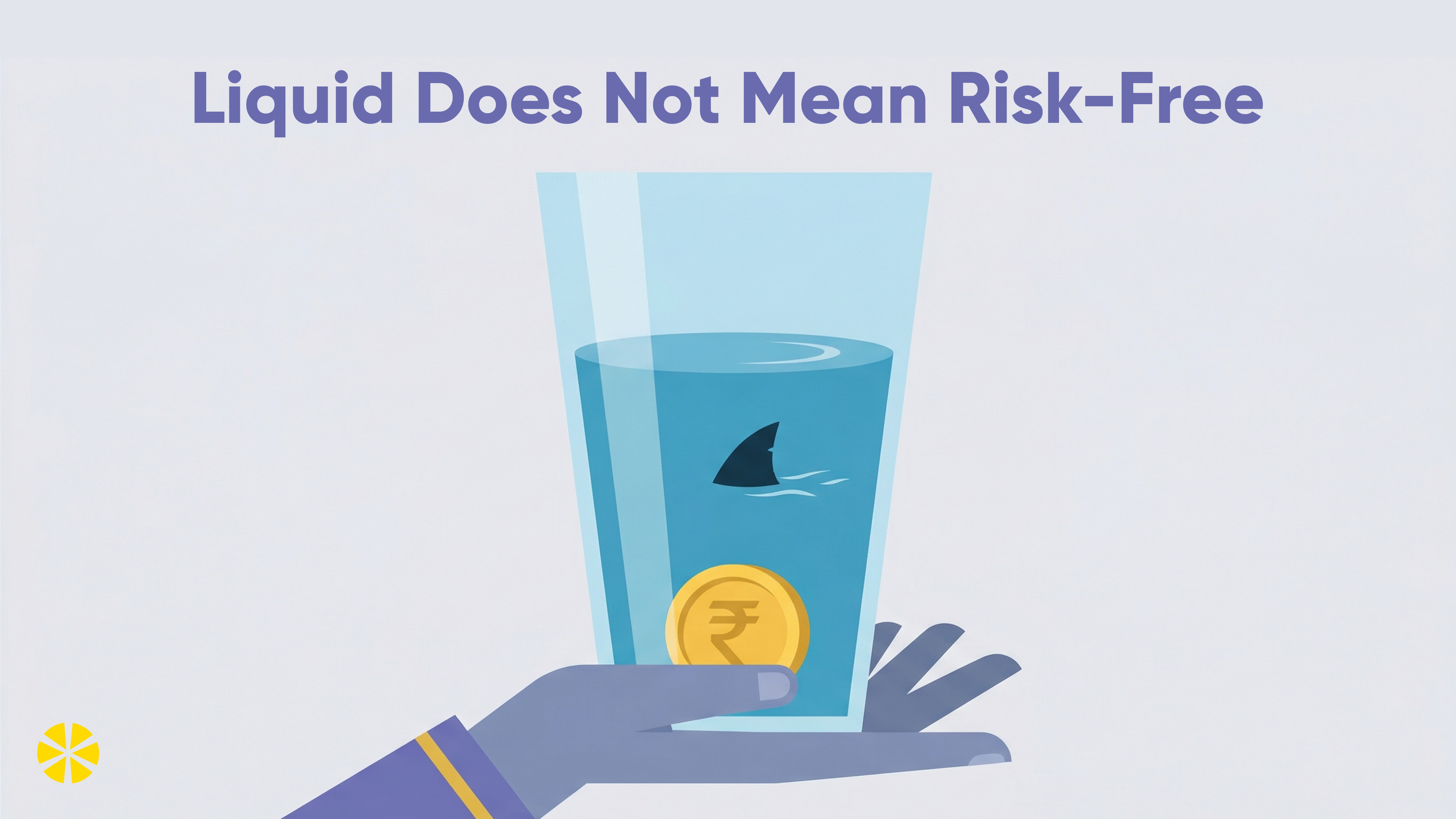
One of the biggest misconceptions is assuming that “liquid” means the same thing as “completely safe” or “just like cash”.
It does not.
“Liquid” mainly refers to ease of access and short-term nature, not a guarantee of principal or return.
That is why a beginner-friendly understanding of liquid mutual fund meaning should always include three truths:
It is a mutual fund, not a bank deposit
It invests in short-term debt instruments
It aims to balance liquidity and relatively low risk, but cannot eliminate risk entirely
Final thoughts
Understanding liquid mutual fund meaning is useful if you want to manage short-term money better in India.
A liquid fund is essentially a mutual fund that invests in very short-term debt instruments. It is often used to park idle money for short durations while keeping it relatively accessible. It may offer better efficiency than leaving large idle balances untouched in a savings account, but it is still market-linked and not risk-free.
If you remember just a few things, remember these:
liquid funds are for short-term parking, not long-term wealth creation
your money gets invested in short-term debt instruments
NAV changes daily, so returns are not guaranteed
redemption is usually easy, but not always instant like a bank account
small losses, while less common, are still possible
The best use of any financial product depends on the goal behind the money. Instead of looking at every rupee as one pool, try separating money for spending, emergencies, and future goals. That mindset leads to better financial decisions over time.
To explore smarter, goal-based ways to save, plan, and direct your money, visit Multipl, check the latest resources on Multipl, and discover how Multipl approaches everyday financial planning with goals at the center.
FAQs about liquid mutual funds in India
What is a liquid mutual fund in simple terms?
A liquid mutual fund is a debt mutual fund that invests in very short-term instruments like Treasury Bills, commercial papers, and certificates of deposit. It is mainly used to park money for short durations with relatively easy access.
How does a liquid fund work in India?
You invest money, receive fund units based on NAV, and the fund manager deploys that money into short-term debt instruments. The NAV changes daily based on income, valuation changes, and expenses.
What happens to money invested in a liquid fund?
The fund pools your money with that of other investors and invests it in short-term debt securities. As these holdings generate income or mature, the fund’s NAV reflects that movement.
Can I withdraw money from a liquid fund anytime?
You can usually place a redemption request anytime, but the payout often follows T+1 business-day processing. Some funds offer instant redemption with limits and conditions.
Are liquid funds safe in India?
Liquid funds are generally considered lower-risk than many mutual fund categories, but they are not risk-free. Credit events, valuation changes, and market stress can affect returns.
Do liquid funds ever lose value?
Yes. Although relatively uncommon, liquid funds can show small negative returns over short periods or during unusual market or credit events.
How long should I stay invested in a liquid fund?
Liquid funds are generally meant for very short holding periods, such as a few days to a few months. They are commonly used for idle cash, near-term goals, or temporary parking before money is needed elsewhere.
Is a liquid fund better than a fixed deposit?
Not necessarily. A liquid fund may offer more flexibility and no fixed lock-in in many cases, but returns are market-linked and not guaranteed. A fixed deposit may offer more predictability, while a liquid fund may suit money that needs easier access.
Are liquid funds good for an emergency fund?
They can be useful for a part of an emergency fund, especially the portion you may not need instantly. But it is usually wise to keep some emergency money in a savings account as well, because liquid fund redemption is often T+1 and may not be as immediate as cash in the bank.
Final thoughts
Understanding liquid mutual fund meaning is useful if you want to manage short-term money better in India.
A liquid fund is essentially a mutual fund that invests in very short-term debt instruments. It is often used to park idle money for short durations while keeping it relatively accessible.
It may offer better efficiency than leaving large idle balances untouched in a savings account, but it is still a market-linked product with some risk. The right use case is usually short-term parking of money that does not need instant access every minute, but may still be needed soon.
If you are evaluating how to separate spending money, emergency buffers, and goal-based savings more intentionally, Multipl can help you think about money in buckets instead of balances.
Multipl is a AMFI registered Mutual Fund Distributor (ARN No. 319633). *Based on historical returns of Liquid Fund category.
Disclaimer: Mutual Fund investments are subject to market risks, read all scheme related documents carefully.