•
1 min read
Salary in Liquid Fund? A 1-2 Month Cash Parking Framework
Your salary lands. Bills are due over the next few days or weeks. Some money will be spent soon, some will sit idle till the next EMI cycle, and some may remain untouched for a month or two.
This is exactly where many working professionals get stuck: is it okay to keep one or two months salary in a liquid fund, or should that money remain in a savings account?
The short answer: sometimes yes, but not all of it, and not blindly.
A better question is not “bank account or liquid fund?” but how much of your monthly salary needs instant access, and how much can be parked for short-term cash management without disrupting daily life.
That distinction matters. If you keep too much in your savings account, a large part of your money may remain idle. If you move everything out, you may create friction when bills, rent, EMIs, or surprise expenses hit. The right setup is usually a layered approach: some cash for immediate access, some for near-term spending, and some for short-term parking.
If you are new to the category, start with this primer on liquid mutual fund meaning, then come back to this guide for the practical framework.
TL;DR
Keeping part of one to two months’ salary in a liquid fund can work, but the split should follow your bill calendar, not a rule of thumb.
Money due in the next 7–15 days, mandatory auto-debits and your emergency buffer stay in the bank.
Your realistic parking amount is whatever is left after immediate bills, a stress buffer, and known expenses in the next 30–45 days.
Liquid funds are market-linked products meant for short-duration holding, so redemption timing has to line up with your spending dates.
In this article, we’ll answer:
Can you withdraw money from a liquid fund at any time?
Is it okay to keep one or two months salary in a liquid fund?
Where should you keep salary between payday and bill day?
When does a liquid fund for monthly expenses make sense?
When should you avoid parking salary in a liquid fund?
This is not generic emergency-fund advice. It is a practical salary-parking framework built for working professionals in India.
Why the “salary in liquid fund” question matters
For most salaried people, money does not get used the moment it arrives.
Your salary may come in on the 1st, but:
rent may go out on the 3rd,
SIPs may debit on the 5th,
credit card bill may be due on the 10th,
school fees may be due on the 15th,
discretionary spending may happen through the month.
That means some part of your salary remains unused for days or weeks. Over time, this creates a familiar pattern: large balances sitting in low-yield bank accounts simply because they are convenient.
This is why many professionals now explore alternatives to traditional idle cash storage. If you want broader context, see where should salaried Indians keep money between payday and bill day and the hidden cost of idle cash.
But before deciding whether to park monthly salary in liquid fund products, it helps to understand what a liquid fund is actually designed for.
What is a liquid fund in simple terms?
A liquid fund is a type of mutual fund that typically invests in short-duration debt and money-market instruments with very short maturities. In simple terms, it is designed for short-term parking of money, not long-term wealth creation and not day-to-day transaction convenience.
You can think of it as a tool for cash you do not need this minute, but may need relatively soon.
That makes it relevant for:
short-term cash parking,
temporary storage of idle money,
money for planned expenses in the coming weeks or months,
holding funds between salary credit and actual use.
If you want a deeper breakdown, read how liquid mutual funds work in India and exploring money market funds: stability and returns.
So, is it okay to keep one or two months salary in a liquid fund?
Yes, for many people, it can be okay to keep part of one to two months’ salary in a liquid fund. But it should depend on your cash-flow pattern, not a rule of thumb.
Here is the key principle:
Money needed immediately belongs in instant-access cash. Money needed soon but not today may be considered for short-term parking.
That means you usually should not move all your salary into a liquid fund. Instead, divide it into buckets based on timing and certainty of use.
A useful way to think about it:
Keep in your bank account
expenses due in the next few days,
mandatory auto-debits,
rent, EMI, utility payments,
minimum emergency cash buffer,
money you may need instantly.
Consider short-term parking
money not needed for at least a few days to a few weeks,
predictable expenses later in the month,
salary surplus between two cycles,
idle cash you want to manage more efficiently.
This is why the answer to “is it okay to keep one or two months salary in a liquid fund” is not purely yes or no. It depends on whether that money is operational cash or temporarily idle cash.
For a broader comparison, you may also want to read liquid fund vs savings account vs fixed deposit vs HYSA and savings account vs liquid fund vs HYSA in India.
The 1–2 month cash parking framework
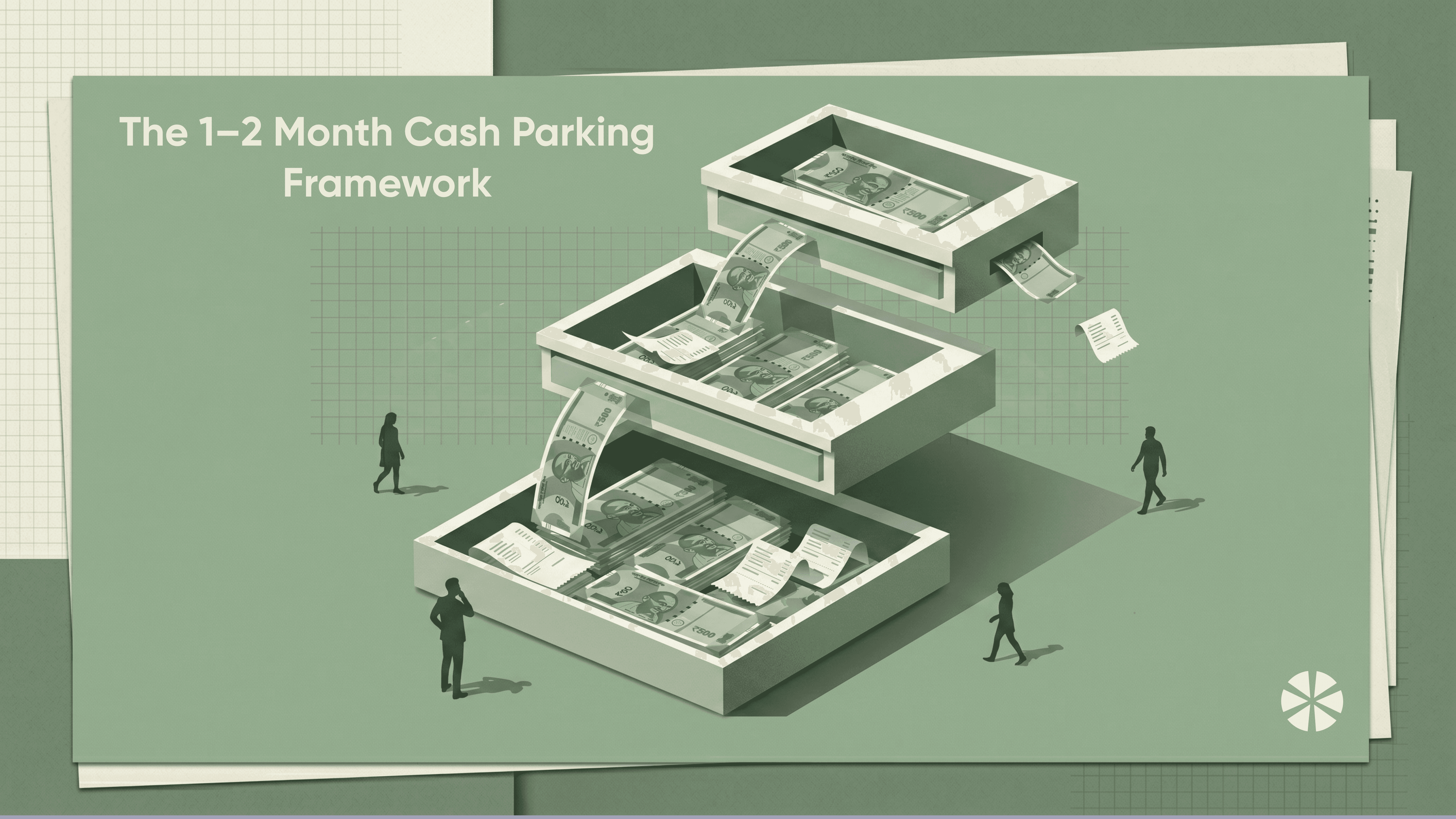
Here is a practical decision framework for deciding whether your salary should stay in your bank account or be parked elsewhere.
Bucket 1: Instant-access money
This is money you should not experiment with.
It includes:
7–15 days of core expenses,
bills due before your next planned transfer,
ATM cash needs,
health or urgent family expenses,
any amount that would cause stress if not available instantly.
If your lifestyle involves frequent UPI payments, unpredictable spending, or low cash-flow slack, this bucket may need to be larger.
Rule: keep this in your salary or linked savings account.
This is especially true if your bill dates are clustered right after payday. In that case, the question is not “where do I invest?” but “how do I avoid transfer friction?”
Bucket 2: Near-term planned spending
This includes money you know you will use this month, but not immediately.
For example:
credit card payment due in 10 days,
school fee due in two weeks,
travel spending next month,
annual insurance premium coming up,
festival or event spending you are actively planning.
This bucket sits in the grey zone. It may be too soon for long-term investments, but too idle for a plain savings balance.
For many working professionals, this is where a liquid fund for short term cash parking may start making sense.
The important condition: your withdrawals and redemptions should fit your spending timeline. If your expense is highly time-sensitive and missing it would create penalties or stress, be conservative.
If you are saving toward upcoming lifestyle goals, liquid funds for short-term goals offers useful context.
Bucket 3: One-month surplus or float
This is where the “salary in liquid fund” idea becomes most practical.
Suppose:
your monthly household expenses are ₹70,000,
your salary is ₹1,10,000,
you typically end each month with ₹20,000–₹30,000 unused before the next salary credit,
or you maintain one extra month of planned spending cushion.
That extra float often sits without a defined role. It is not your long-term investment corpus. It is not your emergency fund. It is simply cash waiting to be used later.
For this category, many people consider a liquid fund for monthly expenses or for planned short-term use.
This is especially useful if:
you are disciplined about tracking bills,
you have a separate emergency buffer,
your spending dates are reasonably predictable,
you are not relying on that exact amount for daily transactions.
Bucket 4: Emergency buffer
This is where people often make mistakes.
Your emergency fund and your monthly salary cash flow are not the same thing.
If you are deciding whether to park monthly salary in liquid fund products, first ask:
do I already have emergency cash?
how much of it needs to be instantly accessible?
what happens if I lose income, face a medical expense, or need money the same day?
Some people are comfortable keeping part of their emergency reserves in short-term instruments. Others prefer more of it in bank-accessible form. The right answer depends on job stability, dependents, medical needs, and overall financial profile.
If this topic is on your mind, read liquid fund safety: can liquid funds lose money? and mutual funds vs fixed deposits: where should you park your money.
A simple formula to decide how much salary can stay outside your bank account
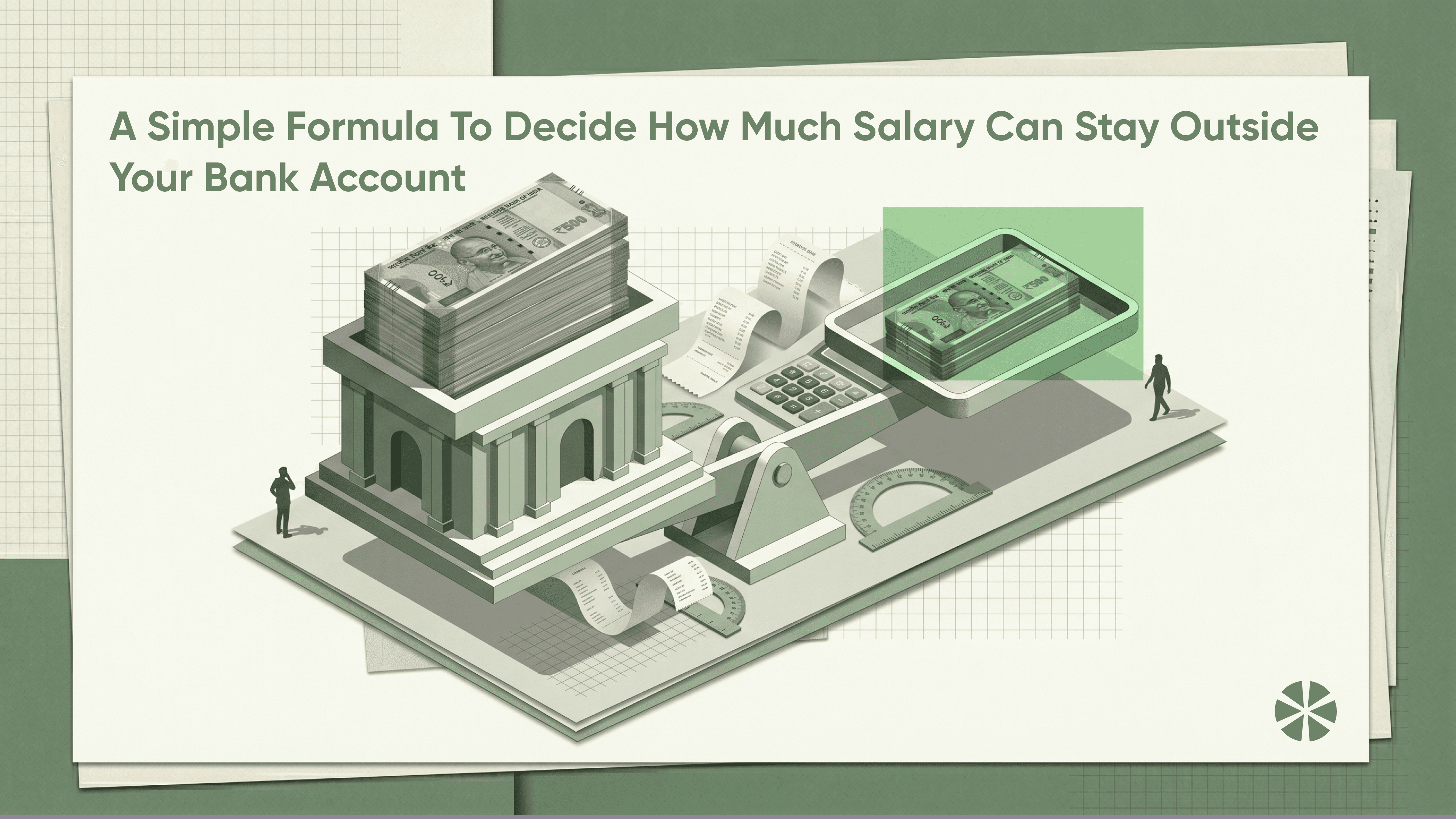
Use this 4-step checklist.
Step 1: Calculate your immediate 10-day requirement
Add:
rent/EMI,
utility bills,
SIPs and auto-debits,
groceries,
transport,
minimum medical buffer.
Keep this amount in your bank account.
Step 2: Add a stress-free buffer
Add another amount that helps you avoid panic. For some people this is ₹10,000. For others it is half a month’s expenses.
Keep this in instant-access form too.
Step 3: Identify planned expenses due later
Map the next 30–45 days of known expenses. Separate:
fixed,
semi-fixed,
uncertain.
The more certain and farther away the expense, the more suitable it may be for short-term parking.
Step 4: Only then consider the residual balance
What remains after steps 1–3 is your realistic short-term parking amount.
That is the portion for which a liquid fund may be considered.
Three salary scenarios to make this practical
1. The tight monthly cash-flow professional
You earn, spend, and reset every month. Most of your salary goes toward:
rent,
EMIs,
family support,
groceries,
transport,
card payments.
In this case, keeping large parts of salary in a liquid fund may not help much. Your main need is transaction convenience and certainty.
A better focus may be:
optimise bill timing,
maintain a small buffer,
avoid holding excess idle cash beyond operational needs.
If you still want better cash efficiency, compare your options in short-term investment options in India and short-term investment options in India for 3 to 12 months.
2. The stable salaried planner
You have:
predictable income,
fixed bill dates,
some monthly surplus,
a separate emergency fund.
This is the ideal profile for a structured approach. You can keep:
month-to-month operational cash in your bank account,
near-term surplus in a liquid fund or similar short-term parking bucket,
longer-horizon money in appropriate investments.
This kind of setup is often more practical than leaving everything in one account.
If that sounds like you, the complete guide to managing short-term money in India is a useful next read.
3. The lifestyle-goal spender
You are not just paying bills. You are saving for:
vacations,
gadgets,
annual shopping,
festive spending,
planned experiences.
In this case, your salary may need multiple mini-buckets, not one big pile. Some money is for essentials, some for spending goals, and some for short-term parking.
This is where goal-based systems can work better than generic “save whatever is left” advice. Explore how Indians undervalue goal-based saving, 10 key steps to master goal-based investing, and what is spendvesting.
Can I withdraw money from a liquid fund at any time?
This is one of the most common questions, and it is exactly why salary parking needs planning.
A liquid fund is generally considered a relatively accessible category for short-term money, but “accessible” is not the same as “same as your bank balance this second.”
So the more accurate mindset is this:
If you need money for routine, planned spending: short-term parking may work.
If you need money with zero delay and zero operational dependency: keep it in the bank.
If missing access by even a short window would be a problem: do not move that money.
This distinction is critical when deciding where to keep salary between payday and bill day.
How redemption timing actually works
Redemption requests placed before the scheme cut-off on a business day are usually processed at that day’s NAV, with money credited the next business day. SEBI also permits an instant redemption facility on liquid schemes, capped at ₹50,000 or 90% of your folio value per day, whichever is lower. Redeem within seven days of investing and a small graded exit load applies, which falls to nil from the seventh day onwards. Plan transfers so that no bill date depends on a redemption landing exactly on time.
What happens to money invested in a liquid fund?
Another useful question is: what happens to money invested in a liquid fund?
In broad terms:
your money is pooled into a mutual fund structure,
the fund invests in short-term instruments,
the value changes based on the underlying portfolio and accrual dynamics,
your money is meant for short-duration holding, not instant spending.
For the average salaried user, the practical takeaway is not to treat a liquid fund like a payment account. Treat it like a short-term holding layer in your cash system.
This also answers another search-worthy question: do liquid funds ever lose value? They are often used for relatively lower-volatility short-term parking, but they are still investment products, not the same thing as a guaranteed bank balance. That is why suitability matters more than slogans.
For a detailed look, see are liquid funds safe in India.
When a liquid fund for monthly expenses makes sense
Using a liquid fund for monthly expenses may make sense when:
you have at least one bank-resident buffer,
your expense calendar is predictable,
you are moving only the amount not needed instantly,
you actively separate spending money from parking money,
you want a more efficient setup than keeping all cash idle.
It can also make sense if you maintain one extra month of salary as a planning cushion, especially when that money tends to sit untouched until needed.
When you should avoid parking salary in a liquid fund
Avoid or minimise this setup if:
your account balance regularly runs tight before month-end,
you have frequent unplanned expenses,
you rely on immediate access every few days,
you do not yet have an emergency buffer,
you are likely to forget redemption timing,
you treat all available money as swipe-ready spending cash.
In these situations, operational simplicity may be more valuable than trying to optimise every rupee of idle cash.
A more practical alternative: a balanced two-layer setup
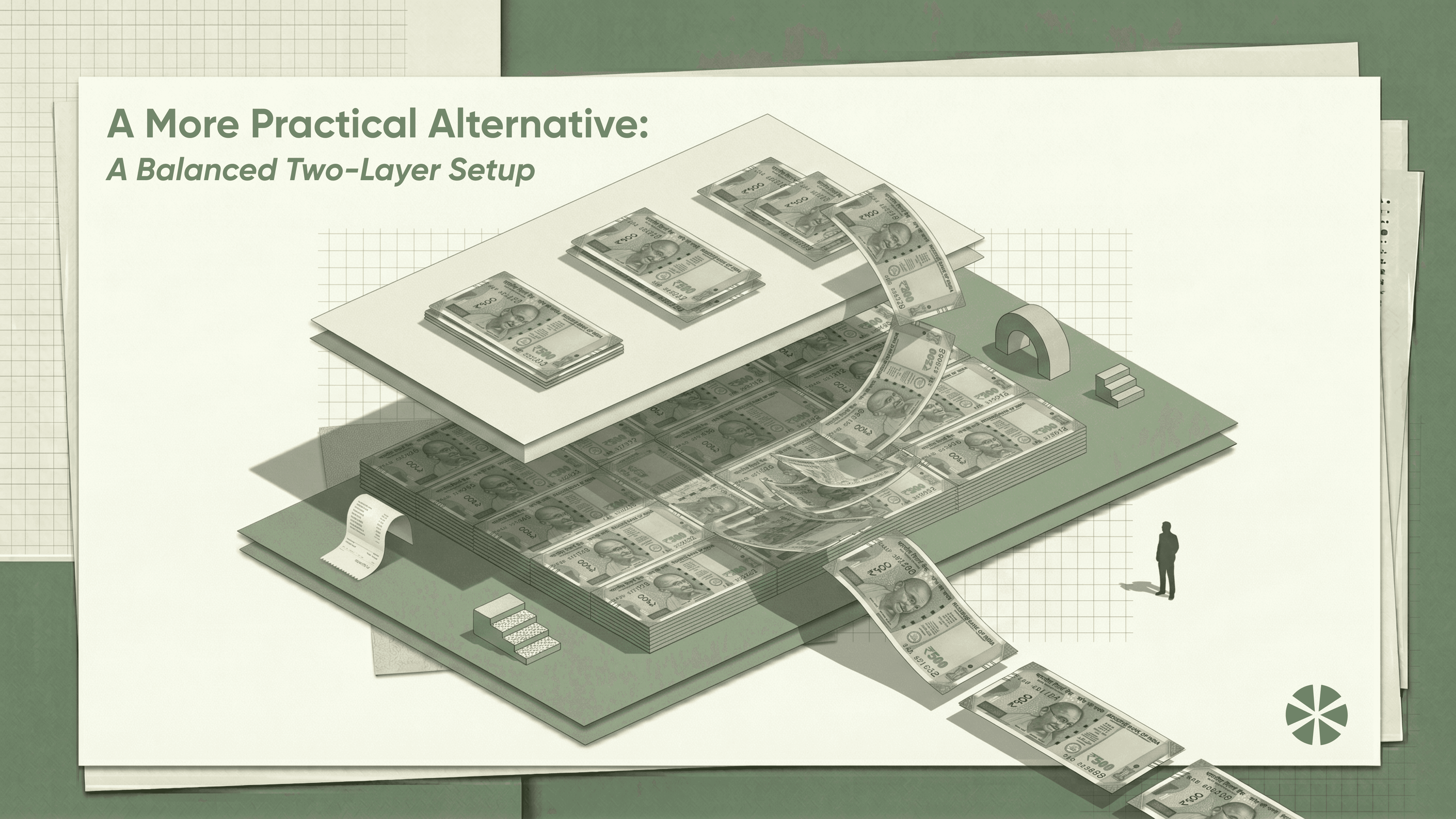
For most working professionals, the best answer is not “all bank” or “all liquid fund.”
It is:
Layer 1: Instant-access salary cash
For:
core bills,
auto-debits,
near-term essentials,
emergency access.
Layer 2: Short-term parking layer
For:
money not needed immediately,
known expenses later in the month,
one-month float,
planned short-term spending buckets.
This kind of setup is closer to how real people actually use money.
If you are exploring smarter cash management beyond a traditional savings account, what is a higher-yield spending account and how does Multipl work, the spending money hack, and Multipl’s approach to saving, investing and spending smarter can help you evaluate a more blended model.
Salary in liquid fund: the real takeaway
So, is it okay to keep one or two months salary in a liquid fund?
For many salaried professionals, yes—partly.
But the smarter answer is not based on months of salary alone. It should be based on:
when your bills are due,
how much cash you need instantly,
whether your emergency fund already exists,
how predictable your spending is,
how comfortable you are with a two-layer money system.
If your money is sitting idle only because it is easier to leave everything in a savings account, that is not a strategy. It is just inertia.
A better approach is to separate:
spending cash
from
parking cash.
That is how you decide whether a salary in liquid fund approach is right for you.
And if your goal is not just to store money but to align it with upcoming expenses and planned life moments, start with Multipl or explore how to get started.
FAQs
Can I withdraw money from a liquid fund at any time?
Liquid funds are commonly used for short-term access compared to many other investment categories, but they should not be treated exactly like a savings account balance for instant daily spending. Keep money needed immediately in your bank account.
Is it okay to keep one or two months salary in a liquid fund?
It can be okay to keep part of one or two months’ salary in a liquid fund if that portion is not needed instantly, your bill schedule is predictable, and you already maintain an accessible buffer.
What is the difference between a liquid fund and a savings account?
A savings account is built for transactions, instant access, and cash management. A liquid fund is an investment product used for short-term cash parking. They solve different problems, which is why many people use both.
Are liquid funds safe in India?
Liquid funds are often considered for relatively low-volatility short-term parking, but they are still market-linked products and not identical to guaranteed bank deposits. Suitability depends on your time horizon and access needs.
How are liquid fund returns taxed?
For investments made on or after 1 April 2023, gains from liquid funds are added to your income and taxed at your slab rate, whatever the holding period. Tax applies only when you redeem, so a mid-month withdrawal to pay a bill is a taxable event. Factor that in before comparing headline returns with a savings account.
Where should I keep salary between payday and bill day?
Keep near-immediate spending money in your salary or savings account. For money not needed right away, a short-term parking layer may be worth considering, depending on your cash-flow pattern.
What happens to money invested in a liquid fund?
It is invested through a mutual fund into short-term instruments designed for liquidity and short-duration holding. It is best viewed as a parking layer, not as a payments wallet or primary spending account.
Conclusion
The question is not whether liquid funds are “better” than savings accounts in every situation. The real question is which part of your salary needs instant access, and which part is simply waiting for its turn to be used.
Once you separate those two, the decision becomes much clearer.
For most salaried Indians, the smartest framework is simple: keep your essentials accessible, keep your contingency buffer intact, and only park the balance that is genuinely idle. That is how short-term money starts working harder—without making your everyday life harder.
Multipl is a AMFI registered Mutual Fund Distributor
(ARN No. 319633). *Based on historical returns of Liquid Fund category.
Disclaimer: Mutual Fund investments are subject to market risks, read all scheme related documents carefully.