•
1 min read
Liquid Funds During Market Crash: What Actually Happens?

When markets crash, fear spreads fast. Equity portfolios fall, headlines turn dramatic, and many first-time investors begin asking a very specific question: what happens to liquid funds during market crash India scenarios?
It is a fair question. If you are using liquid funds for emergency savings, short-term goals, salary parking, or idle cash, you do not want vague reassurance. You want evidence.
The good news is that liquid funds and equity markets do not behave the same way during a crash. In India’s 2020 COVID panic, equity markets saw a sharp fall, but liquid funds as a category behaved very differently because they invest in very short-term debt instruments rather than stocks. SEBI’s framework for liquid funds caps portfolio maturity at 91 days, which is one reason their price behaviour is usually far less volatile than equity funds. (SEBI/AMFI)
Still, “usually” is not the same as “always.” And 2020 gave Indian investors two separate stress events to learn from:
the COVID market crash, and
the Franklin Templeton debt fund crisis in April 2020.
These are often mixed up, even though they were not the same thing.
This article breaks down what actually happened to liquid fund NAV during COVID, what the Franklin episode did and did not mean, and whether liquid funds are safe in market crash conditions for idle money.
If you are new to the category, it helps to first understand what liquid funds are and how they work in India. And if you want the simple version first: liquid funds are not designed to behave like equity funds, but they are also not risk-free cash equivalents.
The short answer: do liquid funds crash when stocks crash?
Usually, no.
A stock market crash is primarily an equity risk event. Liquid funds, by contrast, invest in short-duration debt instruments such as treasury bills, commercial paper, certificates of deposit, and other money market securities with very short maturities. Their returns are driven more by short-term interest rates, portfolio quality, and market liquidity than by stock prices. (AMFI)
That means a liquid fund vs equity market fall comparison is often misleading. When equities fall 20%, 30%, or more, liquid funds generally do not mirror that move. They tend to show much smaller day-to-day changes because the underlying instruments mature quickly and are structurally different from shares.
That said, liquid funds can still face three kinds of stress:
credit risk if an issuer in the portfolio has repayment trouble,
liquidity risk if many investors redeem at once in a stressed market,
mark-to-market impact on securities that are not instantly maturing.
If you want a broader comparison between bank balances and short-term parking options, see Liquid Fund vs Savings Account vs Fixed Deposit vs HYSA: Complete Comparison.
What happened in March 2020 when Indian markets crashed?

March 2020 was one of the most stressful phases in modern financial markets. As COVID-19 lockdown fears intensified globally, Indian equities plunged. The NIFTY 50 and broader risk assets fell sharply in a matter of weeks, while bond and credit markets also came under strain.
But here is the key distinction: liquid funds as a category did not collapse the way equities did.
Why?
Because liquid funds held very short-term money market and debt instruments. With maturities capped at 91 days, the average holding period of the underlying portfolio was short, limiting duration risk. (AMFI)
In plain English: if a fund owns instruments that mature soon, the portfolio resets faster. That reduces sensitivity to long-term interest-rate moves and usually softens large NAV swings.
So if you are wondering about liquid fund NAV during COVID, the category’s broad pattern was:
no equity-style collapse,
limited NAV volatility relative to stocks,
temporary stress linked more to debt-market liquidity than to stock-market panic.
This is why many investors use liquid funds for short-term parking rather than wealth-building. They are meant for money you may need in the near future, not for chasing high returns.
For a plain-language explainer, Liquid Mutual Fund Meaning: How It Works in India is a good companion read.
Why did people still panic about debt funds in 2020?
Because 2020 was not just an equity crash story. It was also a credit and liquidity stress story in parts of the debt market.
On April 27, 2020, the RBI announced a ₹50,000 crore Special Liquidity Facility for Mutual Funds (SLF-MF) because heightened volatility and redemption pressure had created liquidity strains in mutual funds. (RBI)
That matters because it shows something important: even if liquid funds are structurally lower-risk than equity funds, the debt market itself is not immune to stress. If many investors rush to redeem at once, fund houses may need market liquidity to sell holdings smoothly. When market liquidity dries up, anxiety rises.
But this still does not mean all debt categories behaved the same way.
That distinction becomes critical when discussing the Franklin Templeton liquid fund crisis India narrative, which is often misunderstood.
The Franklin Templeton episode: what actually happened?
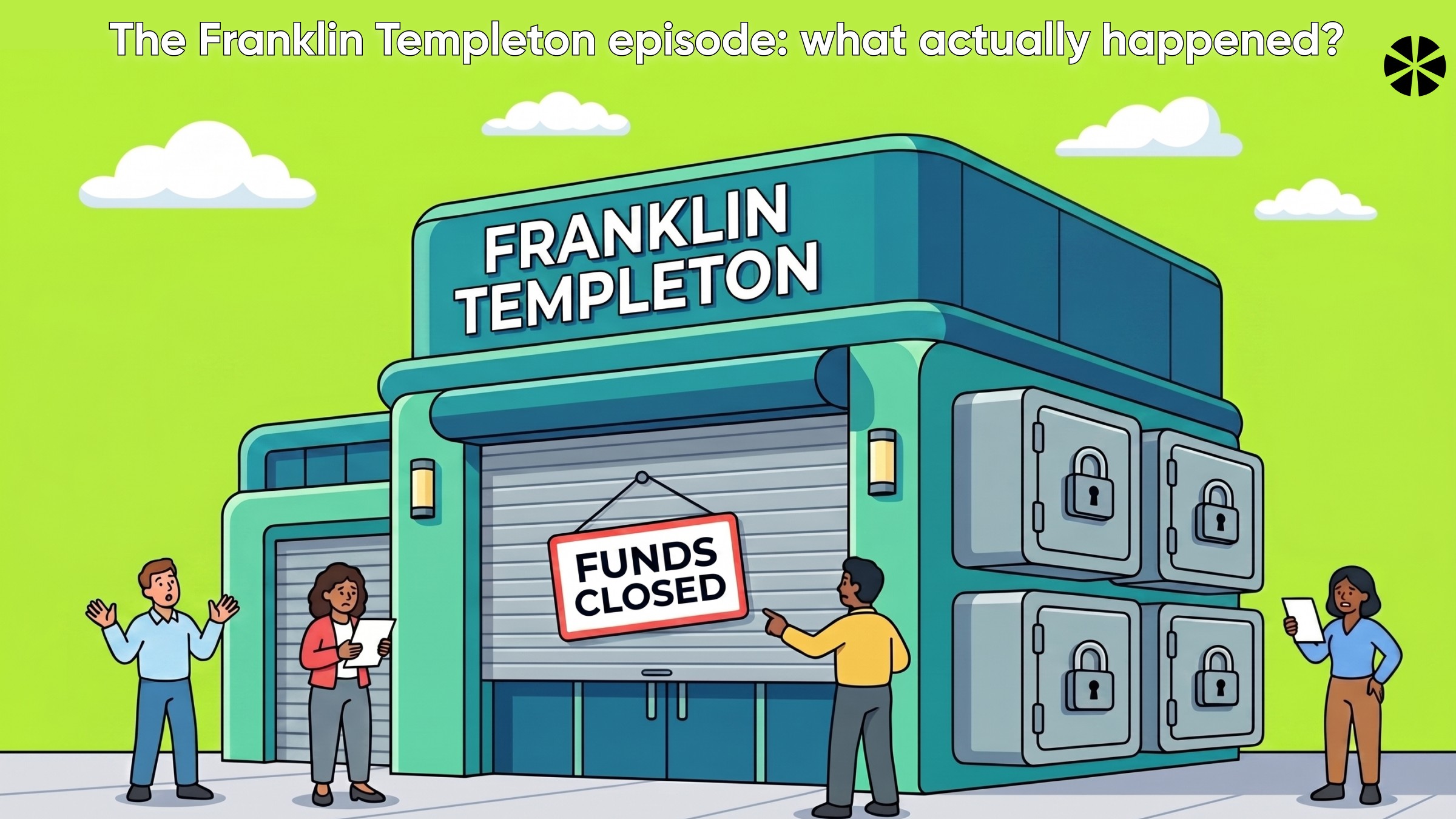
In April 2020, Franklin Templeton Mutual Fund in India announced the winding up of six yield-oriented managed credit schemes because the market had become illiquid under the severe impact of COVID-19. (Franklin Templeton) (Press release)
This was a major event for the Indian mutual fund industry. But it is important to state clearly:
The Franklin shutdown did not mean all liquid funds failed.
It involved specific debt schemes with different portfolio characteristics, especially higher credit risk and lower-liquidity exposures than a plain vanilla liquid fund category typically carries.
In other words, the event was about certain credit-oriented debt funds under severe liquidity stress, not proof that every liquid fund becomes dangerous when the market crashes.
This is where many retail investors get confused. They see “debt fund problem” and assume every short-term debt product is equally exposed. That is not how fund categories work.
If you want to understand the risk side better, two useful reads are Liquid Fund Safety: Can Liquid Funds Lose Money? and Liquid Funds Risks: Can You Lose Money in Them?.
So, are liquid funds safe in market crash conditions?
A better answer than “yes” or “no” is this:
Liquid funds are generally safer than equity funds during market crashes, but they are not the same as guaranteed bank deposits.
That is the right mental model.
Here is why many investors still consider them relatively resilient:
1. They hold short-maturity instruments
Short maturity reduces interest-rate sensitivity and helps portfolios roll over faster.
2. They are designed for liquidity
Liquid funds are built for short-term cash management, which is why investors often use them for salary buffers, emergency parking, or planned near-term expenses.
3. They usually do not track equity panic
A stock market fall does not automatically translate into a proportionate fall in liquid fund NAV.
But here is the caution side:
4. “Low risk” is not “no risk”
If underlying issuers face trouble or if market-wide liquidity freezes, liquid funds can see temporary stress.
5. Fund quality matters
Portfolio composition, credit quality, concentration, and fund-house risk management all matter.
6. Your use case matters
Money needed tomorrow should be parked differently from money needed in six months.
That is why investors should not ask only, “Are liquid funds safe?” They should ask, “Safe for what purpose?”
For instance, if you are deciding where to keep money temporarily, Where Should Salaried Indians Keep Money Between Payday and Bill Day? and Salary in Liquid Fund: How Much Should You Keep? offer practical frameworks.
What happens to money invested in a liquid fund during a crisis?
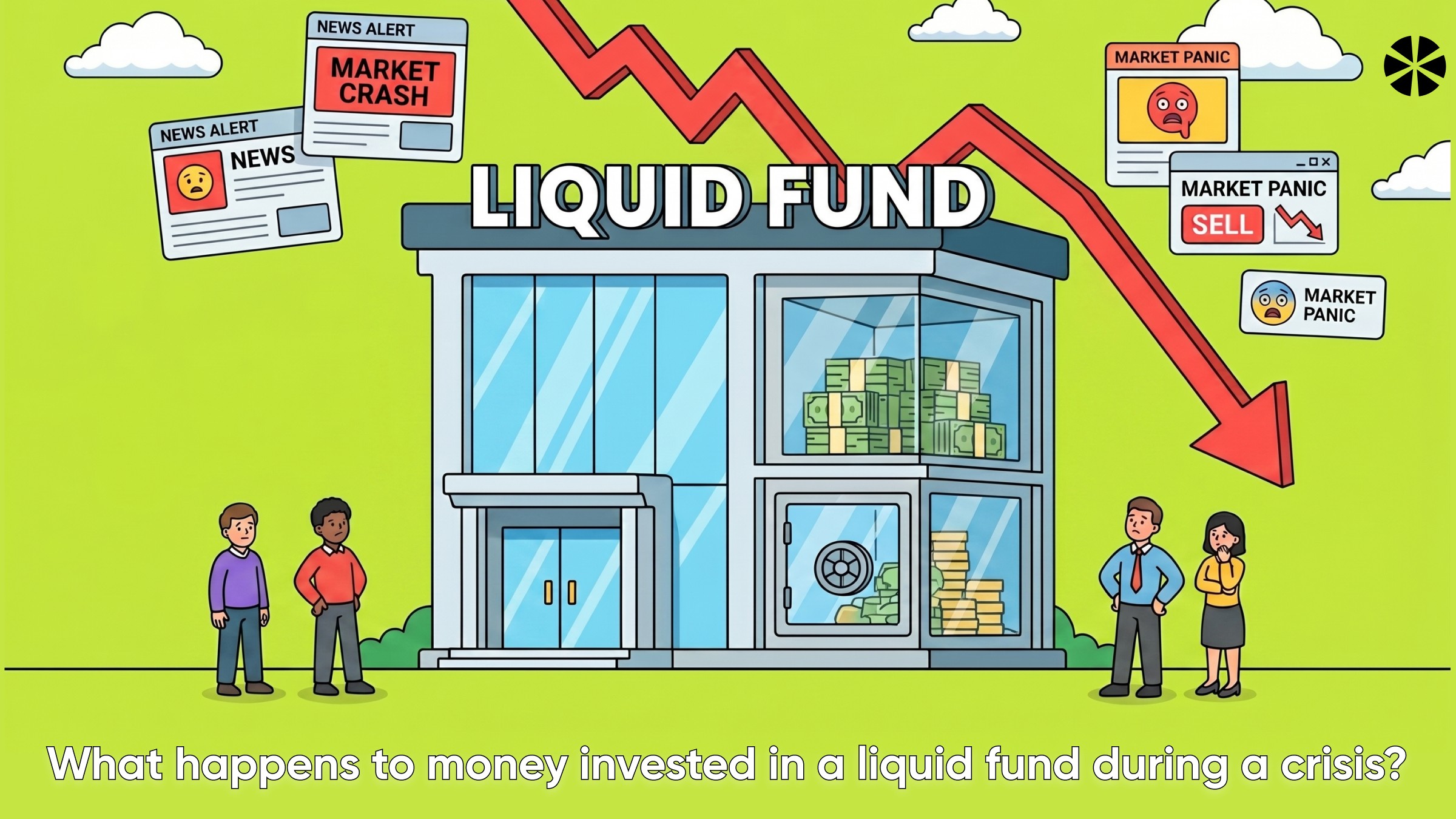
Your money remains invested in the underlying short-term instruments held by the scheme. As those instruments accrue interest or mature, the fund’s NAV updates accordingly. In normal conditions, this creates a relatively smooth return profile. In stressed conditions, the curve may become less smooth due to valuation changes, spreads widening, or redemption pressure.
So when people ask, “What happens to money invested in a liquid fund?”, the answer is:
it does not vanish because stocks fell,
it remains linked to the debt securities the fund owns,
it may experience mild NAV fluctuation,
and in rare stressed scenarios, access or pricing can be affected by market liquidity and portfolio quality.
This is also why investors should understand withdrawal timelines before parking meaningful money in a liquid fund. See Liquid Fund Withdrawal: When Can You Get Your Money? and Instant Redemption Liquid Funds: Best Options and Limits in India.
What did COVID teach investors about liquid funds?
COVID taught three lasting lessons.
Lesson 1: Equity fear and debt fear are different
A stock market crash is not automatically a liquid fund crash. The asset classes respond to different risks.
Lesson 2: Category labels matter
A liquid fund is not the same as a credit risk fund, low-duration fund, or corporate bond fund. In 2020, many retail investors discovered too late that “debt fund” is a broad umbrella, not a single risk bucket.
Lesson 3: Liquidity matters as much as return
During calm periods, investors chase slightly higher yields. During a crisis, they suddenly care more about access, stability, and quality. That is why it is dangerous to pick a short-term parking product only on headline return.
A good starting point for that broader decision is Short-Term Investment Options in India: 8 Safe Places for Idle Money.
Should you avoid liquid funds because of 2020?

Not necessarily.
In fact, the 2020 period arguably showed why investors must be more precise, not more fearful.
If your goal is short-term cash management, liquid funds can still be a sensible option when used correctly. What matters is:
the fund’s portfolio quality,
your time horizon,
your liquidity needs,
and whether you understand the difference between “market-linked” and “guaranteed.”
If your expectation is “I want zero fluctuation and deposit-like certainty,” then a bank savings account or fixed deposit may fit your psychology better, even if the return is lower. If your expectation is “I want a place for idle cash that may do better than a savings account while still staying relatively accessible,” then a liquid fund may fit.
That trade-off is exactly why readers often compare idle money in savings accounts with products designed for short-term parking.
A practical way to think about liquid funds during market crash India situations
Use this checklist before investing:
Liquid funds may be appropriate if:
the money is for short-term use,
you want better cash efficiency than a standard savings account,
you understand that small NAV fluctuations are possible,
you do not expect equity-like returns.
You may want to reconsider if:
you need principal certainty at all times,
you cannot tolerate even minor mark-to-market movement,
you may need the full amount instantly in every situation,
you are choosing a fund without understanding its portfolio quality.
For many people, the right answer is not “all savings account” or “all liquid fund.” It is a split based on purpose. Keep truly immediate cash in the bank and park a second layer of idle money in appropriate short-term instruments.
For a more complete framework, The Complete Guide to Managing Short-Term Money in India (2026) ties together savings accounts, liquid mutual funds, and higher-yield spending accounts.
The bottom line
So, what happens to liquid funds when markets crash?
Usually, they do not crash like equities. During the March 2020 COVID selloff, liquid funds in India faced stress very differently from stock funds because they held short-term debt instruments, not shares. (AMFI)
But 2020 also proved that debt markets can face liquidity and credit stress, especially in riskier segments. The Franklin Templeton episode was real and serious, yet it was not evidence that every liquid fund is unsafe. It was a reminder to understand category risk, portfolio quality, and liquidity dynamics. (Franklin Templeton) (RBI)
For Indian investors, the smartest takeaway is this: liquid funds are tools, not magic. Used for the right purpose, they can be a practical home for idle money. Used with the wrong expectations, they can create confusion.
If you are evaluating where your near-term money should sit, start by understanding the category properly, compare it against your liquidity needs, and choose based on purpose rather than panic.
FAQs
What is a liquid mutual fund in simple terms?
A liquid mutual fund is a debt mutual fund that invests in very short-term instruments, usually maturing within 91 days. It is commonly used for parking idle cash, emergency buffers, or money needed in the near term. It is lower risk than equity funds, but it is not risk-free.
What is the difference between a liquid fund and a savings account?
A savings account offers capital stability and instant usability for banking transactions, but usually lower returns. A liquid fund is a market-linked short-term debt product that may offer better cash efficiency, but its NAV can fluctuate slightly and withdrawals depend on fund processes.
Do liquid funds ever lose value?
Yes, they can. While losses are usually small compared with equity funds, liquid funds can face temporary NAV dips because of credit events, valuation changes, or liquidity stress.
Can I withdraw money from a liquid fund at any time?
You can usually redeem on business days, and some schemes offer instant redemption within limits. But “any time” does not always mean immediate bank-credit in every case. Check the scheme’s redemption rules carefully.
Is it okay to keep one or two months salary in a liquid fund?
For many investors, yes, that can be reasonable as part of a short-term cash parking strategy. But the right amount depends on your job stability, spending pattern, and how much instant bank liquidity you want to keep.
Are liquid funds safe in India?
They are generally considered relatively low-risk within mutual funds, especially compared with equity funds, but they still carry market, credit, and liquidity risk.
Multipl is a AMFI registered Mutual Fund Distributor (ARN No. 319633).
*Based on historical returns of Liquid Fund category.
Disclaimer: Mutual Fund investments are subject to market risks, read all scheme related documents carefully.