•
1 min read
Liquid Fund Withdrawal: When Can You Get Your Money?
TL;DR — Liquid fund withdrawal timeline at a glance
You can place a redemption request on any business day, usually 24x7 through an app. The credit to your bank, though, follows fund and banking cycles.
Standard redemption: T+1 business day (request before the cut-off on Monday → money typically credited Tuesday).
Instant redemption (if supported): money can reach your bank within minutes, capped by SEBI at ₹50,000 or 90% of the folio value per day per scheme, whichever is lower.
Cut-off time for liquid fund redemption: 3:00 PM on business days (as per SEBI rules).
Exit load: graded exit load applies if you redeem within 7 days of investment (0.0070% on Day 1, tapering to nil from Day 7).
Weekends and holidays push processing to the next working day, so liquid funds suit planned liquidity rather than 24x7 emergency cash.
If you are parking money in a liquid fund, the first question is rarely “What is the portfolio made of?” It is usually much simpler:
If I need my money, how fast can I get it back?
That is exactly the right question to ask.
A liquid fund is often positioned as a place for short-term money, emergency buffers, salary parking, or near-term spending goals. But for most people, usefulness depends on one thing: withdrawal speed. If the money does not reach your bank account when you need it, even a relatively better return than a savings account may not feel worth it.
So, can you withdraw money from a liquid fund at any time? The short answer is: you can place a redemption request whenever the platform allows, but the actual credit to your bank depends on cut-off time, business days, fund processing, and whether instant redemption is available.
This guide explains liquid fund withdrawal in plain language: how redemption works, when money usually reaches your bank, whether same-day withdrawal is possible, what happens on weekends and holidays, whether liquid funds carry penalties or exit load, and how all of this compares with a savings account.
New to the category? Liquid Mutual Fund Meaning: How It Works in India covers the basics before you get into redemption timelines.
The short answer: when can you withdraw from a liquid fund?
You can usually redeem a liquid fund on any business day, and in many cases you can submit the request digitally through the app or platform where you invested.
The more useful question is: When will liquid fund money come to your bank account?
Liquid fund redemption usually follows one of these timelines:
·Instant redemption: in eligible cases, within seconds
·Same-day: sometimes possible if the request is placed within the cut-off and the fund/platform supports it
·T+1 business day: the most common expectation for standard redemption
·Later than T+1: if the request is made after cut-off, on a weekend, on a market holiday, or if there are banking/operational delays
Liquid funds are liquid, then, but not exactly ATM-liquid. If your expectation is “tap and spend instantly like a debit card,” a savings account still has an edge on accessibility. If your expectation is “I want short-term money to stay reasonably accessible while it earns more than idle cash,” liquid funds can make a lot of sense.
For a deeper comparison, see Liquid Fund vs Savings Account vs Fixed Deposit vs HYSA: Complete Comparison.
How liquid fund withdrawal actually works
When you invest in a liquid fund, your money is used to buy units of that mutual fund. When you want your money back, you submit a redemption request. The fund house then processes the request, calculates the applicable NAV as per the rules, redeems the units, and transfers the amount to your registered bank account.
Step by step:
1.You place a redemption request through the app, AMC, registrar, or investment platform.
2.The request is time-stamped. If it is placed within the applicable cut-off on a business day, it may be processed for that day.
3.Units are redeemed.
4.The proceeds are sent to your linked bank account.
5.The amount reflects in your account based on fund and banking timelines.
Withdrawal here is not a cash withdrawal. It is a redemption settlement process. That distinction matters, because it explains why the answer to “can I withdraw money from a liquid fund at any time?” is not the same as “will I receive it instantly?”
Liquid fund redemption time: what does T+1 mean?
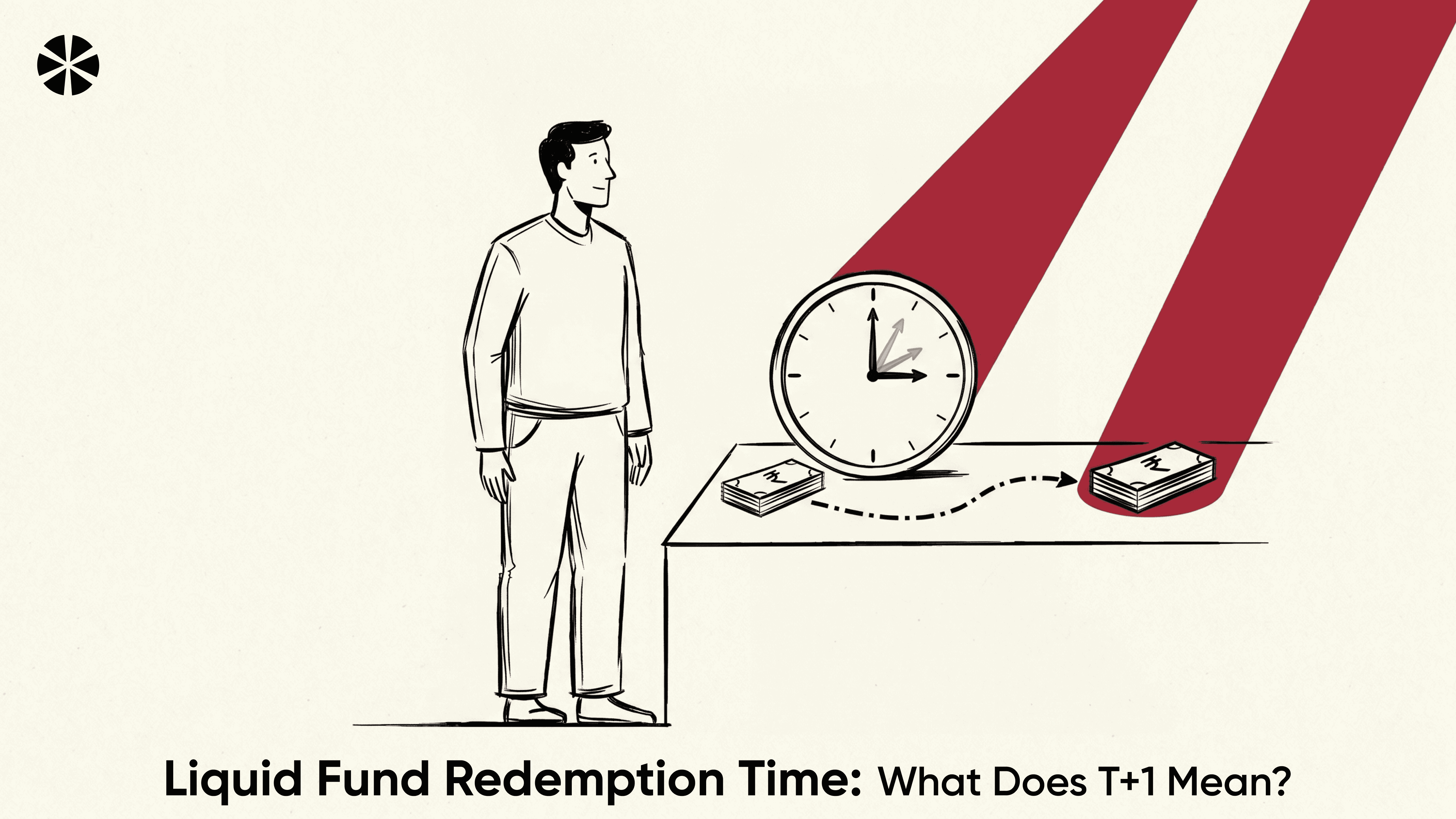
You will often hear that liquid funds are redeemed on T+1 basis. T is the transaction day. The +1 is the next business day.
Submit a valid redemption request on Monday before cut-off and the money typically reaches your bank on Tuesday. Submit it after cut-off, and Tuesday becomes the transaction day for processing, pushing the credit to Wednesday.
Timing within the day matters, not just the date.
Plenty of investors assume that because liquid funds invest in short-term instruments, redemption must always be immediate. Operationally, settlement still follows a process.
To understand why many people still use liquid funds despite this slight delay, read Short-Term Investment Options in India for 3 to 12 Months, which places liquid funds in the broader short-term money context.
Liquid fund withdrawal timeline table (when money actually hits your bank)
When you place the redemption request | Applicable NAV day | Expected bank credit (standard redemption) | With instant redemption (if eligible) |
|---|---|---|---|
Monday, before 3:00 PM cut-off | Monday | Tuesday | Within minutes |
Monday, after 3:00 PM cut-off | Tuesday | Wednesday | Within minutes |
Friday, before 3:00 PM cut-off | Friday | Monday | Within minutes |
Friday, after 3:00 PM cut-off | Monday | Tuesday | Within minutes |
Saturday or Sunday | Monday | Tuesday | Within minutes |
Day before a long weekend / market holiday | Next business day | Business day after that | Within minutes |
Indicative timelines. Actual credit depends on the scheme, the platform, banking rails (NEFT/RTGS/IMPS windows) and holiday calendars. Instant redemption is subject to the SEBI cap of ₹50,000 or 90% of folio value per day per scheme, whichever is lower.
Can I withdraw money from a liquid fund at any time?
Yes, in principle. You can usually initiate a withdrawal request whenever your platform permits, especially through online access.
No, not in the sense of immediate bank access at all hours. Liquid fund withdrawal is still subject to business-day processing, cut-off timing, platform-level features, bank settlement windows, weekends and market holidays, and in some cases instant redemption eligibility.
Submit a request on Sunday night and your money will not necessarily hit your bank account on Sunday night. That is the difference between placement flexibility and settlement timing.
Instant redemption in liquid funds: is it real?
Yes. Instant redemption liquid fund options do exist with some fund houses and platforms. Think of it as a feature with conditions, not a universal rule.
Instant redemption usually has limits such as:
only certain liquid funds are eligible,
only specific platforms support it,
a SEBI-mandated cap of ₹50,000 or 90% of folio value per day per scheme, whichever is lower,
the investor’s bank account must be properly linked and verified, and
the facility may not work during downtime, bank maintenance, or platform issues.
For most users, instant redemption is a convenience layer, not the default behaviour of every liquid fund. If you are building an emergency buffer, do not assume the full amount can always be pulled out instantly. Keep the expectation realistic, especially if you may need access outside market working cycles.
This is one reason many people split short-term money across buckets instead of using a single parking spot. That idea is unpacked in Where Should Salaried Indians Keep Money Between Payday and Bill Day? 5 Smarter Parking Spots.
Liquid fund withdrawal rules in India: what affects the timeline?
Several things decide how quickly your money actually arrives.
1. Cut-off time
Cut-off time is one of the biggest drivers of redemption speed. For liquid fund redemptions, the SEBI cut-off is 3:00 PM on business days.
Place the request before cut-off on a business day and it may be processed that day. Place it after cut-off and it is typically treated as the next business day’s transaction. One late click can push your payout by a full working day.
Example:
Request placed Monday morning: possible processing Monday, payout around Tuesday
Request placed Monday late evening: likely treated as Tuesday request, payout around Wednesday
When you need money urgently, that gap matters a lot.
2. Weekends and market holidays
Liquid funds do not settle the way a 24/7 wallet does. If you place a redemption request on:
Saturday
Sunday
a mutual fund/market holiday
a banking holiday affecting settlement
The effective processing may happen only on the next working day. So a liquid fund should not be your only instantly available emergency bucket.
3. Platform processing time
Even if the underlying fund is efficient, the platform you invested through may have its own internal cut-offs, batch timings, or operational flow. A direct AMC platform, a registrar and an investing app will not all behave identically from a user experience point of view. The backend settlement may be similar, but the visible timing can differ.
4. Bank credit timeline
Sometimes the fund redemption is done, but the bank credit shows up later because of banking rails or processing cycles. “Redeemed” and “available in your bank account” are related, not always the same minute.
5. Instant redemption eligibility
If your liquid fund and platform support instant redemption, a limited withdrawal can reach you faster than normal redemption. If they do not, standard timelines apply.
Is there an exit load on liquid fund withdrawal?
Here is a detail people miss. Many investors assume liquid funds are penalty-free from day one. Not always true.
In India, SEBI requires liquid funds to charge a graded exit load for redemptions within 7 days of investment. The standard slab applied by fund houses is:
Redemption on (days since investment) | Exit load on redemption value |
|---|---|
Day 1 | 0.0070% |
Day 2 | 0.0065% |
Day 3 | 0.0060% |
Day 4 | 0.0055% |
Day 5 | 0.0050% |
Day 6 | 0.0045% |
Day 7 onwards | Nil |
In rupee terms, redeeming ₹1,00,000 on Day 1 costs roughly ₹7. Small, but worth knowing before you treat a liquid fund like a current account. From Day 7 onwards, there is no exit load.
Liquid funds are meant for short-term money, yes. They are still not the same as a savings account where money moves in and out with no market-linked structure.
The practical takeaway:
If your money may be needed within a day or two, check whether a liquid fund is the right place.
If your money is being parked for a short but meaningful period, liquid funds can still be useful.
Always check the specific scheme’s exit load and redemption terms before investing.
For more on risk and suitability, see Liquid Fund Safety: Can Liquid Funds Lose Money?.
Do liquid funds ever lose value when you withdraw?
Liquid funds are among the lower-risk mutual fund categories. That does not make them risk-free. Your withdrawal amount depends on the value of your units at redemption.
In normal conditions they are built for relative stability, but they remain market-linked products. Returns are not guaranteed, NAV can move, and in rare cases value fluctuations can affect the outcome. Mutual funds are subject to market risk, and past performance is not indicative of future results.
This matters because some people treat liquid funds as identical to bank balances. They are not. A liquid fund can be a smart short-term parking option once you understand the product mechanics.
For a beginner-friendly overview, The Complete Guide to Managing Short-Term Money in India (2026) is a useful next read.
Liquid fund vs savings account: which is better for withdrawals?
If your only priority is immediate access, a savings account wins. The simple comparison:
Feature | Liquid Fund | Savings Account |
|---|---|---|
Access to money | Redemption-based | Immediate withdrawal/transfer |
Speed | Instant in some cases, often T+1 | Usually immediate |
Return potential | Typically higher than idle savings, not guaranteed | Usually lower but fixed by bank terms |
Risk | Low, but market-linked | Bank deposit structure |
Exit load | May apply in very early days | Usually none for simple withdrawal |
Why do people still use liquid funds? Because most savers are not optimising only for instant liquidity. They are balancing accessibility, short-term returns, idle cash efficiency and goal-based usage.
If that sounds like your situation, these explainers may help:
How Much Money Are You Losing by Keeping ₹1 Lakh in a Savings Account?
Why Most People Lose Money Without Realising It – The Hidden Cost of Idle Cash
Is it okay to keep one or two months’ salary in a liquid fund?
One of the most practical questions people ask. It can be okay, but only if you are clear about withdrawal timing.
If this is money you may need instantly for rent, bills, EMI, or an emergency, keeping all of it in a liquid fund is not ideal. Withdrawal often takes a day, so you could face a mismatch between the moment you need the money and the moment it arrives.
A more practical approach for many salaried people:
keep some money in a savings account for immediate use,
keep some in a liquid fund for near-term but not same-minute needs, and
organise the rest around your goals.
That mirrors the broader logic of goal-based planning, which Multipl covers in 10 Key Steps to Master Goal-Based Investing and Life’s Big Moments Deserve Big Planning: How Indians Undervalue Goal-Based Saving.
What happens to money invested in a liquid fund?
Once invested, your money is pooled into a mutual fund that typically holds short-duration debt and money market instruments. You are allotted units based on the applicable NAV. Over time, the fund’s value moves according to its underlying portfolio and accrual dynamics.
When you redeem, your units are sold back to the fund and the proceeds are transferred to your bank.
In plain user language: you do not “lock” money the way some deposits do, you also do not hold it as plain cash in a bank ledger, and access comes through redemption rather than direct withdrawal.
For more on this mechanism, Exploring Money Market Funds: Stability and Returns gives helpful context.
Practical examples of liquid fund withdrawal timelines
Four situations most Spendvesters will recognise.
Scenario 1: You redeem on a working Monday before cut-off. Your request is likely processed the same business day. Money may reach your bank by Tuesday, sometimes earlier depending on the facility.
Scenario 2: You redeem on Monday after cut-off. The request may be treated as Tuesday’s transaction. Credit may happen around Wednesday.
Scenario 3: You redeem on Friday after cut-off. Now the weekend gets in the way. Processing may effectively start on Monday, and money may arrive around Tuesday.
Scenario 4: You rely on instant redemption. If supported and within limits, the amount may arrive within minutes. If it is not supported for that amount or timing, standard redemption timelines apply.
The lesson: liquid funds are good for planned liquidity, not guaranteed 24/7 immediacy.
When should you avoid depending only on liquid fund withdrawals?
A liquid fund may not be the best sole parking option if:
you need cash unpredictably at odd hours,
you have fixed bill deadlines that cannot slip,
you are parking money needed within a few days,
you are uncomfortable with even small timing uncertainty, or
you have not checked the exit load and platform rules.
In those cases, a mix of account types works better. If you are weighing alternatives, Best Savings Account Alternatives in India 2026: Higher-Yield Options That Actually Work is worth reading.
How to think about liquid fund withdrawal the smart way
Instead of asking, “Can I withdraw anytime?”, ask these five better questions:
How fast do I need the money in the worst case?
Am I okay with T+1 instead of immediate access?
Is instant redemption available for my fund and amount?
Could weekends or holidays create a problem for me?
Am I moving money out too quickly and triggering exit load?
Those questions lead to better decisions than simply chasing “higher returns than savings.”
Conclusion
Liquid fund withdrawal in India is simple in concept but important in detail.
Yes, you can redeem a liquid fund relatively easily. But the real answer depends on when you place the request, whether it is a business day, whether cut-off has passed, whether instant redemption is available, and when the bank credit actually happens.
That means a liquid fund is not a replacement for every rupee in your savings account. It is better understood as a short-term money parking tool for funds you want accessible, but not necessarily instantly swipe-ready at all times.
If you use it with the right expectation, it can be a smart part of your short-term money strategy.
If you are comparing where to keep near-term cash, start with Liquid Mutual Fund Meaning: How It Works in India, then explore Savings Account vs Liquid Mutual Funds vs Higher-Yield Spending Accounts: The Complete 2026 Comparison Guide, and browse the rest of the Multipl blog for practical money explainers built for real life.
FAQs: Liquid fund withdrawal
1. How long does it take to withdraw money from a liquid fund in India?
Standard liquid fund redemptions are settled on a T+1 business day basis. Place the request before the 3:00 PM cut-off on a business day and the money usually reaches your bank account the next working day. With instant redemption, eligible amounts (up to ₹50,000 or 90% of folio value per day per scheme, whichever is lower) can be credited within minutes, including on weekends and holidays.
2. Can I withdraw from a liquid fund on a Saturday, Sunday or a public holiday?
You can place the request on any day, but standard processing only happens on business days. A weekend request is typically treated as the next working day’s transaction, with credit the day after that. Only the instant redemption facility credits money on non-business days, and only within its limits.
3. What is the cut-off time for liquid fund redemption?
The SEBI cut-off for liquid fund redemption is 3:00 PM on business days. Requests received on or before 3:00 PM get the same day’s NAV; requests after 3:00 PM get the next business day’s NAV. Some apps and distributors apply an earlier internal cut-off, so check your platform’s stated timing.
4. Is there any penalty or exit load for withdrawing from a liquid fund early?
Yes. A graded exit load applies for redemptions within 7 days, starting at 0.0070% on Day 1 and reducing to nil from Day 7 onwards. On ₹1 lakh, that is about ₹7 on Day 1. There is no lock-in and no penalty after the 7-day window.
5. Is a liquid fund good enough as an emergency fund?
It works well as a second layer of an emergency fund. Since withdrawals are usually T+1, most people keep 2–4 weeks of expenses in a savings account for instant needs and park the remaining buffer in a liquid fund for better yield with near-term access.
Multipl is a AMFI registered Mutual Fund Distributor
(ARN No. 319633). *Based on historical returns of Liquid Fund category.
Disclaimer: Mutual Fund investments are subject to market risks, read all scheme related documents carefully.