•
1 min read
Idle Cash Strategy: Savings Account or Liquid Fund?
Most people do not have a money problem. They have a money placement problem.
A salary comes in, sits in a savings account, gets used for bills, shopping, travel, and short-term goals, and whatever is left keeps lying there “just in case.” It feels safe. It feels simple. But over time, this habit creates an invisible drag on your finances: the opportunity cost of keeping money in a savings account.
That does not mean every rupee should be moved out of your bank account. In fact, an all-or-nothing approach is usually a bad idea. The smarter move is to build an idle cash strategy—a practical system for deciding:
how much cash to keep in a savings account,
how much to park in a liquid fund,
and which bucket to use for bills, emergencies, and planned spending.
For salaried professionals, freelancers, and couples managing shared finances, this framework can make idle money work harder without making daily life harder.
If you are still deciding between a savings account or liquid fund, think of this guide as a playbook—not a sales pitch. The goal is not to push all your cash into one product. The goal is to match each part of your money to the job it needs to do.
Why idle cash deserves a strategy
Idle cash is any money that is not needed today but is still sitting in a low-yield account by default. This could include:
salary waiting for bills to be debited,
emergency money beyond immediate access needs,
travel or shopping funds for the next few months,
freelance income waiting for tax payments,
or surplus household cash without a clear allocation.
The problem is not liquidity. The problem is lazy allocation.
In India, savings accounts offer convenience and immediate access, but they are not always the most efficient place for larger idle balances. At the same time, market-linked products such as liquid funds come with their own trade-offs around returns, risk, and settlement timing. The Reserve Bank of India defines savings deposits as bank deposits intended to encourage savings with liquidity features, while SEBI-regulated mutual funds operate under a different structure and risk framework. RBI and SEBI both make this distinction clear.
That is why the right question is not “Which is better?” It is:
Where should each type of idle cash sit based on when you need it next?
The three-bucket idle cash strategy
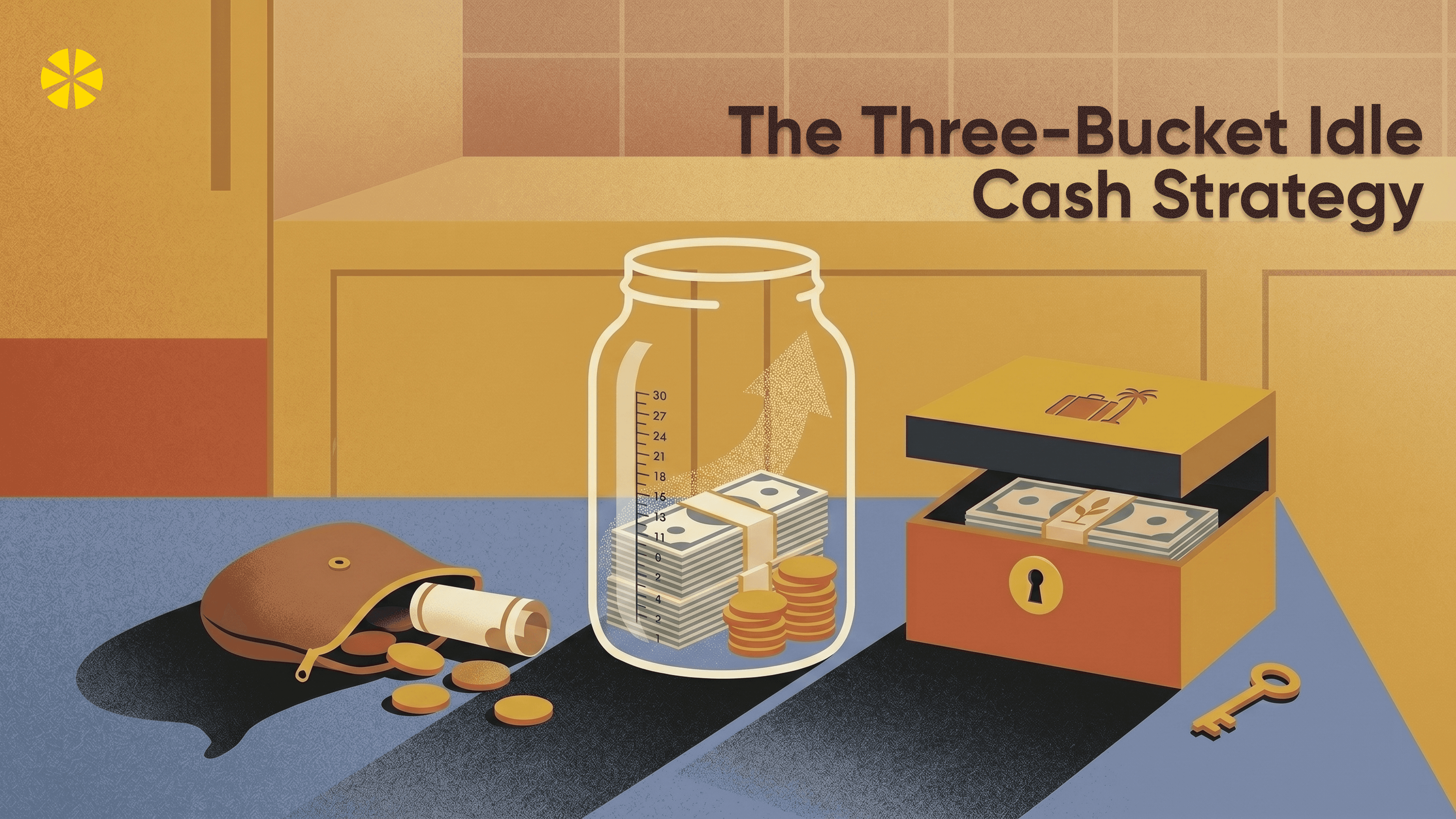
A simple way to decide where to keep idle cash in India is to divide cash into three buckets:
Instant-access bucket
7-to-30-day bucket
Planned-spend bucket
This framework is more useful than a generic “move money to liquid funds” recommendation because it reflects how people actually spend.
Bucket 1: Instant-access bucket
This is the money that should stay in your savings account.
Use it for:
UPI and card spending,
rent and EMIs,
utility bills,
autopay deductions,
medical needs,
and any amount you may need within 24 hours.
A good rule of thumb is to keep:
your next 2–4 weeks of routine expenses,
plus a small buffer for unplanned spending,
in your savings account.
If you are wondering how much cash to keep in a savings account, the answer is usually not all your surplus, but enough for friction-free daily life.
Why this bucket matters
Your savings account is your operating account. It optimizes for convenience, not efficiency. That is okay. Immediate-access money should be boring.
The mistake is turning the operating account into a long-term parking lot.
If you want a deeper comparison of everyday parking options, see Savings Account vs Liquid Fund vs HYSA in India 2026: A Side-by-Side Comparison for Working Professionals and Liquid Fund vs Savings Account vs Fixed Deposit vs HYSA: Complete Comparison.
Bucket 2: 7-to-30-day bucket
This is where liquid funds often start becoming relevant.
This bucket is for money you probably will not need today, but may need soon, such as:
salary set aside for month-end bills,
near-term emergency reserve beyond immediate cash,
tax money for freelancers,
school fees due next month,
or surplus lying unused between pay cycles.
A liquid mutual fund typically invests in very short-term debt and money market instruments with residual maturity of up to 91 days, as defined by SEBI’s mutual fund categorization framework. That short-duration structure is what makes liquid funds popular for short-term cash parking. SEBI
If you need a plain-English explainer, read Liquid Mutual Fund Meaning: How It Works in India.
Why this bucket exists
A lot of idle cash is not truly “emergency cash” or “daily spending cash.” It is simply waiting cash.
That waiting cash is where many people lose money silently. Not because they are paying fees, but because they are accepting low productivity for money that could have been allocated more intentionally.
This is the real opportunity cost of keeping money in a savings account: not just lower returns, but the habit of leaving medium-urgency money in the wrong place.
For a practical look at that hidden drag, see Why Most People Lose Money Without Realising It - The Hidden Cost of Idle Cash and How Much Money Are You Losing by Keeping ₹1 Lakh in a Savings Account? (And 5 Apps That Fix It).
Bucket 3: Planned-spend bucket
This is money earmarked for upcoming goals over the next few weeks or months:
vacation,
festive shopping,
gadgets,
annual insurance premiums,
wedding-related expenses,
or planned lifestyle spends.
This money should not be mixed with your daily operating account, because visibility changes behavior. Once separated, it is easier to protect from impulse spending and align with timelines.
This is also where structured saving can become more useful than casual saving. Instead of randomly retaining extra cash in a savings account, you assign it a purpose and timeline.
For examples of how this works for real-life goals, explore Liquid Funds for Short-Term Goals: Vacation, Wedding & More and How Multipl Helps You Save on Travel Without Killing the Vibe.
Savings account or liquid fund? Ask these 5 questions
Instead of asking which option is universally better, ask the following:
1. When will I need this money next?
Within 24 hours: savings account
Within 7 to 30 days: liquid fund may be worth considering
Within 1 to 6 months for a planned goal: a separate short-term parking strategy may help
Time horizon is the first filter.
2. Do I need instant access or just reasonably quick access?
Savings accounts offer instant availability. Liquid funds are generally redeemable, but access depends on cut-off times, processing, and settlement rules. SEBI’s framework and AMC processes matter here, so investors should understand operational timelines instead of assuming “instant means instant.” SEBI
For a practical breakdown, read Liquid Fund Withdrawal: When Can You Get Your Money?.
3. Am I comfortable with low risk, not zero risk?
A savings account balance with a regulated bank is different from a mutual fund investment. Liquid funds aim for stability, but they are still market-linked debt products, not guaranteed-return accounts. Credit events, interest rate movements, and portfolio issues can affect outcomes, even if volatility is typically lower than in many other fund categories.
If your question is “Do liquid funds ever lose value?” the honest answer is: they are designed to be relatively stable, but they are not risk-free. Read Liquid Fund Safety: Can Liquid Funds Lose Money? for the nuances, and compare that with Emergency Fund in Liquid Funds: Is It Safe in India?.
4. Is this money mentally “spent” already?
If you already know this money is for school fees, travel, rent, or festive shopping, then it should not sit in the same pool as free cash. Purpose-led money deserves its own bucket.
That is one reason goal-based systems tend to work better for behaviour, not just returns. See Life’s Big Moments Deserve Big Planning: How Indians Undervalue Goal-Based Saving.
5. What is the cost of doing nothing?
This is the question most people ignore.
If ₹50,000 or ₹2 lakh is lying idle month after month in a savings account without being needed immediately, the cost is not dramatic on any one day. But over years, repeated under-allocation adds up.
That is why parking surplus cash in India needs more thought than “leave it in the bank unless something better comes along.”
A practical split-allocation playbook
Here is a simple working model. It is not personal financial advice, but a sensible starting point.
For salaried individuals
Keep in savings account:
1 month of routine expenses
bill payment float
short-term emergency buffer
Consider liquid-fund-style parking for:
second layer of near-term emergency money
salary left unused after monthly obligations
money waiting for known spends in the next 1–3 months
A related framework is covered in Salary in Liquid Fund? A 1-2 Month Cash Parking Framework and Where Should Salaried Indians Keep Money Between Payday and Bill Day? 5 Smarter Parking Spots.
For freelancers and self-employed professionals
Freelancers often face irregular inflows, which makes bucket separation even more important.
Savings account bucket:
1 month of personal expenses
essential business payments
immediate tax/admin needs
Short-term parking bucket:
tax reserves due later in the quarter
invoice collections waiting for allocation
cash reserve for inconsistent income periods
For this group, the problem is usually not returns first. It is cash-flow discipline.
For couples and households
Couples should avoid putting all cash in one joint low-yield pool without purpose tags.
A better setup:
shared savings account for bills and household operations,
separate near-term parking for future planned spends,
and designated reserves for annual or semi-annual costs.
The key is clarity:
what is spend-now money,
what is reserve money,
and what is goal money.
When a savings account is still the better choice
It is easy to overcorrect once you learn about idle cash inefficiency. But there are times when the savings account is still the right answer.
Choose simplicity over optimization when:
your balance is small and fully used each month,
you need same-day access with zero process friction,
you are uncomfortable with any market-linked product,
you have not yet built a basic emergency reserve,
or your financial system is still messy.
A simple system you will actually follow is better than an optimized system you abandon.
If you are just beginning, start with the basics in 10 Simple Ways to Manage Your Money Better.
When a liquid fund may deserve a closer look
A liquid fund can be worth evaluating when:
you regularly maintain surplus cash above monthly needs,
your money is idle for days or weeks at a time,
you want better short-term cash organization,
you are building a structured goal-based saving system,
or you are comparing short-term investment options beyond traditional deposits.
You can also explore broader comparisons through Short-Term Investment Options in India for 3 to 12 Months and Liquid Funds vs Overnight Funds: Which Is Better for Idle Cash?.
A note on safety, liquidity, and expectations
Let’s keep this realistic.
Liquid funds are not a magic replacement for bank accounts. Savings accounts are not “bad.” Each has a role.
The better question is allocation by purpose:
Savings account = transaction convenience and instant access
Liquid fund = short-term parking for money not needed immediately
Goal-based setup = better visibility and less accidental spending
Also, returns should not be the only factor. Tax treatment, redemption timing, risk comfort, and usage discipline all matter. Before investing in any mutual fund, review scheme documents and official disclosures from the fund house and regulator. The Association of Mutual Funds in India provides investor education resources, and SEBI’s investor portal is also a good starting point. AMFI SEBI Investor
How Multipl fits into an idle cash strategy

Multipl’s broader value is not just about “invest more.” It is about helping users connect spending goals with smarter money behavior.
That matters because most idle cash does not stay idle forever. It eventually becomes:
a vacation,
a festival purchase,
a gadget,
an annual payment,
or a lifestyle goal.
When money is attached to a timeline and purpose, decision-making improves.
If you want to understand this philosophy better, start with What is spendvesting? and What Is a Higher-Yield Spending Account (HYSA) and How Does Multipl Work? A Complete 2026 Guide.
The bottom line
The best idle cash strategy is not “keep everything in savings” or “move everything to a liquid fund.”
It is this:
keep immediate-use money in your savings account,
separate near-term but not urgent cash from daily money,
assign planned spending money to dedicated buckets,
and review your idle balance regularly.
If you have been asking savings account or liquid fund, the answer is often both—used intentionally.
That is how you reduce the opportunity cost of keeping money in a savings account without sacrificing convenience. That is also the smartest answer to where to keep idle cash in India.
The goal is not to chase every extra percentage point. The goal is to stop treating all cash like it has the same job.
When your money has better roles, your financial decisions become clearer, calmer, and more effective.
FAQs
What is a liquid mutual fund in simple terms?
A liquid mutual fund is a type of debt mutual fund that invests in very short-term instruments. It is commonly used for parking money that may be needed soon, but not necessarily today. Learn more in Liquid Mutual Fund Meaning: How It Works in India.
What is the difference between a liquid fund and a savings account?
A savings account is meant for instant-access banking and transactions. A liquid fund is a market-linked short-term parking option for surplus cash that is not required immediately. Savings accounts prioritize convenience; liquid funds are often considered for short-term cash efficiency.
Can I withdraw money from a liquid fund at any time?
You can generally place a redemption request, but actual access depends on fund processes, cut-off timing, and settlement timelines. Read Liquid Fund Withdrawal: When Can You Get Your Money?.
Do liquid funds ever lose value?
Yes, they can, though they are typically designed for lower volatility than many other mutual fund categories. They are not guaranteed-return products. See Liquid Fund Safety: Can Liquid Funds Lose Money?.
Is it okay to keep one or two months salary in a liquid fund?
For some people, yes—especially if part of that salary is not needed immediately. But the right split depends on your bills, emergency needs, income stability, and comfort with liquidity timing. A useful starting point is Salary in Liquid Fund? A 1-2 Month Cash Parking Framework.
Why should I not keep large amounts in a savings account?
Because money that is not needed immediately may be earning less than it could in a better-structured short-term allocation setup. The hidden issue is the opportunity cost of idle cash, not just the balance itself.
Multipl is a AMFI registered Mutual Fund Distributor (ARN No. 319633).
*Based on historical returns of Liquid Fund category.
Disclaimer: Mutual Fund investments are subject to market risks, read all scheme related documents carefully.