•
1 min read
Liquid Funds as a Bank Account: Can You Use Them in India?

Many Indians want the same thing from their money: safety, easy access, and better returns than a typical savings account. That is why the idea of using liquid funds as a bank account sounds so attractive. If your money is just sitting idle between salary day and bill day, why not place it somewhere that may earn more and still remain accessible?
The short answer is: yes, but not exactly.
A liquid fund can work well as a cash parking layer for short-term money. But it is not a real bank account, and treating it like one without understanding the differences can create friction at the worst possible time. You cannot assume the same spending access, protection structure, or transaction convenience that comes with a savings account.
This guide explains where liquid funds fit, where they do not, and how to think about liquid fund vs bank account in India in a practical, day-to-day way.
What is a liquid fund, in simple terms?
A liquid fund is a type of debt mutual fund that primarily invests in very short-term money market and debt instruments. These instruments usually have short maturities, which is why liquid funds are commonly used for idle cash, emergency buckets, and short-term goals rather than long-term wealth creation. If you want a beginner-friendly explanation, read Liquid Mutual Fund Meaning: How It Works in India.
As per SEBI’s mutual fund category definitions, liquid funds invest in debt and money market securities with maturity of up to 91 days, making them one of the lowest-duration mutual fund categories in India. SEBI’s categorisation framework and AMFI’s investor resources help clarify this structure.
That design gives liquid funds three appealing traits:
relatively low volatility compared to many other mutual fund categories
potential for returns that may beat a basic savings account over time
easier access than locking money away in long-tenure products
But “accessible” does not mean “identical to a bank account.”
So, can liquid fund be used like a bank account?
Only partially.
You can use a liquid fund like a place to temporarily hold money. You generally cannot use it like a full-service bank account for everyday banking.
That distinction matters.
A bank account is built for:
receiving salary
UPI payments
debit card spending
ATM withdrawals
bill payments
auto-debits
cheque issuance
instant person-to-person transfers
insured deposit storage up to applicable limits
A liquid fund is built for:
parking idle cash
seeking relatively better short-term efficiency
redeeming money when needed
managing near-term surplus without locking it up
If your question is, “Can I replace my savings account with a liquid fund entirely?” the answer is usually no.
If your question is, “Can I move some idle money out of my savings account into a liquid fund to potentially earn more while keeping it reasonably accessible?” the answer is often yes.
That is why the better mental model is not “liquid fund as bank account,” but “liquid fund as a smart parking layer attached to your banking life.”
Liquid fund vs bank account India: the operational difference
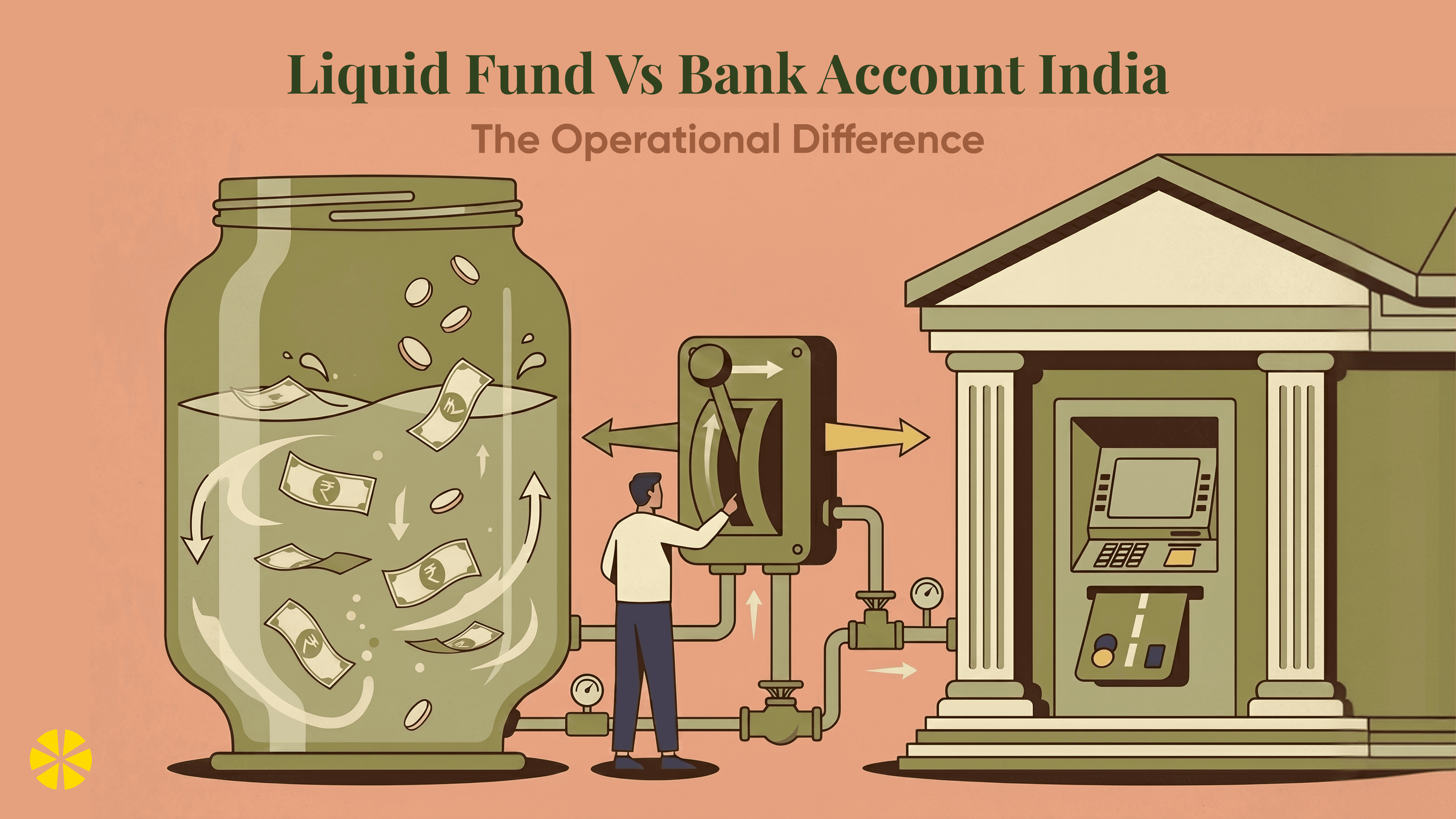
The biggest mistake people make is comparing only returns. In reality, this decision is about how money behaves when you need it.
Here is the practical side-by-side view.
Feature | Savings Account | Liquid Fund |
|---|---|---|
UPI access | Yes | No direct native UPI spend from the fund itself |
Debit card / ATM | Yes | No |
Salary credit | Yes | No |
Auto-debits / mandates | Yes | Limited to app/product structure, not like a standard bank account |
Withdrawal speed | Usually instant | Depends on redemption cut-off, platform flow, and settlement timeline |
Value fluctuation | Principal typically stable | NAV-based; low risk, but not risk-free |
Deposit insurance | Eligible bank deposits covered up to applicable DICGC limits | No deposit insurance because this is a mutual fund investment |
Return potential | Usually lower, especially in basic accounts | Often higher than plain savings accounts, but not guaranteed |
Daily spending usability | High | Indirect, unless an app layer creates a spending experience |
Best use case | Transactional money | Idle cash and short-term parking |
The Reserve Bank of India’s deposit insurance framework applies to eligible bank deposits through DICGC, currently up to ₹5 lakh per depositor per bank subject to the scheme rules. That protection does not apply to mutual funds because they are market-linked investment products, not bank deposits. See DICGC and RBI’s depositor information for details.
Why people want an app like savings account with liquid fund
The demand is easy to understand. Most people do not want to manually optimize every rupee. They want:
money to stay available
returns to be better than idle account balance
spending to remain simple
no complicated investing behavior
That is where modern fintech experiences become interesting. Some platforms try to make short-term cash management feel smoother by combining saving, spending intent, and investing workflows. If you are exploring that model, What Is a Higher-Yield Spending Account (HYSA) and How Does Multipl Work? A Complete 2026 Guide explains the idea in more detail.
The key point is this: when an app makes liquid funds feel more spend-friendly, it is usually doing so through a product layer built on top of the underlying investment. That is not the same as the mutual fund itself becoming a bank account.
Can you use liquid funds for daily expenses?
Not directly in the way you use a bank account for daily expenses.
This is one of the most important answers for users searching use liquid funds for daily expenses.
If you need to pay your landlord over UPI, swipe a card at a grocery store, withdraw cash from an ATM, or handle an urgent utility bill in seconds, a normal bank account still does that best.
Liquid funds usually require:
redemption request
processing based on platform and fund rules
settlement into your bank account or usable balance
then spending from that account or app balance
That means a liquid fund introduces one extra layer between stored value and spendable value.
So while they may support your spending strategy, they are not a seamless substitute for transaction banking.
A useful framework is:
daily expenses → savings/current account
next 1–8 weeks of flexible idle cash → liquid fund layer
locked commitments or emergency reserves → separate allocation depending on risk and access needs
For a broader comparison of cash-parking choices, see Liquid Fund vs Savings Account vs Fixed Deposit vs HYSA: Complete Comparison.
What about withdrawal speed and redemption timelines?
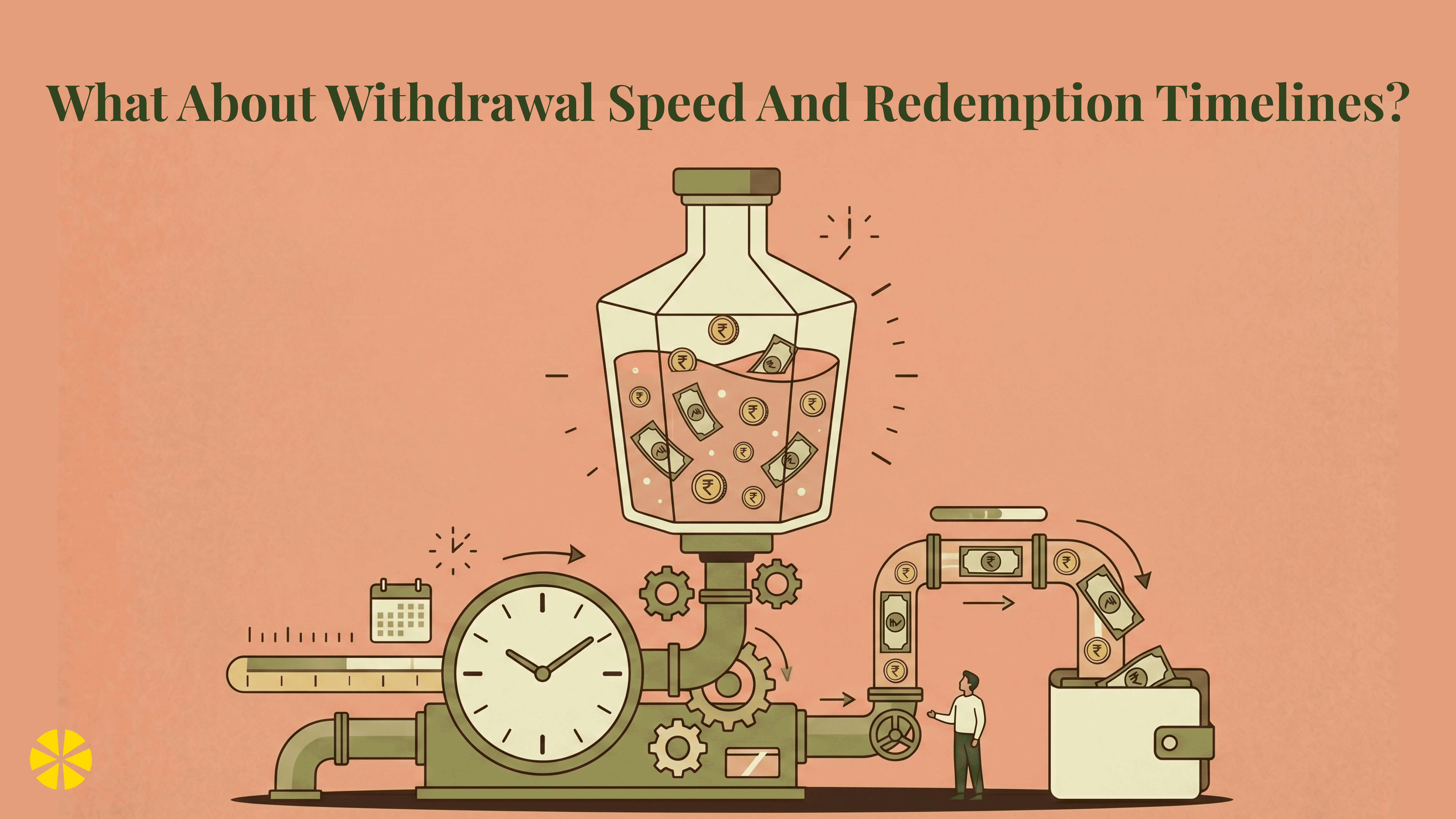
This is where theory meets real life.
People often assume liquid funds are “instant.” That is not always true in the way bank transfers or card swipes are instant. Redemption timelines depend on:
the app or platform you use
cut-off timings
instant redemption eligibility
amount limits
bank processing windows
weekends and holidays
SEBI and AMFI investor materials make clear that mutual fund redemptions follow process, cut-off, and settlement rules rather than behaving like a bank ledger balance. SEBI mutual fund guidance and AMFI are helpful references.
If fast access matters to you, read Liquid Fund Withdrawal: When Can You Get Your Money?. It explains the practical redemption side that many “liquid funds are like savings accounts” articles skip over.
This is exactly why liquid funds work well for planned liquidity, but not always for zero-notice spending.
Are liquid funds safe enough to act like a bank account?
They can be relatively conservative compared to many market-linked products, but they are not the same as insured bank deposits.
That difference should never be glossed over.
Liquid funds invest in short-duration debt instruments, which generally lowers interest-rate risk compared to longer-duration debt funds. But they can still carry:
credit risk
liquidity risk
market/NAV movement
platform execution delays
temporary dislocation risk in stressed markets
So if your definition of “bank account” includes “principal is operationally stable and insured within deposit rules,” then a liquid fund is not a direct substitute. If your definition is “a low-friction place for short-term surplus that may earn more than idle cash,” then yes, it can play a similar role.
For a fuller discussion, Liquid Fund Safety: Can Liquid Funds Lose Money? is worth reading.
Where liquid funds fit best in real life

Here is the most practical way to think about liquid funds for idle cash India.
1. Salary parked between payday and bill day
If your salary lands on the 1st but large spending happens over the next 2–4 weeks, part of that money may sit unproductively. This is one of the clearest use cases for liquid funds, especially if your core transaction money remains in the bank. A useful companion read is Where Should Salaried Indians Keep Money Between Payday and Bill Day? 5 Smarter Parking Spots.
2. Emergency fund layers
Some people keep all emergency money in a savings account. Others split it—one part instantly accessible in bank cash, another in relatively liquid instruments. Whether this suits you depends on your risk tolerance and need for same-minute access. For that use case, see Emergency Fund in Liquid Funds: Is It Safe in India?.
3. Short-term goals
Vacation money, annual insurance premiums, festive budgets, school fees, and upcoming discretionary spends all fit the “known future use, uncertain exact date” category. Liquid funds can be effective here because the money is not locked away, yet it is not entirely idle either. Also explore Liquid Funds for Short-Term Goals: Vacation, Wedding & More.
4. Spending-linked planning
If you like the idea of earmarking future expenses while making your money work harder in the interim, a spending-oriented framework may be more useful than a plain invest-or-save binary. What is spendvesting? introduces that concept.
When liquid funds should not replace your bank account
There are clear situations where a bank account remains non-negotiable.
Do not replace your bank account with a liquid fund if:
you rely heavily on instant UPI payments
you need ATM withdrawals frequently
most of your bills are on auto-debit
you keep very little buffer money and need same-minute access
you are uncomfortable with any market-linked product
you treat all short-term cash as emergency cash
you want deposit insurance protection rather than investment exposure
This is especially important for beginners. A liquid fund may be suitable for overflow cash, but your core operating balance should still live where it can handle everyday financial life without friction.
A smarter “yes, but not exactly” framework
If you are trying to decide whether a liquid fund can function like a bank account, use this simple model:
Keep money in a bank account when it is:
needed today
needed for UPI/card/ATM access
used for auto-debits
part of your zero-stress emergency buffer
Keep money in a liquid fund when it is:
idle for a few days to a few months
not needed for immediate swipe-and-pay use
intended for short-term parking
sitting between earning and spending
part of a deliberate cash management system
That middle layer is where many savers lose opportunity by doing nothing. If that sounds familiar, Why Most People Lose Money Without Realising It - The Hidden Cost of Idle Cash expands on the problem.
What should beginners do?

If you are new to this category, do not begin by moving all your cash.
Instead:
identify your true monthly transaction balance
keep that in your bank account
identify surplus cash that usually sits idle
evaluate whether a liquid fund or similar short-term option is appropriate
test with a small amount first
understand redemption timelines before depending on it
never confuse “reasonably accessible” with “bank-account instant”
If you are comparing apps and experiences, Liquid Fund Apps in India: Compare Liquidity, Returns and Minimums and Multipl – Save, Invest & Spend Smarter with Spendvesting can help you think through the product-layer differences.
The real answer: liquid funds are a cash parking tool, not a banking replacement
The best way to frame the issue is this:
A liquid fund can behave like a smart holding zone for idle money, but it does not replace the utility of a bank account.
That is the operational truth behind the phrase liquid funds as a bank account.
Use a bank account for:
payments
salary inflows
emergency immediacy
everyday banking rails
Use liquid funds for:
short-term idle cash
planned near-term spending
money waiting to be deployed
surplus that should not remain fully unproductive
If you want a deeper look at where liquid funds sit among other short-term options, Short-Term Investment Options in India for 3 to 12 Months offers a broader decision framework.
FAQs
Can liquid fund be used like bank account in India?
Not fully. A liquid fund can be used for parking idle cash and redeeming when needed, but it does not work like a full bank account for UPI, debit cards, ATM withdrawals, salary credit, or auto-debits.
Is there an app like savings account with liquid fund access?
Yes, some platforms create a smoother experience around short-term investing and spending goals, but the underlying liquid fund is still a mutual fund—not a bank deposit. The app layer may improve usability, but it does not turn the fund itself into a bank account.
Can I use liquid funds for daily expenses?
Usually not directly. In most cases, you first redeem the money and then spend it from your linked bank account or supported app balance. That makes liquid funds better for planned access than for real-time daily transactions.
Are liquid funds safer than a savings account?
Not in the same way. Savings accounts are bank deposits and may have deposit insurance up to applicable DICGC limits, while liquid funds are market-linked mutual funds and do not have deposit insurance.
What is better for idle cash in India: bank account or liquid fund?
For same-day spending and transaction convenience, a bank account is better. For short-term idle cash that may otherwise sit unused, a liquid fund can be more efficient—provided you understand the risks, timelines, and limits.
Conclusion
So, can you use liquid funds as a bank account in India?
Yes, to an extent—but only as a short-term cash parking layer, not as a full banking replacement.
That distinction is what matters most. A bank account is built for movement. A liquid fund is built for parking. One is a daily money tool. The other is a short-term allocation tool.
If you combine them intelligently, you can get the best of both: smooth day-to-day spending and a smarter home for idle cash. But if you expect a liquid fund to behave exactly like a savings account, you may run into avoidable surprises around access, spending, and safety assumptions.
In other words, the smartest setup is rarely bank account or liquid fund. For most people, it is bank account plus liquid fund, with each doing the job it is actually designed to do.
Multipl is a AMFI registered Mutual Fund Distributor
(ARN No. 319633). *Based on historical returns of Liquid Fund category.
Disclaimer: Mutual Fund investments are subject to market risks, read all scheme related documents carefully.