•
1 min read
Salary in Liquid Fund: How Much Should You Keep?

If you are a salaried professional in India, the question is no longer just _where_ to keep your money. The better question is: how much salary should you keep in a liquid fund, and how much should stay in your bank account?
That is where most people get stuck.
Some people leave their full salary in a savings account for convenience. Others move too much into investments and then scramble when rent, card bills, school fees, or EMI dates arrive. The right answer sits somewhere in between.
This guide gives you a practical framework to decide whether it is okay to keep one or two months' salary in a liquid fund, how to split your monthly income between bank balance and liquid fund, and when that split should change based on your job stability, responsibilities, and spending pattern.
For most working professionals, a simple rule works well:
Keep near-term bill money in your bank account
Keep your buffer and short-term idle cash in a liquid fund
Keep larger emergency reserves in layers, not in one place
If you are new to the category, start with this simple explainer on liquid mutual fund meaning, then come back to this guide for the “how much” decision.
TL;DR
Benchmark the split on your monthly expenses, not your salary figure.
Keep 30 to 45 days of committed expenses in your bank account for rent, EMIs, auto-debits and card bills.
Park 1 to 2 months of expenses in a liquid fund as your buffer, and stretch to 3 months if you have a dual income or a separate emergency reserve.
Redemption requests placed before the cut-off are usually credited the next working day. SEBI caps instant redemption at ₹50,000 or 90% of your folio value per day per scheme, whichever is lower.
Liquid funds carry low risk, not zero risk, so keep your emergency money layered across more than one place.
Why this question matters more than people think
Most salary earners focus on earning, budgeting, and investing. But there is a fourth piece that deserves more attention: cash placement.
Where your salary sits between payday and spending day affects:
liquidity
returns
discipline
emergency readiness
opportunity cost
A large amount of idle money in a normal savings account often earns very little relative to inflation or available short-term alternatives. That is exactly why more Indians are rethinking where to park money for a few weeks or a few months. If this sounds familiar, you may also want to read Why Most People Lose Money Without Realising It - The Hidden Cost of Idle Cash.
The goal is not to chase returns with money you may need tomorrow. The goal is to build a monthly cash-flow operating system that keeps your life smooth while making idle cash work harder.
First, what is a liquid fund in simple terms?
A liquid fund is a type of mutual fund that invests in very short-term debt and money market instruments. It is generally used for parking money that you may need in the near future, without locking it away for long periods.
In simple terms, think of it as a place for money that is:
not being spent today
may be needed in days, weeks, or a few months
should stay relatively accessible
should not remain completely idle
If you want a deeper beginner-friendly explanation, see What is a Liquid Mutual Fund in India and Exploring Money Market Funds: Stability and Returns.
So, how much salary should you keep in a liquid fund?
Here is the short answer:
Yes, it is okay to keep one or two months' salary in a liquid fund for many salaried Indians — but not all of it, and not blindly.
A better approach is to divide your salary into three layers:
The 3-layer salary split
Layer 1: Immediate spending money
Keep this in your bank account.
This includes:
rent
EMIs
utility bills
SIPs due this month
insurance premiums due soon
school fees
groceries
UPI and card spending buffer
Rule of thumb: Keep 30 to 45 days of committed expenses in your savings account.
This is your operational cash. It should be instantly available and should not depend on redemption timelines, fund cut-off timing, or transfer delays.
Layer 2: Monthly salary buffer
This is where liquid funds can fit well.
This includes money you may need soon, but not necessarily today:
extra cash between payday and bill day
one salary cycle of safety
planned irregular expenses
annual subscriptions
travel money for the next few months
a soft emergency cushion
Rule of thumb: Keep 0.5 to 2 months of expenses in a liquid fund, depending on household stability.
This is the amount most people are actually asking about when they say, “Should I keep salary in liquid fund?”
Layer 3: Emergency fund and short-term goals
This can be split across liquid funds and other low-volatility options depending on the time horizon.
Examples:
job-loss reserve
medical emergency cushion
wedding fund within 12 months
vacation fund
moving-city fund
home repair reserve
For a more detailed comparison of parking options, read Liquid Fund vs Savings Account vs Fixed Deposit vs HYSA: Complete Comparison.
The right answer depends on your income stability
There is no universal number. The correct allocation depends less on your salary amount and more on your cash-flow predictability.
Here is a practical framework.
1. Stable salaried professional with regular income
You receive your salary on time every month. Your job is steady. Your monthly expenses are mostly predictable.
Recommended split
Bank account: 1 month of expenses
Liquid fund: 1 to 2 months of expenses
Emergency reserve beyond that: separate layer depending on comfort
Example
If your household monthly expenses are ₹60,000:
Keep ₹60,000 in bank
Keep ₹60,000 to ₹1,20,000 in liquid fund
This setup works well for people who want convenience without keeping too much money idle.
If you want a broader view of short-duration parking choices, see Short-Term Investment Options in India for 3 to 12 Months.
2. Salaried professional with EMIs and dependents
If your cash-flow has multiple non-negotiable outflows, your savings account balance should be a little higher.
Recommended split
Bank account: 1 to 1.5 months of essential expenses
Liquid fund: 1 month of expenses
Emergency reserve: 3 to 6 additional months, layered separately
Why?
When you have EMIs, children, or family obligations, the cost of a temporary cash mismatch is high. In this case, your bank account is not just for convenience. It is part of your risk management.
This is also why understanding Liquid Fund Safety: Can Liquid Funds Lose Money? matters before using liquid funds as a core money-parking tool.
3. Dual-income household
If two people earn, the pressure on any one month’s salary is lower, especially when one income can cover essentials.
Recommended split
Bank account: 0.75 to 1 month of shared essential expenses
Liquid fund: 1.5 to 3 months of expenses
Goal buckets: create separate short-term pools
Why?
Dual-income households can often afford to keep a larger share of idle money in a liquid fund because the income source is diversified.
This is also a good match for goal-based saving, especially if you are planning travel, festivals, education purchases, or annual household spends.
4. Freelancer, consultant, or variable-income professional
If your income comes in unevenly, the definition of “monthly salary” itself becomes unstable.
Recommended split
Bank account: 1.5 to 2 months of bare-minimum expenses
Liquid fund: 1 to 3 months of average expenses
Extra surplus: allocated based on expected receivables and goals
Why?
You need more cash visibility and flexibility. Moving too much money out of your account can create friction if client payments are delayed.
For this profile, liquid funds are still useful, but not as a full replacement for bank balance. They are better used as a staging area for surplus cash rather than a near-zero balance operating account.
5. Early-career professional with low fixed obligations
If you are single, have low rent or live with family, and do not have heavy EMI obligations, your money can work a bit harder.
Recommended split
Bank account: 0.5 to 1 month of expenses
Liquid fund: 1 to 2 months of expenses
Surplus: toward goals or long-term investing
This group often leaves too much money idle simply because they have not built a system yet. If that sounds like you, read Where Should Salaried Indians Keep Money Between Payday and Bill Day? 5 Smarter Parking Spots.
A simple rule of thumb: Keep X in bank, Y in liquid fund
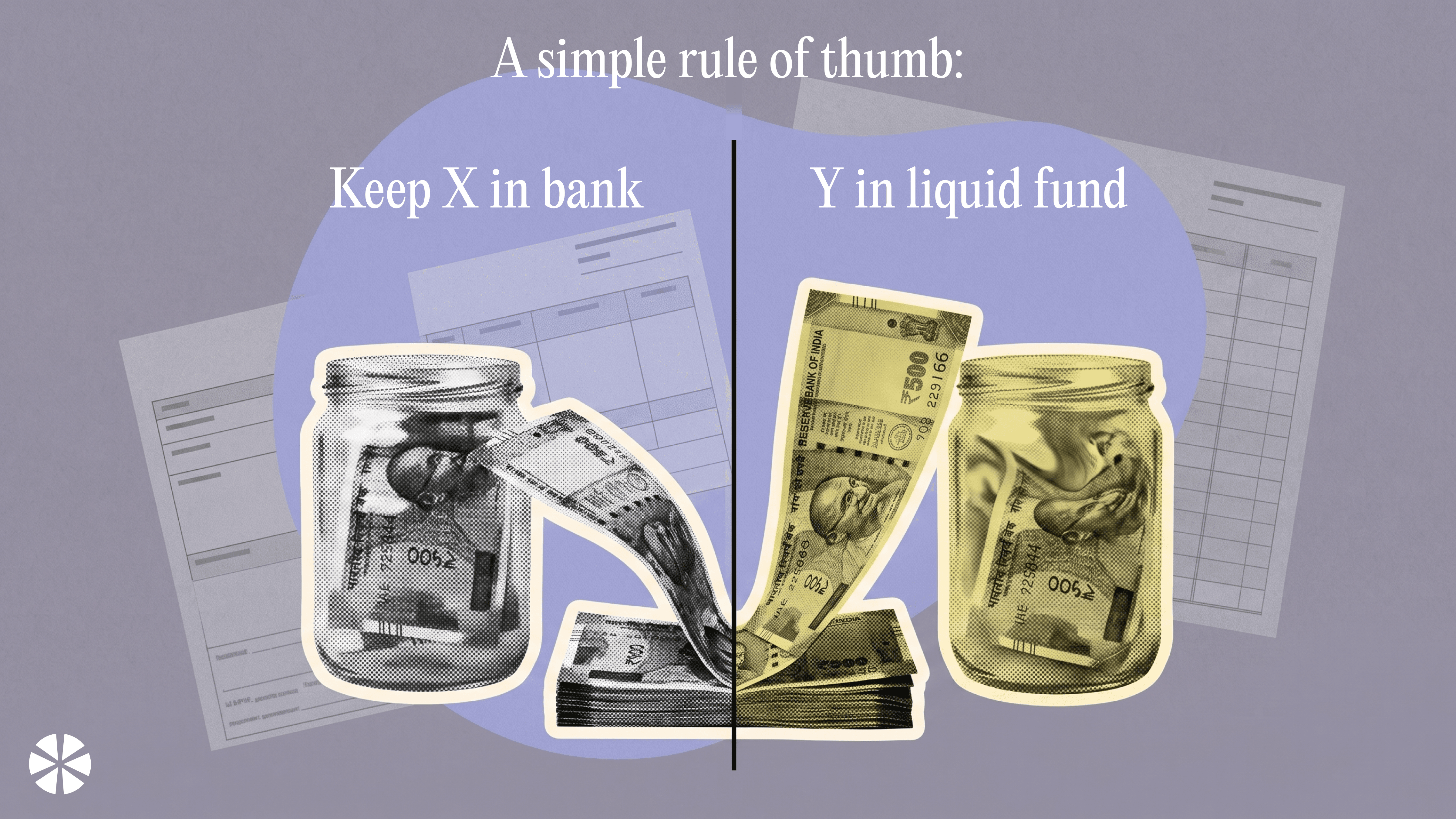
If you want one practical answer that fits most people, use this:
The 1-1 rule
Keep 1 month of essential expenses in your bank account
Keep 1 month of expenses in a liquid fund
The 1-2 rule
If your income is stable and obligations are manageable:
Keep 1 month in bank
Keep 2 months in liquid fund
The 2-1 rule
If your cash flow is less stable or your obligations are high:
Keep 2 months in bank
Keep 1 month in liquid fund
Notice that the benchmark is expenses, not just salary. That is important.
If you earn ₹1.2 lakh per month but spend ₹55,000, you do not need to treat your full salary as your cash buffer. On the other hand, if you earn ₹80,000 and spend ₹70,000, your safety layer should be based on that tighter margin.
Is it okay to keep one or two months salary in a liquid fund?
Yes, for many people it is reasonable, but only if:
your current month’s bills remain in the bank
you understand liquid funds are low-risk, not no-risk
your withdrawal need is not truly instant at every hour
you are not using a liquid fund as your only emergency access source
For many salaried workers, one to two months of expenses in a liquid fund is sensible. But one to two months of full salary may be too much or too little depending on your actual spending.
That is the mistake many blogs make: they talk in terms of income, while your real life runs on expenses.
When you should keep less in a liquid fund
Keep a smaller amount in a liquid fund if:
your salary credit date is unpredictable
you have large EMIs auto-debiting early in the month
you support parents or children financially
you face frequent unplanned medical or household costs
you are uncomfortable with anything other than bank-stored cash for immediate access
you are still building your first emergency fund
In these cases, do not force optimization at the cost of peace of mind.
When you can keep more in a liquid fund
You can consider a larger liquid-fund buffer if:
your salary is regular and dependable
your bank account often carries excess money for weeks
your monthly expenses are well tracked
you have a separate emergency reserve
your short-term goals are already mapped out
you want a better place to park money than a low-yield savings account
If you are comparing this decision against traditional idle cash habits, How Much Money Are You Losing by Keeping ₹1 Lakh in a Savings Account? is a useful next read.
What happens to money invested in a liquid fund?
This is another common question behind the scenes.
When you invest in a liquid fund, your money is pooled and invested into short-term debt instruments. The fund value changes based on the underlying portfolio, and the objective is generally capital stability with liquidity over short holding periods.
You are not “locking” salary in the same way as a fixed deposit. But you are also not keeping it in the exact same format as a bank deposit.
That is why liquid funds are best treated as cash management tools, not as guaranteed-return buckets.
Exit load and how fast your money comes back
Liquid funds carry a graded exit load for the first six days, which matters if you are parking a single salary cycle. The load starts at 0.0070% of redemption value if you exit on day 1 and tapers to 0.0045% on day 6. From day 7 onwards it is nil. On a ₹1 lakh redemption on day 3, the load works out to roughly ₹6, so the cost is small, but the seven-day mark is still the cleaner exit point.
On timing, a normal redemption placed before the cut-off is processed at that day's NAV and the money usually reaches your bank on the next working day. Most liquid schemes also offer instant redemption, which SEBI caps at ₹50,000 or 90% of your folio value per day per scheme, whichever is lower. Plan the rest of your withdrawals around bank working days, not weekends.
For a broader understanding of where liquid funds fit among other short-term options, see The Complete Guide to Managing Short-Term Money in India.
Liquid fund for monthly salary vs savings account: which is better?
This is not an either-or choice.
A savings account is better for:
immediate access
auto-debits
UPI and card transactions
day-to-day spending
A liquid fund is better for:
money sitting unused for days or weeks
salary surplus after bills
near-term buffers
short-term goal parking
That is why the smartest setup is usually a combination, not a replacement.
If you want a detailed side-by-side comparison, go through Savings Account vs Liquid Fund vs HYSA in India 2026: A Side-by-Side Comparison for Working Professionals.
A monthly cash-flow system you can actually use
Here is a practical model you can follow every salary day:
On salary credit day
Leave this month’s bills and spending money in your bank account
Leave a small cushion for UPI, ATM, and surprise spends
Move the true surplus into a liquid fund
Keep goal-specific money separated mentally or digitally
Review this split once every 3 months
Suggested buckets
Bills account balance: 30–45 days of mandatory expenses
Liquid fund buffer: 1–2 months of expenses
Emergency layer: separate reserve
Goal buckets: travel, gadgets, education, annual renewals
This is where tools and products built around planned spending can make a real difference. If you like the idea of turning upcoming expenses into smarter money habits, explore What is spendvesting? and Turn Your Future Expenses into Smart Investments.
Common mistakes to avoid
1. Keeping everything in the bank for comfort
Comfort matters, but excessive idle cash has a cost.
2. Moving too much away from immediate access
If routine cash flow becomes stressful, the allocation is too aggressive.
3. Using salary amount instead of expense amount
Expense-based planning is more realistic.
4. Treating liquid funds as risk-free in absolute terms
They are generally low risk, but not equivalent to cash under all conditions.
5. Mixing emergency money and lifestyle money
A Europe trip fund and a medical emergency reserve should not sit in your mind as one number.
Where Multipl fits in this decision

For many users, the challenge is not knowing that better options exist. The challenge is creating a system where money for future spending does not stay idle.
That is where Multipl’s approach becomes relevant. Instead of treating saving and spending as opposites, Multipl helps users prepare for upcoming expenses more intentionally. If your goals include travel, planned purchases, or short-term spending buckets, this model can help reduce idle cash drift while keeping your money aligned to real life.
You can start with the Multipl homepage, explore the concept of spendvesting, or review How Multipl Helps You Save on Travel Without Killing the Vibe.
Final verdict: how much salary should you keep in a liquid fund?
For most salaried Indians, the smartest answer is:
Keep this month’s spending and bill money in your bank account
Keep one to two months of expenses in a liquid fund
Keep a separate emergency reserve beyond that
Adjust upward or downward based on stability, EMIs, and dependents
So, if you are asking, “Should I keep salary in liquid fund?”, the answer is yes — but only the part of your salary that is not needed immediately.
And if you are asking, “Is it okay to keep one or two months salary in a liquid fund?”, the more precise answer is:
It is often okay to keep one or two months of expenses in a liquid fund, while keeping near-term cash needs in your bank.
That balance gives you what most people actually want: liquidity, control, and less idle money.
FAQs
Is it okay to keep one or two months salary in a liquid fund?
Yes, for many salaried professionals it can be reasonable. But use monthly expenses, not just salary, as the benchmark. Keep current bills and spending money in your bank account first.
Should I keep salary in liquid fund or savings account?
Usually both. Use a savings account for immediate transactions and auto-debits, and a liquid fund for surplus cash, short-term parking, and buffer money.
What is a liquid mutual fund in simple terms?
A liquid mutual fund is a short-term debt fund used to park money for near-term needs. It is designed for liquidity and relatively low volatility, not long lock-ins.
Can I withdraw money from a liquid fund at any time?
Liquid funds are generally meant to be accessible, but they should not be treated exactly like instant cash in a bank account. Keep immediate-use money separate.
Are liquid funds safe in India?
They are generally considered lower-risk than many market-linked options, but they are not completely risk-free. Understand the product before using it as a major cash bucket.
What is the difference between a liquid fund and a savings account?
A savings account is best for instant spending and banking convenience. A liquid fund is better for money that can sit for some time without being spent immediately.
How are liquid fund gains taxed for a salaried person?
For units bought on or after 1 April 2023, gains from liquid funds are added to your total income and taxed at your income tax slab rate, whatever the holding period. There is no indexation benefit. Tax is paid only when you redeem, unlike savings account interest, which accrues and is taxable each year beyond the ₹10,000 Section 80TTA deduction.
How much salary do I need before parking it in a liquid fund makes sense?
Most liquid funds accept lump sums from ₹500 to ₹5,000, so the entry barrier is low. The practical test is different: if your account routinely carries ₹25,000 or more that sits untouched for two weeks or longer every month, that surplus is worth moving. Below that, the difference in returns rarely justifies the extra step.
Multipl is a AMFI registered Mutual Fund Distributor (ARN No. 319633). *Based on historical returns of Liquid Fund category.
Disclaimer: Mutual Fund investments are subject to market risks, read all scheme related documents carefully.