•
1 min read
Savings Account vs Liquid Mutual Funds vs Higher-Yield Spending Accounts: The Complete 2026 Comparison Guide

TLDR
Savings accounts pay roughly 2.5% to 4% a year and exist for transactions, not returns.
Liquid mutual funds have historically returned about 5% to 7% a year (not guaranteed) by holding treasury bills, government securities and money market instruments.
Higher-Yield Spending Accounts hold your spending money in liquid mutual funds while keeping it available to spend, so the returns and the risk profile come from those funds.
Use a savings account for daily transactions, liquid funds for emergency and short-term money, and a Higher-Yield Spending Account for money you have already earmarked to spend.
Introduction: Why this comparison matters more today than ever
For decades, the savings account has been the default place to store money. It is familiar, convenient, and universally available.
But financial infrastructure has evolved significantly.
Today, individuals have access to tools that allow their money to remain both accessible and productive. Among these, liquid mutual funds and Higher-Yield Spending Accounts represent important developments.
Understanding how these options compare helps individuals make better decisions about where to store their short-term and spending money.
Understanding the purpose of each option
Before comparing returns, it is important to understand the original purpose behind each option.
Savings accounts: designed for transactions
Savings accounts were built primarily to enable:
Deposits and withdrawals
Everyday transactions
Immediate liquidity
Returns were never their primary function.
Their main goal is convenience.
Liquid mutual funds: designed for cash management

Liquid mutual funds were created to manage short-term idle money efficiently.
They invest in:
Treasury bills
Government securities
Money market instruments
These instruments are selected for their short maturity periods and relative stability.
Liquid mutual funds are widely used by:
Corporations
Businesses
Institutional investors
to manage idle cash.
Higher-Yield Spending Accounts: designed for spending money efficiency
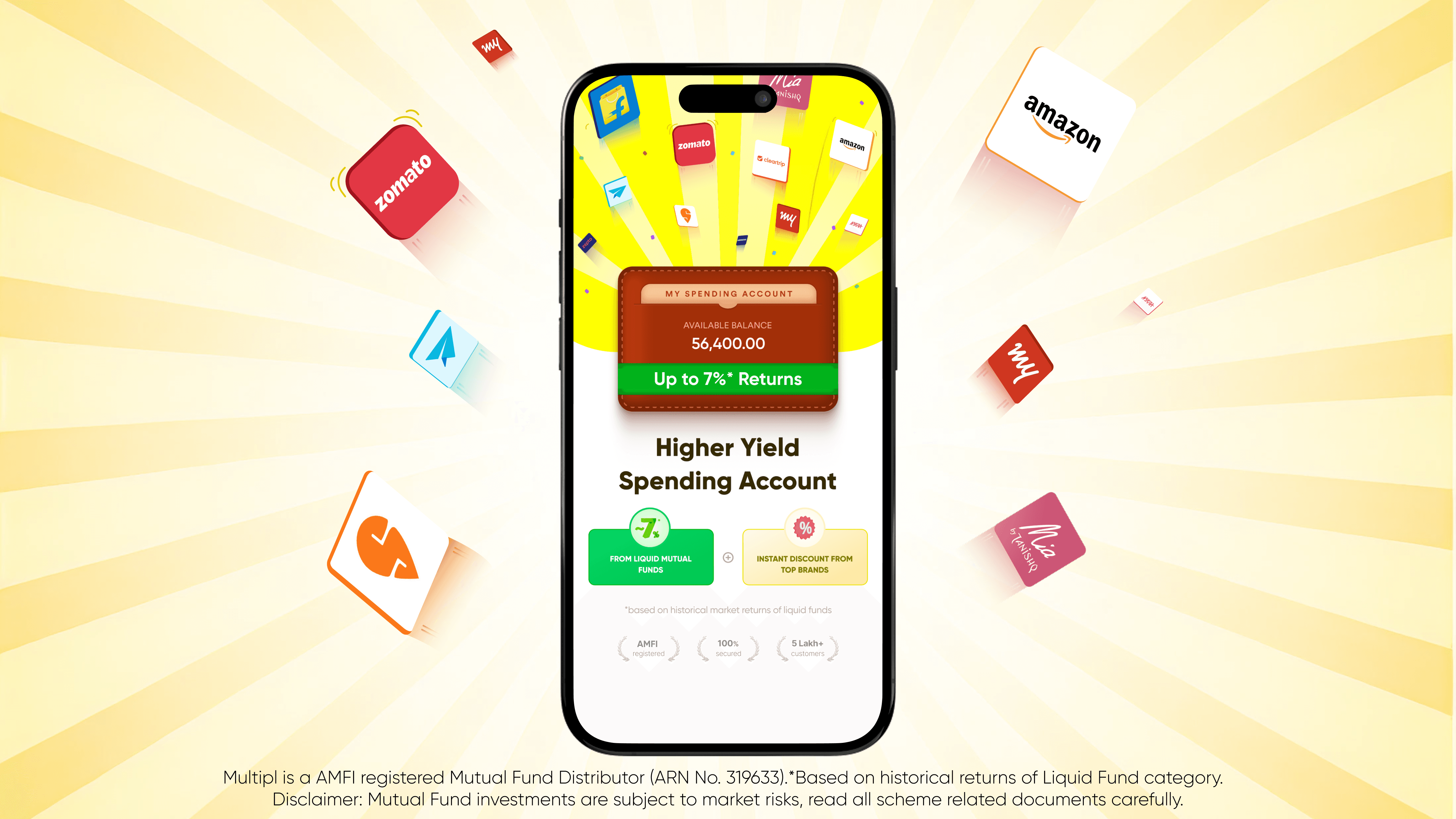
Higher-Yield Spending Accounts represent an evolution of personal finance infrastructure.
They allow individuals to:
Store spending money in liquid mutual funds
Maintain accessibility
Improve cash efficiency
This bridges the gap between traditional savings accounts and investment tools.
Comparing returns: savings account vs liquid mutual fund vs Higher-Yield Spending Account
Savings accounts typically offer:
2.5% to 4% annually
Liquid mutual funds have historically delivered approximately:
5% to 7% annually (not guaranteed)
Higher-Yield Spending Accounts derive their returns from liquid mutual funds.
This allows spending money to potentially remain more efficient while accessible.
The three options at a glance
Feature | Savings account | Liquid mutual fund | Higher-Yield Spending Account |
|---|---|---|---|
Typical return | 2.5% to 4% a year | ~5% to 7% a year, not guaranteed | Derived from liquid mutual funds |
Access to money | Instant | High, subject to redemption processing | Built into the spending flow |
Risk level | Very low | Low, short-term debt instruments | Same as the underlying liquid funds |
Best used for | Daily transactions | Emergency and short-term money | Money already earmarked to spend |
Comparing liquidity
Liquidity refers to how quickly money can be accessed.
Savings accounts offer instant liquidity.
Liquid mutual funds offer high liquidity, though redemption may take some processing time depending on platform and fund structure.
Higher-Yield Spending Accounts are designed to integrate liquidity with spending infrastructure.
Comparing risk levels
Savings accounts are considered very low risk.
Liquid mutual funds carry low risk relative to equity mutual funds, as they invest in short-term debt instruments.
Higher-Yield Spending Accounts inherit the risk characteristics of liquid mutual funds.
Accessibility and usability
Savings accounts are familiar and simple to use.
Liquid mutual funds require selecting funds and managing redemptions.
Higher-Yield Spending Accounts simplify this by integrating liquid mutual funds into spending workflows.
This makes efficient cash management easier.
Which option is best for different purposes?
Savings accounts are best suited for:
Daily transactions
Immediate liquidity needs
Liquid mutual funds are best suited for:
Emergency funds
Short-term savings
Higher-Yield Spending Accounts are best suited for:
Spending money
Planned lifestyle expenses
Improving cash efficiency
Conclusion
Savings accounts remain useful for transactions.
Liquid mutual funds provide better efficiency for short-term money.
Higher-Yield Spending Accounts extend this concept by helping spending money remain productive while accessible.
Understanding these differences helps individuals make better financial decisions.
Frequently asked questions
Are liquid mutual funds safe compared to a savings account?
A savings account carries very little risk and, in India, deposits are insured up to ₹5 lakh per bank per depositor by DICGC. Liquid mutual funds are not insured, but they hold short-maturity debt such as treasury bills and money market instruments, which makes them low risk relative to equity funds. Returns are still market-linked and not guaranteed.
How quickly can I get money out of a liquid mutual fund?
Most liquid funds settle redemptions on the next business day, and many offer instant redemption up to ₹50,000 or 90% of the folio value per day, whichever is lower, as permitted by SEBI. Processing times vary by fund and platform.
Do I pay tax differently on savings interest and liquid fund returns?
Savings account interest is added to your income, with a deduction of up to ₹10,000 available under Section 80TTA for those on the old regime. Gains from liquid funds bought after 1 April 2023 are taxed at your slab rate as short-term capital gains, and tax is due only when you redeem.
Should I keep my emergency fund in a Higher-Yield Spending Account?
An emergency fund works best where you can reach it without thinking. A Higher-Yield Spending Account suits money you have already planned to spend, such as rent, travel or a purchase a few weeks away. Many people split the two: a buffer in the bank, the rest working in liquid funds.
Multipl is a AMFI registered Mutual Fund Distributor (ARN No. 319633). *Based on historical returns of Liquid Fund category.
Disclaimer: Mutual Fund investments are subject to market risks, read all scheme related documents carefully.