•
1 min read
Cash Sweep vs Liquid Fund: Which Works Better in 2026?
When people compare cash sweep vs liquid fund, they are usually asking a very practical question:
“Where should I keep short-term money so it stays accessible but earns better than a plain savings account?”
That question matters more in 2026 because idle cash has become expensive in a different way. If your money sits in a low-yield account, it may remain “safe,” but it often does very little for you. The result is a hidden opportunity cost that many salaried professionals, freelancers, business owners, and families overlook. If this sounds familiar, you may also want to read Why Most People Lose Money Without Realising It - The Hidden Cost of Idle Cash and Idle Money in Savings Account: What to Do Instead.
Two of the most common options for short-term cash parking in India are:
Sweep accounts / auto-sweep FDs
Liquid mutual funds
Both are designed to do more than a regular savings account. But they work very differently when it comes to returns, taxation, access speed, flexibility, and ideal use cases.
This guide gives you a direct, decision-first comparison of auto sweep vs liquid fund India, so you can pick the right home for your short-term money instead of defaulting to whatever your bank already offers.
What is a cash sweep or auto-sweep account?
A cash sweep or auto-sweep account is usually a savings account feature offered by banks. Once your account balance crosses a preset threshold, the surplus is automatically “swept” into a fixed deposit. When you need money, the bank may reverse-sweep funds back into savings. Banks are free to set deposit interest rates, including savings and term deposit rates, within RBI’s framework. (rbi.org.in)
In simple terms:
Your base money stays in savings
Extra cash moves into FD-like buckets
You may get FD-style rates on the swept amount
Liquidity is often easier than a traditional fixed deposit, but not always identical to instant cash in hand
This is why many people compare sweep in FD vs liquid fund. Both aim to make idle money work harder without locking it away like a long-tenure investment.
What is a liquid fund?
A liquid fund is a category of debt mutual fund that invests in very short-term money market and debt instruments. Under SEBI’s categorization framework, liquid funds are a specific mutual fund category, and the industry uses SEBI-mandated risk labelling through the Riskometer. (amfiindia.com)
Liquid funds are typically used for money you may need in the near future, such as:
emergency buffer
salary parked between payday and bill day
travel fund
tax money set aside
lump sum waiting to be deployed
short-term goals within a few weeks to a few months
If you are new to the category, start with Liquid Mutual Fund Meaning: How It Works in India and What Are Liquid Funds? A Complete Guide for 2026.
AMFI describes liquid funds as suitable for parking surplus cash for short periods, typically with a reasonable degree of liquidity and relative stability compared with longer-duration debt categories. (uat.amfiindia.com)
Cash sweep vs liquid fund: the core difference
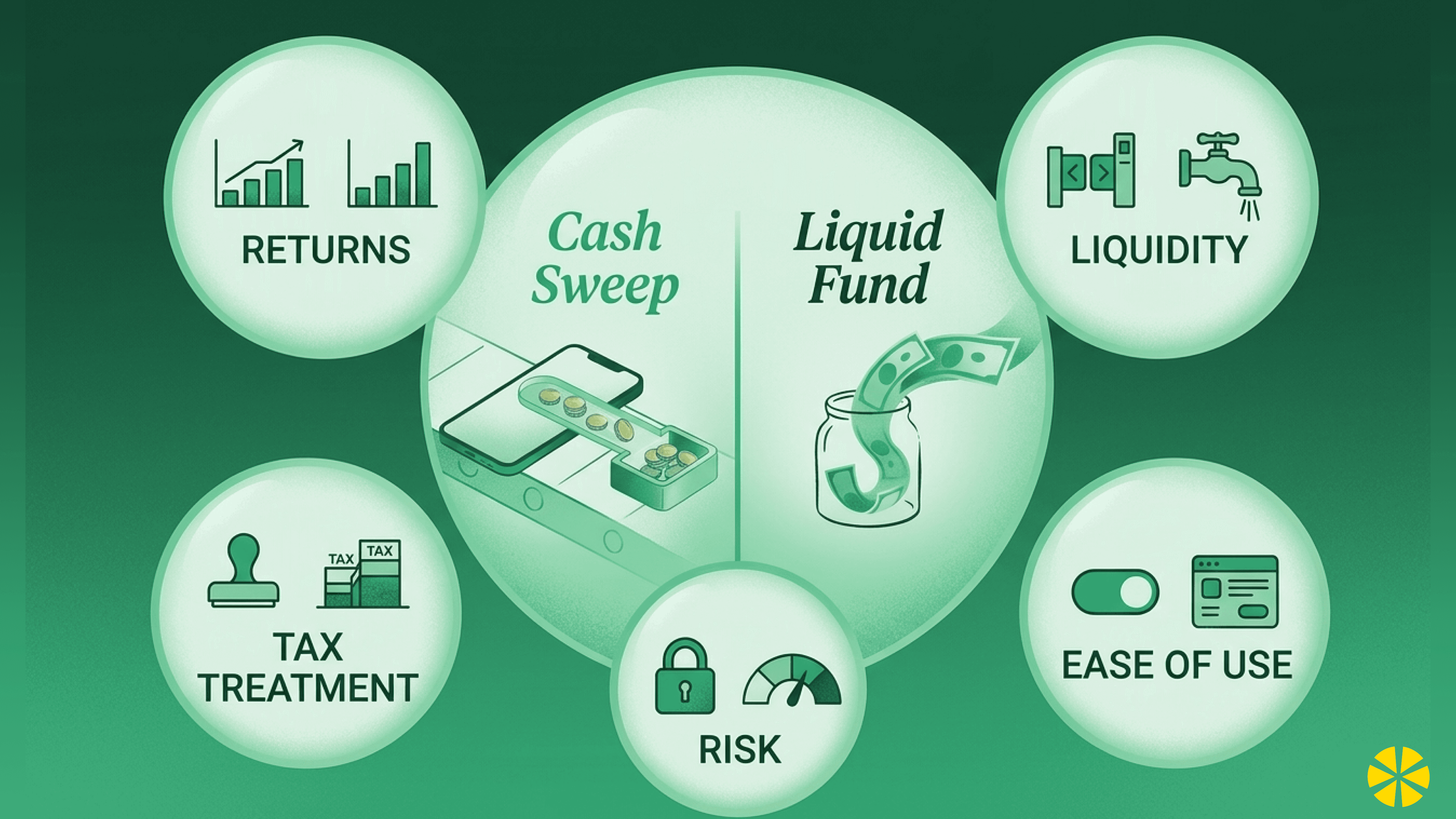
Here is the simplest way to think about it:
Cash sweep = bank deposit product with automation
Liquid fund = market-linked mutual fund designed for short-term money
That distinction affects almost everything else.
A sweep account is fundamentally tied to your bank’s deposit architecture. A liquid fund is part of the mutual fund ecosystem, regulated through SEBI and run by asset management companies. RBI regulates banks and the deposit system, while SEBI regulates mutual funds and their disclosure/risk frameworks. (rbi.org.in)
So when comparing liquid fund vs sweep account, you are not choosing between two versions of the same product. You are choosing between deposit-style certainty and market-linked short-duration exposure.
Cash Sweep vs Liquid Fund: side-by-side comparison
Factor | Cash Sweep / Auto-Sweep FD | Liquid Fund |
|---|---|---|
Structure | Savings account + linked fixed deposit | Debt mutual fund |
Regulator | RBI/banking system | SEBI/mutual fund system |
Return type | Stated deposit rate set by bank | Market-linked, not guaranteed |
Capital fluctuation | Usually low and deposit-like | Generally low, but NAV can move |
Liquidity | Good, depends on bank sweep rules | Good, redemption timeline depends on platform/fund |
Taxation | Interest taxed as per slab | Debt fund capital gains taxed as per prevailing rules |
Best for | People who want bank familiarity and simpler predictability | People optimizing short-term returns, flexibility, and goal-based cash parking |
Now let’s go deeper.
1. Returns: which one usually earns more?
This is often the first thing people ask when evaluating sweep FD or liquid fund.
Cash sweep returns
A sweep account typically pays:
regular savings account interest on the base balance
fixed deposit interest on swept surplus
That can be better than leaving all your money in savings. RBI’s published banking snapshots continue to show savings deposit rates materially below many term deposit rates. (rbi.org.in)
Liquid fund returns
Liquid fund returns are not fixed. They depend on:
short-term interest rate environment
portfolio quality
expense ratio
money market yields
portfolio management by the fund house
This means liquid funds can sometimes outperform many basic savings accounts and some sweep structures over short periods, but there is no guaranteed rate. AMFI notes that liquid and money market mutual funds are often used as a potentially more attractive destination for surplus cash than savings deposits, though investors must understand they are mutual funds, not deposits. (uat.amfiindia.com)
Practical takeaway
If you want:
more predictability: sweep account wins
potentially better market-linked short-term efficiency: liquid fund may win
If your goal is simply to stop losing return on idle cash, compare this with Best Savings Account Alternatives in India 2026: Higher-Yield Options That Actually Work and Short-Term Investment Options in India: 8 Safe Places for Idle Money.
2. Liquidity: how fast can you get your money back?
This is the most important real-life filter for best option for short term cash.
Sweep account liquidity
Auto-sweep accounts are designed to feel seamless. In many cases, the bank reverses funds automatically when your savings balance falls below the amount needed for transactions. That convenience is the biggest reason some users prefer a sweep setup over mutual funds.
But the actual experience varies by bank:
minimum sweep threshold may differ
FD breakup rules may differ
reverse sweep may have product-specific conditions
premature withdrawal treatment may affect effective earnings
So sweep accounts are convenient, but they are not one uniform product across India.
Liquid fund liquidity
Liquid funds are known for relatively high accessibility among mutual fund categories, but they are still redemption-based products. SEBI’s liquidity risk framework and additional risk-management rules exist precisely because open-ended debt schemes must manage redemptions prudently. (sebi.gov.in)
For investors, that means:
money is usually accessible fairly quickly
exact withdrawal timing can depend on cut-off times, platform processes, and redemption mode
it is convenient, but not always the same as ATM-style access
If immediate withdrawal timing is your biggest concern, read Liquid Fund Withdrawal: When Can You Get Your Money? and Instant Redemption Liquid Funds: Best Options and Limits in India.
Practical takeaway
Choose:
cash sweep if you want banking-style access integrated with daily spending
liquid fund if you can handle redemption mechanics and want a more purpose-built idle cash vehicle
3. Risk: which one is safer?
This is where many comparisons become too simplistic.
Sweep accounts
A sweep account is built on bank deposits. For most users, that feels more familiar and psychologically safer. Returns are stated upfront, and there is no daily NAV movement visible to the user.
Liquid funds
Liquid funds are among the lower-risk mutual fund categories, but they are still not risk-free. SEBI requires scheme risk disclosure via the Riskometer, and liquid funds operate under dedicated liquidity and risk-management norms. (investor.sebi.gov.in)
That means two things are true at once:
liquid funds are generally designed for low-volatility short-term parking
they can still carry limited market, credit, or liquidity risk
This is why serious investors should not treat auto sweep vs liquid fund India as just a returns battle. It is also a risk-structure choice.
For a more focused explanation, see Liquid Fund Safety: Can Liquid Funds Lose Money?.
4. Tax treatment: where the difference becomes meaningful
Tax is one of the least understood parts of the cash sweep vs liquid fund decision.
Tax on sweep accounts
Interest earned via auto-sweep FDs is generally treated like bank deposit interest. In practical terms, it is taxable according to your income tax slab.
Tax on liquid funds
Liquid funds, being non-equity mutual funds, are taxed based on the prevailing debt mutual fund tax rules applicable at the time of sale/redemption. AMFI’s current tax regime page lays out how capital gains taxation works across mutual fund categories and holding periods. (amfiindia.com)
For many users, the important point is not “which has lower tax in all cases?” but rather:
one is interest income
the other is typically capital gains on redemption
That difference can affect:
post-tax outcomes
reporting
TDS expectations or lack thereof, depending on structure
suitability for your income bracket
Because tax rules can evolve, you should always verify current treatment before making a large move.
Practical takeaway
If you want pure simplicity, sweep accounts may feel easier to understand.
If you want to compare post-tax outcomes properly, liquid funds deserve a closer look instead of being dismissed.
5. Ease of use: which one feels simpler?
For many working professionals, the winning product is not the one with the “best” spreadsheet answer. It is the one they will actually use consistently.
Sweep account wins on familiarity
You usually:
keep using your bank account
set a threshold
let the bank automate the movement
This makes sweep accounts ideal for people who:
dislike managing multiple apps
want a passive setup
prefer guaranteed-looking returns over variable NAV-based outcomes
Liquid funds win on flexibility
Liquid funds can be better if you:
segment money by goal
want more control over where short-term cash sits
are already comfortable with mutual fund platforms
prefer a dedicated short-term allocation rather than one giant bank account
This is where a modern money stack starts to matter. Instead of asking only “sweep fd or liquid fund?”, a better question is:
“What role does this money play?”
That is the thinking behind solutions like What Is a Higher-Yield Spending Account (HYSA) and How Does Multipl Work? A Complete 2026 Guide and Where Should Salaried Indians Keep Money Between Payday and Bill Day? 5 Smarter Parking Spots.
Who should choose a cash sweep account?
A cash sweep or auto-sweep FD may suit you if:
you want bank-native convenience
you need funds closely tied to your transaction account
you value predictable deposit rates
you do not want to think about NAVs, redemptions, or fund selection
your goal is to improve on savings account returns without changing behavior much
This option is especially useful for:
salary accounts with fluctuating monthly surplus
business owners who keep operational cash in one bank
people who want a “set it and forget it” parking layer
Who should choose a liquid fund?
A liquid fund may suit you if:
you want a purpose-built product for short-term idle cash
you are comfortable with mutual fund investing basics
you want to separate spending money from parked money
you compare options based on post-tax efficiency, flexibility, and portfolio quality
you do not need every rupee accessible through your debit card instantly
Liquid funds are often a better fit for:
emergency buffers
travel funds
near-term goal money
cash waiting for deployment
salary surplus beyond your immediate spending window
For use-case-based planning, Liquid Funds for Short-Term Goals: Vacation, Wedding & More is a useful next read.
The smarter framework: don’t use one bucket for everything

Here is where many people go wrong: they try to pick one product for all cash.
In reality, your money has different jobs:
transaction money — needed instantly
near-term spending money — needed this month or next
short-term goal money — needed in a few weeks to months
true emergency money — accessible, but not mixed with everyday spending
A sweep account can work well for category 1 and part of 2.
A liquid fund can work well for categories 2, 3, and sometimes 4, depending on your comfort and planning style.
If you want to build a more intentional short-term cash plan, The Complete Guide to Managing Short-Term Money in India (2026): Savings Accounts, Liquid Mutual Funds, and Higher-Yield Spending Accounts lays out the broader framework.
Where Multipl fits in this decision

Multipl’s approach is useful for people who do not just want “higher returns than savings” in theory. They want a system that connects saving, investing, and spending more intelligently.
If you are comparing a liquid fund vs sweep account, you are already thinking beyond the default bank balance. The next step is asking whether your money can be parked in a way that is:
more intentional
goal-linked
spending-aware
less likely to sit idle without purpose
That is exactly why products positioned around higher-yield spending and spend-linked savings are becoming more relevant. A good starting point is Multipl – Save, Invest & Spend Smarter with Spendvesting, and if you want to explore directly, visit Turn Your Future Expenses into Smart Investments.
Final verdict: cash sweep or liquid fund?
If you want the shortest possible answer to cash sweep vs liquid fund, here it is:
Choose cash sweep if you want banking simplicity, predictable rates, and easy integration with day-to-day transactions
Choose liquid fund if you want a more dedicated short-term parking option with market-linked returns, flexibility, and better cash segmentation
Neither is automatically “better” in every case.
The real winner depends on:
how soon you need the money
whether you want guaranteed-looking or market-linked returns
your tax situation
how much convenience matters
whether the money is for spending, buffer, or a near-term goal
For many people, the best answer is not either/or. It is:
keep immediate spending liquidity in bank-linked systems
move non-immediate short-term cash into a more intentional parking option
That is the difference between simply storing money and actually managing it.
FAQs
Is auto sweep better than a liquid fund in India?
It depends on what “better” means for you. Auto sweep is usually better for simplicity, bank-linked access, and predictable deposit-style returns. Liquid funds are often better for structured short-term cash parking if you are comfortable with mutual funds and redemption-based access.
Which gives higher returns: sweep in FD vs liquid fund?
A sweep FD gives a stated bank deposit rate, while a liquid fund gives market-linked returns that can change over time. There is no universal winner. Compare current bank rates, fund quality, expense ratio, and your holding period.
Is a liquid fund safer than a sweep account?
Usually, a sweep account feels safer because it is a bank deposit product. Liquid funds are generally low risk within mutual funds, but they are not risk-free and their NAV can fluctuate slightly.
Can I use a liquid fund for emergency money?
Yes, many people do. But emergency money should be kept where you are personally comfortable with the access timeline. If you need instant card-based access, keep at least part of it in a more immediately accessible bucket.
What is the best option for short term cash in 2026?
The best option for short-term cash depends on use case. For daily liquidity, sweep accounts can work well. For goal-based short-term parking, liquid funds may be more suitable. For many users, a combination works best.
Sweep FD or liquid fund for salary surplus?
If your salary surplus may be spent anytime this month, a sweep setup may be easier. If it is surplus you want to separate from day-to-day spending for a few weeks or months, a liquid fund can be a stronger option.
Multipl is a AMFI registered Mutual Fund Distributor (ARN No. 319633).
*Based on historical returns of Liquid Fund category.
Disclaimer: Mutual Fund investments are subject to market risks, read all scheme related documents carefully.