•
1 min read
UPI Apps With Daily Returns: Best Options

UPI Apps With Daily Returns: Which Ones Actually Deliver?
If you have ever searched for UPI apps with daily returns, you probably noticed that many apps sound similar. They all promise some version of “earn while you pay,” “grow idle cash,” or “get more from your balance.” But once you look closely, the mechanics are very different.
Some apps are simply UPI payment apps. Some help you move money into a savings product. Some route idle cash into a liquid mutual fund. A few try to connect parking money and spending in one experience. For users, that difference matters more than the marketing line.
This is where most comparison articles fall short. They compare brand claims, not the actual money flow. But if you want the best UPI apps with daily returns, the right question is not “Which app is popular?” It is:
Where does the return actually come from?
Is the money still easy to spend?
Is there any lock-in?
Can you access funds instantly or only after redemption?
Is it built for idle cash with UPI, or just an investment add-on?
UPI itself is an instant bank-to-bank payment system developed by NPCI, and users can link multiple bank accounts within one UPI app. That means UPI is the payment rail, not the source of yield. Any “daily return” comes from the underlying product where money is kept, not from UPI by itself. NPCI explains this clearly. Likewise, mutual fund products in India operate within a SEBI-regulated framework, and liquid funds are part of the debt mutual fund category structure recognised by industry and regulation. See NPCI and AMFI.
In other words: UPI cannot magically create returns. The app must connect your money to a return-generating layer such as a bank deposit, cash-management structure, or liquid mutual fund.
This guide gives you a decision-ready comparison of apps that earn returns on UPI balance, especially for Indian users who want everyday usability, not just a parked-money theory.
What “daily returns” really means in UPI-linked apps
Let’s clear up the main confusion first.
When people say earn while paying via UPI, they usually mean one of the following:
Your money sits in a bank account, and you use UPI normally.
In this case, any earnings depend on the bank account interest, not the UPI app.Your money sits in a wallet-like or sweep structure.
Returns may come from a deposit arrangement, partner bank feature, or treasury-like product.Your idle money is invested in a liquid mutual fund, and the app helps you move between spending and invested money.
Here, the return is market-linked, not fixed, and the money typically needs redemption before full use unless the app has a smoother flow.
That distinction is essential. A true contender in the UPI apps with liquid fund integration category should do more than show an “invest” tab. It should make the journey from parked cash to spendable cash simple and predictable.
If you are new to liquid funds, this explainer on Liquid Mutual Fund Meaning: How It Works in India is a useful starting point. And if your main concern is access, Liquid Fund Withdrawal: When Can You Get Your Money? breaks down the practical withdrawal timeline.
The 5-factor framework to judge UPI apps with daily returns
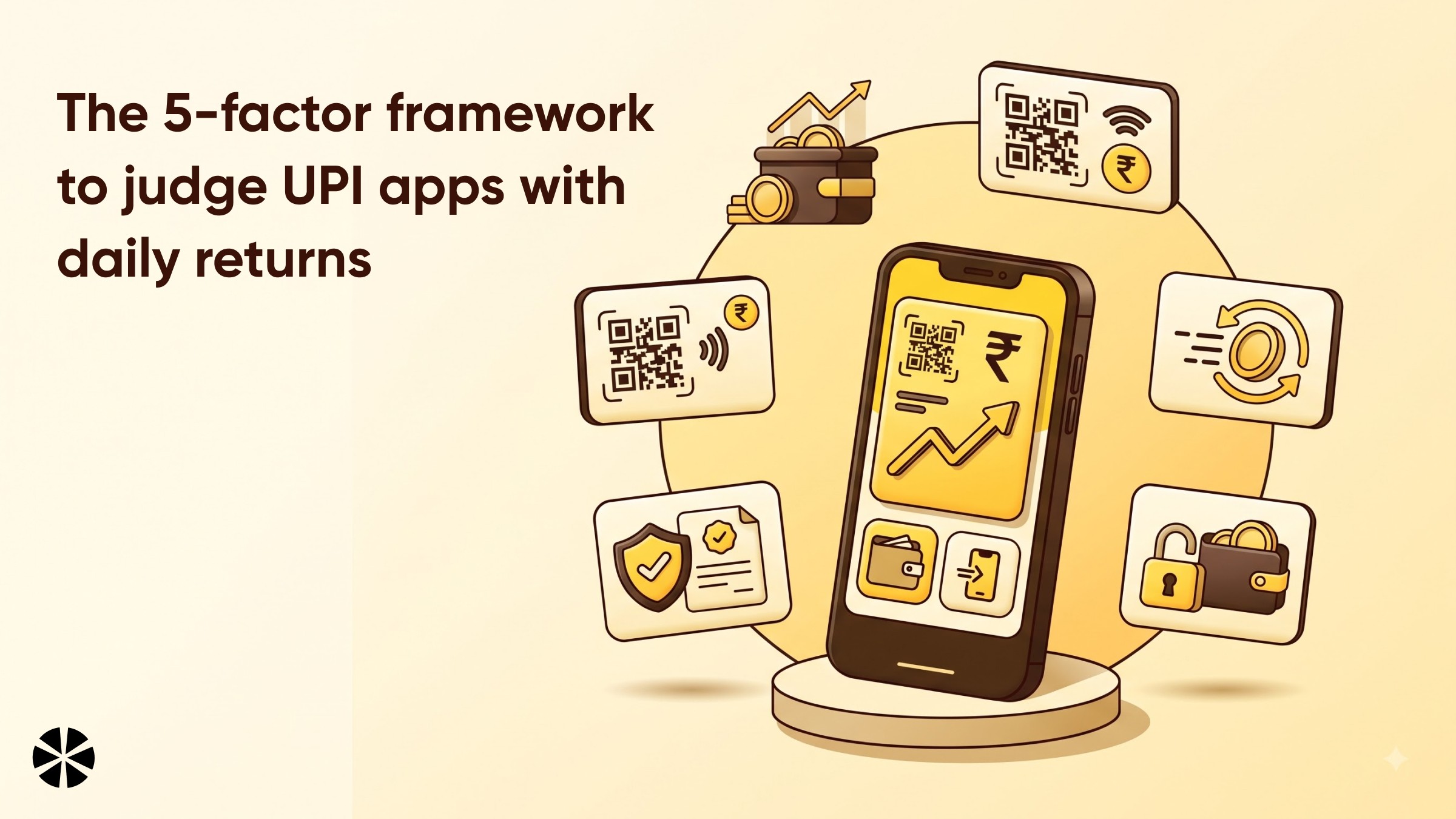
Instead of ranking by downloads or ad claims, use this framework.
1. Source of returns
This is the most important factor.
Ask: what product is generating the yield?
Savings account interest
Fixed deposit sweep
Liquid mutual fund
Overnight fund
Promotional cashback, not actual yield
If the answer is vague, that is a red flag.
For users comparing apps for idle cash with UPI, liquid-fund-based structures are often the most relevant because they are designed for short-term money parking, though they are not risk-free or guaranteed. SEBI’s mutual fund framework and AMFI’s category guidance make it clear that liquid funds belong to debt mutual funds and should be understood as investment products, not bank deposits. See SEBI and AMFI.
For a broader decision view, Multipl’s comparison of Liquid Fund vs Savings Account vs Fixed Deposit vs HYSA: Complete Comparison helps frame where each option fits.
2. Spending integration
A strong app for this use case should reduce friction between saving and spending.
There are two very different models:
Invest separately, redeem manually, then spend
Keep money in a spending-linked setup with a built-in path to earn more on idle cash
The first is common. The second is much harder to execute well.
That is why many apps sound like UPI apps with daily returns, but in reality they are just standard UPI apps with an investment side feature. If your money cannot flow back into your spending life smoothly, the user experience breaks down.
Multipl has written extensively about this “park-to-spend” problem in Where Should Salaried Indians Keep Money Between Payday and Bill Day? and Idle Cash Strategy: Savings Account or Liquid Fund?.
3. Liquidity and redemption speed
This is where glossy comparisons usually hide the caveats.
An app may promote returns, but can you get your money when you need it?
You should check:
Is redemption instant, same day, or T+1?
Are there any time cut-offs?
Are there instant redemption limits?
Can you spend directly, or must funds first return to bank balance?
For users who need high flexibility, this matters more than headline yield. A product with slightly lower returns but much better access can be the better daily-money solution.
To understand these trade-offs, see Instant Redemption Liquid Funds: Best Options and Limits in India and Liquid Fund Withdrawal: When Can You Get Your Money?.
4. Lock-in and usability for short-term cash
The phrase no lock-in gets used loosely.
Technically, many short-term parking products may not have a formal lock-in, but that does not mean friction-free access. Exit loads, processing windows, merchant flow limitations, or transfer dependencies can all reduce real usability.
If your goal is salary parking, bill management, travel saving, or near-term planned spending, then real-life usability matters more than theoretical access.
That is why short-duration decisions should be judged differently from long-term investments. If you are comparing where to keep money for 1 to 90 days, Short-Term Investment Options in India for 1 to 90 Days is highly relevant.
5. Regulatory structure and safety signals
No app should be evaluated only on interface quality.
You should understand whether the underlying money is held as:
bank deposits
mutual fund units
wallet balance
payment account functionality
partner-led investment structure
UPI itself runs on NPCI infrastructure and works through participating banks and UPI apps, but the return layer may involve a separate regulated product structure. See NPCI and NPCI onboarding guidance.
If the return source is a liquid fund, remember: it is an investment product, not a deposit guarantee. For a practical breakdown of risk, read Liquid Fund Safety: Can Liquid Funds Lose Money?.
Comparison: which type of “daily return” UPI app actually delivers?
Here is the simplest way to compare the market.
Category 1: Standard UPI apps with no real yield layer
These apps are excellent for payments, but not for returns.
They let you:
send and receive money
scan QR codes
manage multiple linked bank accounts
But if your money is sitting in a normal savings account, the app itself is not helping idle cash work harder.
Best for: pure payment convenience
Not ideal for: users specifically searching for UPI apps with daily returns
This sounds obvious, but it matters because search intent is often mismatched with product reality.
Category 2: UPI apps with savings or deposit-style earnings
Some products try to pair spending with a bank-led or treasury-style earning mechanism. These may be easier to understand than investments because users are familiar with deposit interest.
The upside:
simpler mental model
often easier onboarding
better comfort for conservative users
The downside:
lower flexibility in some structures
yields may not stay compelling after tax or after promotional periods
the spending-to-earn integration may still be limited
For readers exploring alternatives beyond a plain savings account, Best Savings Account Alternatives in India 2026: Higher-Yield Options That Actually Work is a useful next step.
Category 3: UPI-linked experiences with liquid fund integration
This is the most relevant category for people searching apps that earn returns on UPI balance.
Why? Because liquid funds are designed for short-term idle cash management, and they potentially offer better use of idle money than leaving everything in a low-yield account. But the app experience determines whether this is truly practical for real-world spending.
The upside:
better alignment for short-term cash parking
potentially more efficient use of idle funds
strong fit for salary buffers, planned expenses, and spend-near money
The downside:
returns are market-linked, not fixed
money may need redemption workflows
access and instant use depend on app design and redemption limits
If that is your use case, these pieces provide deeper context: Liquid Fund Apps in India: Compare Liquidity, Returns and Minimums, Cash Management Apps Compared: Which One Fits Your Money?, and Savings Account vs Liquid Funds vs HYSA in India 2026: A Side-by-Side Comparison for Working Professionals.
So which ones actually deliver?
If we use the five-factor framework honestly, the best UPI apps with daily returns are not necessarily the ones with the loudest “daily earning” promise. The strongest options typically share these traits:
a clearly disclosed return source
practical liquidity for short-term needs
minimal friction between parked cash and spendable cash
no misleading “guaranteed” framing for market products
a product design built for everyday money, not only side investments
That means the real winners are usually not generic UPI apps. They are platforms that solve the transition between idle cash, short-term investing, and spending.
This is exactly why the category needs more nuance.
A standard payments app can be brilliant at checkout and still be a poor solution for idle cash. Meanwhile, an investment-first app may offer a liquid fund but still fail as an everyday payments companion if redemption is clunky.
The sweet spot is a product built around parking-to-spend money.
Where Multipl fits in this conversation
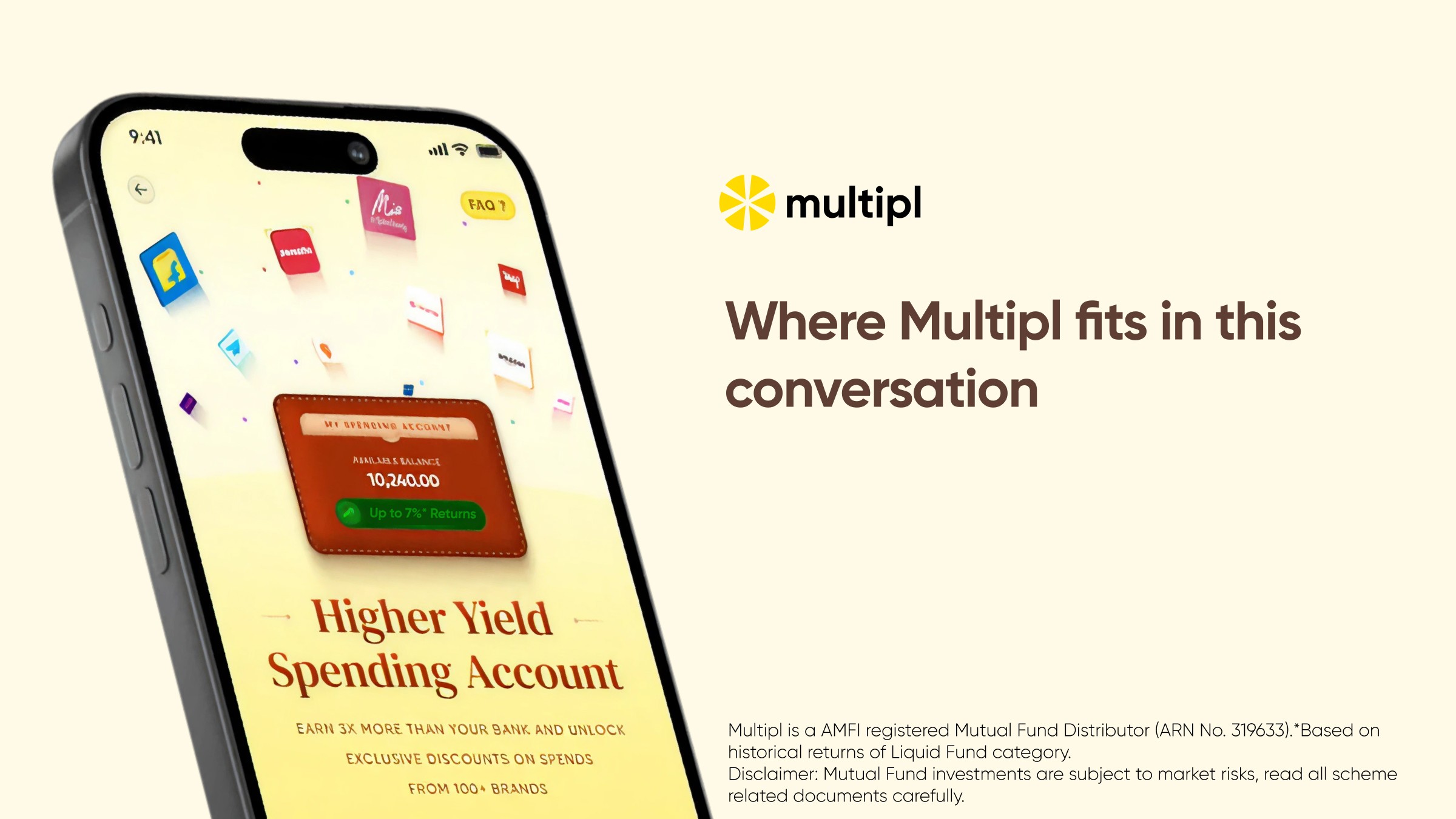
Multipl’s value proposition is different from a generic payments-first app. It focuses on helping users put short-term money to work while staying connected to real spending goals.
That matters because most people do not need a complicated investing stack for every rupee. They need a smarter home for money they plan to use in the near future: travel, festivals, shopping, planned purchases, and monthly cash buffers.
If that resonates, start with What Is a Higher-Yield Spending Account (HYSA) and How Does Multipl Work? A Complete 2026 Guide, then explore The Complete Guide to Managing Short-Term Money in India (2026) and Turn Your Future Expenses into Smart Investments.
The core idea is simple: money waiting to be spent should not always sit idle.
That does not mean every rupee belongs in a market-linked product. It means users deserve better tools to decide what stays liquid, what earns, and what remains ready for life.
How to choose the right app for your needs
Here is a practical shortcut.
Choose a standard UPI app if:
you only care about payment acceptance and speed
your balances are usually low and transient
you do not want an added money-management layer
Choose a bank- or deposit-linked earning model if:
you want simpler returns language
you prefer familiar structures over market-linked ones
you are willing to accept lower upside for simplicity
Choose a liquid-fund-linked model if:
you regularly keep spare cash between salary day and spending day
you want better use of idle balances
you understand that returns are not guaranteed
you care about liquidity, redemption speed, and integration
If you are unsure how much to park this way, Salary in Liquid Fund: How Much Should You Keep? and Salary in Liquid Fund? A 1-2 Month Cash Parking Framework give useful frameworks.
The most important takeaway
The phrase UPI apps with daily returns is catchy, but incomplete.
The real question is not whether an app offers UPI and mentions earnings. The real question is whether it helps your money do three things well at the same time:
stay accessible
earn meaningfully while idle
remain useful for actual spending
That is the difference between a feature and a financial workflow.
For many users, the best choice will not be the app with the highest advertised yield. It will be the one with the clearest product structure, the best liquidity fit, and the least friction between saving and spending.
If you want to go deeper into how idle cash quietly loses value and what better alternatives look like, read Why Most People Lose Money Without Realising It - The Hidden Cost of Idle Cash and How Much Money Are You Losing by Keeping ₹1 Lakh in a Savings Account?.
FAQs
What are UPI apps with daily returns?
These are apps that combine UPI payments with some form of earnings on idle money. The return usually does not come from UPI itself. It typically comes from the underlying product, such as a bank deposit structure or a liquid mutual fund.
Which are the best UPI apps with daily returns in India?
The best option depends on your goal. If you want pure payment convenience, a standard UPI app is enough. If you want earn while paying via UPI, look for apps with a clearly disclosed return source, strong liquidity, low friction, and practical spending integration.
Do UPI apps with liquid fund integration give guaranteed returns?
No. Liquid funds are mutual fund products, so returns are market-linked and not guaranteed. They are often used for short-term parking, but users should still understand the risk, access rules, and redemption process.
Can I use UPI directly from invested liquid fund money?
Usually, not in a fully direct sense. In many setups, money must first be redeemed back into a bank-linked balance before you spend it widely through UPI. The user experience depends heavily on the app’s redemption design and instant access limits.
Are apps that earn returns on UPI balance safe?
Safety depends on the underlying product and regulatory structure. You should check whether your money is in a bank account, mutual fund, or another structure, and understand what protections and risks apply before relying on it for daily cash needs.
Conclusion
Not every app promising “daily returns” is built for the way people actually use money.
Some are payment apps. Some are investment apps. A much smaller set is trying to bridge both worlds.
So if you are comparing UPI apps with daily returns, ignore the slogans and evaluate the mechanics: source of returns, liquidity, lock-in, safety structure, and everyday usability. That is how you find an option that actually delivers — not just in theory, but in your day-to-day financial life.
Multipl is a AMFI registered Mutual Fund Distributor (ARN No. 319633).
*Based on historical returns of Liquid Fund category.
Disclaimer: Mutual Fund investments are subject to market risks, read all scheme related documents carefully.