•
1 min read
Liquid Fund Withdrawal Speed Test 2026 | Multipl

Liquid Fund App Withdrawal-Speed Test: We Timed Instant Redemption on Multipl, Groww, and Zerodha Coin
If you are comparing liquid fund apps, one question matters more than most comparison tables admit: how fast can you actually get your money back when you tap withdraw?
That is the heart of this liquid fund instant withdrawal speed test.
For many users, liquid funds are not just for “parking cash.” They are a practical place for money you may need next week, this weekend, or even later the same day. That is why the app-level withdrawal experience matters. A liquid fund can be low-risk and relatively stable, but if redemption feels confusing or delayed right when you need the money, the experience falls apart.
In this hands-on comparison, we looked at the withdrawal experience across Multipl, Groww, and Zerodha Coin with one goal: understand which app feels closest to “instant,” which one works more like a standard mutual fund redemption flow, and what hidden factors can slow things down.
This is not a returns comparison. It is not a generic primer on debt funds either. It is a user-experience-first look at fastest liquid fund app withdrawal behaviour.
Before we begin, one reminder: liquid funds are low-risk, not risk-free. Returns are market-linked and not guaranteed. Mutual fund gains are taxable, and mutual fund investments are subject to market risks. Please read all scheme-related documents carefully.
What We Tested: Liquid Fund Instant Withdrawal Speed on Multipl, Groww, and Zerodha Coin
We focused on the part users care about most: the journey from tapping redeem to money reaching the bank account, or at least becoming clearly available through an instant-access flow.
The three platforms were chosen because they represent different use cases:
Multipl is built around spend-ready money and short-term parking through liquid funds, wrapped inside its Spendvesting experience.
Groww is a broad retail investing app where liquid funds sit inside a larger mutual fund marketplace.
Zerodha Coin is tied to a more investing-first setup, where withdrawal timing can depend more heavily on the underlying scheme and operational flow.
That makes this a useful liquid fund app comparison speed test rather than a like-for-like product shootout.
If you are still deciding whether liquid funds are even the right bucket for short-term money, Multipl’s explainer on liquid mutual fund meaning and short term money parking guide give the right background without making the category harder than it needs to be.
Our Test Method: Same Amount, Same Bank, Same-Day Redemption Window, Same Stopwatch Rules
To keep this instant redemption liquid fund test fair, we standardised the parts of the experience that usually create noise.
Test Setup
Same Amount: We used a small, practical withdrawal amount that would fit inside typical instant-access thresholds where such facilities were available.
Same Bank: We mapped payouts to the same bank account type to reduce variation from bank-side settlement.
Same-Day Redemption Window: Requests were initiated within the same broad working-day window, away from late cut-off hours.
Same Stopwatch Rules: Timing began the moment the withdrawal or redeem request was confirmed and ended when the app or bank showed the funds as credited or clearly available.
What We Did Not Standardise
Some factors cannot be fully equalised because they are built into the product:
Scheme Eligibility: Not every liquid fund supports instant-access features.
Platform Design: Some apps are built around spending and withdrawals; others are built around investing and portfolio management.
Operational Rails: Banking partners, payout systems, and AMC-side processing can all differ.
That last point matters. Even within the same liquid fund category, the experience can feel very different depending on app design. For broader context on where liquid funds sit versus savings and FDs, Multipl’s liquid fund vs savings account vs fixed deposit vs HYSA comparison is useful for framing the trade-off.
The Result Table: Which App Felt Instant, Which Felt Standard, and Where Delays Can Creep In
Here is the practical takeaway from our withdrawal-speed test.
App | Withdrawal Experience | How It Felt | Main Speed Constraint |
|---|---|---|---|
Multipl | Built around spend-ready liquid access | Closest to instant in user feel | Platform flow and bank rails still matter |
Groww | Depends on whether the selected liquid fund supports instant redemption or standard redemption | Mixed: can feel fast, can feel routine | Fund-level eligibility and standard mutual fund processing |
Zerodha Coin | More scheme- and process-dependent | Usually feels more standard than “tap-and-get” | Underlying redemption timeline and payout process |
In plain English:
Multipl felt most aligned with what users usually expect when they search how fast is liquid fund withdrawal.
Groww can be quick, but the experience is less predictable unless you know exactly which scheme supports instant redemption and under what limits.
Zerodha Coin felt more like a traditional investing workflow where liquidity exists, but not always in the “I need this for a spend right now” sense.
That does not automatically make one app universally “best.” The use case matters. A spend-first user and a portfolio-first investor often need different withdrawal behaviour.
Multipl Withdrawal Flow: How Fast the App Is Built for Spend-Ready Money
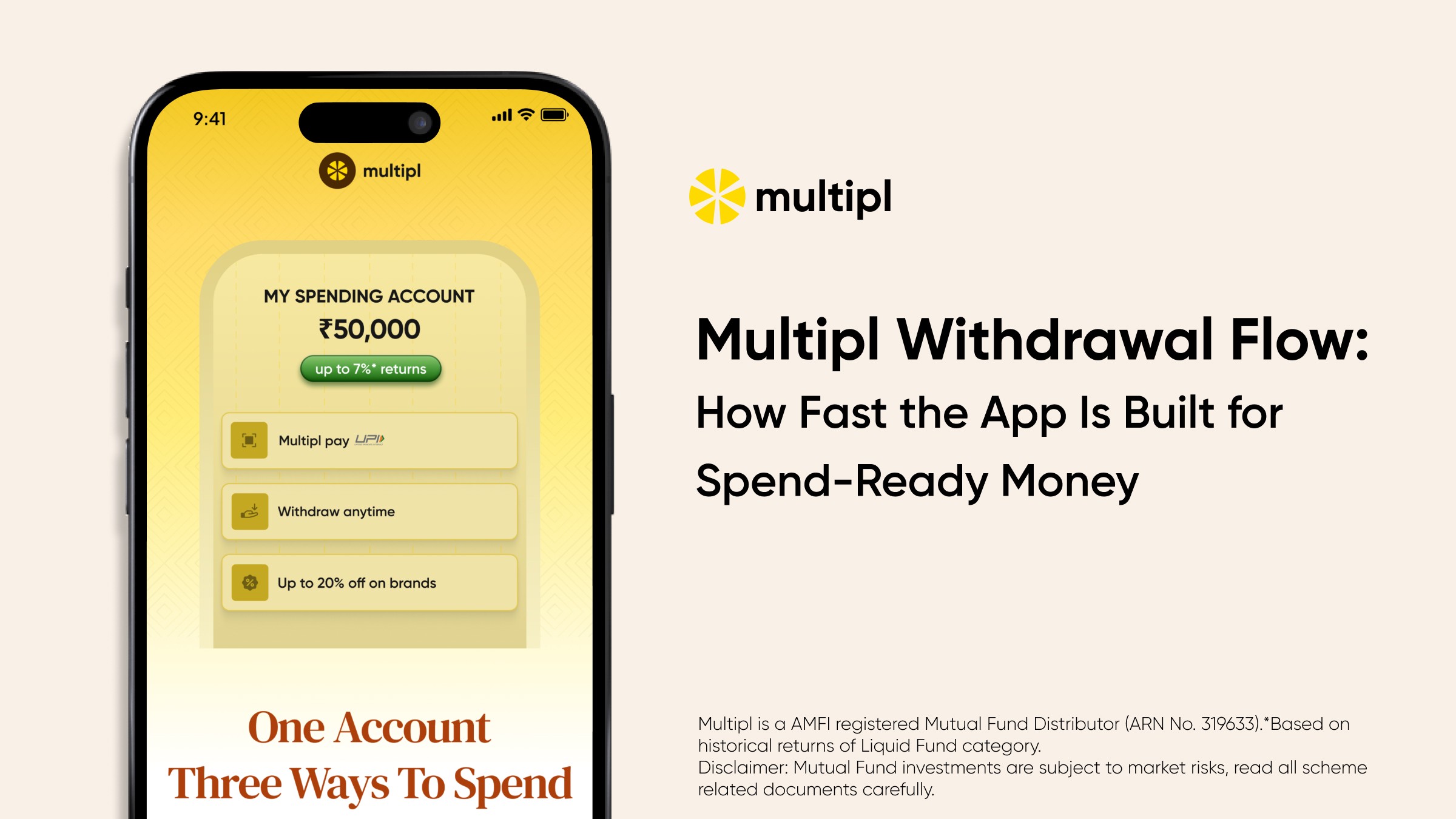
Multipl’s edge is not just the fund category. It is the product design around it.
The app’s core idea is simple: money set aside for future spends should not sit idle in a low-yield bank account if it could earn more in liquid funds until you need it. Multipl positions this as a Higher-Yield Spending Account, where idle money can earn up to 7%* based on historical liquid-fund returns, instead of the roughly 2% to 3.5% many savings accounts offer. Returns are market-linked and not guaranteed.
Think of money for a Swiggy-heavy month, an iPhone you plan to buy in a few months, school fees due next term, a wedding payment, or flight bookings you know are coming. That is the use case. Let the money earn until you spend it, while keeping it accessible.
That positioning shows up clearly in the withdrawal experience. The flow is made for users who think, “I want this money to stay accessible because I may spend it soon,” not “I am rebalancing my portfolio.” It sounds like a small difference. In practice, it changes the whole feel.
Why Multipl Felt Fast
The app is designed for spend-ready money, not just investment holdings.
The withdrawal journey is straightforward, with less friction between intent and action.
The mental model is simple: money parked for near-term use should remain easy to access.
This is the same logic behind Multipl’s instant redemption liquid funds guide, liquid fund withdrawal timelines explainer, and Higher-Yield Spending Account overview.
That does not mean every withdrawal is guaranteed to hit instantly in every case. Bank rails, cut-off timing, and amount limits still matter. No investment is zero-risk, and mutual funds are subject to market risk. Past performance is not indicative of future results. But among the three apps tested, Multipl felt most clearly built for users who care about immediate usability.
It also helps that Multipl frames liquid funds as part of a broader Spendvesting habit: save for real-life purchases, avoid unnecessary debt and EMI traps, and keep your money working until the day you spend it. You can see that more clearly across the Multipl platform and Spendvesting explainer.
Groww Withdrawal Flow: Where Fund-Level Instant Redemption and Standard Redemption Differ
Groww is a familiar app for many Indian investors, but its liquid fund withdrawal experience depends more heavily on the underlying fund setup.
Groww’s own help documentation says standard mutual fund redemptions generally reflect in the bank account within 3 to 4 working days. (Groww help documentation) That alone tells you something important: on Groww, “redeem” does not automatically mean “instant.”
There are two separate user realities here:
1. When A Liquid Fund Supports Instant Redemption
If the selected liquid fund and the operational setup support instant redemption, the experience can be relatively fast and convenient. This is where users sometimes feel Groww is quick.
2. When It Falls Back to Standard Redemption
If the fund does not support instant access, or if the amount or timing falls outside the eligible window, the flow behaves like a regular mutual fund redemption. That means the wait is not “seconds” or “minutes.” It is a standard settlement cycle. This is where user expectations often break.
So in a real-world liquid fund app comparison speed test, Groww sits in the middle:
Faster than many old-school manual investing workflows.
Less predictably instant than a spend-first product experience.
Highly dependent on scheme-level eligibility and user awareness.
This matters because many users do not read the fine print before investing. They pick a liquid fund assuming all liquid funds behave the same at withdrawal time. They do not.
For a broader decision framework for comparing these products, Multipl’s liquid fund apps in India comparison and best mutual fund apps for parking money are useful companion reads.
Zerodha Coin Withdrawal Flow: Why Scheme-Level Redemption Time Matters on Coin
Zerodha Coin is often used by more investing-oriented users, and that shows in how withdrawal expectations should be set.
The key distinction here is that Coin is not primarily marketed as a spend-ready liquid cash layer. It sits inside a broader investing setup. So redemption speed is often more about scheme processing timelines and operational handling than an “instant spending money” design.
Zerodha’s support documentation states that regular withdrawal requests are processed at cut-off times and, if placed before the cut-off, funds are typically credited to the bank account within 24 hours of the cut-off time. (Zerodha support documentation) Zerodha also separately offers an instant withdrawal feature for funds in the Zerodha account, with requests allowed once per day between 9:00 AM and 4:00 PM, including weekends. (Zerodha instant withdrawal feature)
That means two things:
Zerodha does have instant-style withdrawal functionality in its broader setup.
But a Coin user redeeming a liquid mutual fund still needs to pay attention to the actual fund and processing path rather than assuming a one-tap “instant redemption” experience.
In our practical comparison, Coin therefore felt more standard than Multipl and less straightforward than the best-case Groww scenario.
That is not a criticism. It is simply a use-case mismatch for people who care most about fastest liquid fund app withdrawal behaviour over broader investing functionality.
What Actually Affects Withdrawal Speed: SEBI Instant-Access Limits, Cut-Off Times, Weekends, and Bank Rails
This is the section most users skip, and then regret skipping.
Withdrawal speed in liquid funds is never only about the app. It is also shaped by regulation, scheme structure, timing, and payout infrastructure.
SEBI Instant-Access Limits
The mutual fund industry’s instant access facility for eligible liquid schemes has historically worked within caps such as ₹50,000 or 90% of the folio value, whichever is lower, subject to scheme and operational availability under SEBI’s framework. (SEBI framework)
So even if an app says “instant,” that usually applies only up to a certain limit and only for eligible liquid funds.
Cut-Off Times
The time of day matters. Requests placed before the operational cut-off can move faster than requests placed later. Zerodha explicitly notes cut-off-based processing for standard withdrawals. (Zerodha withdrawal timeline) The same general logic applies widely across mutual fund operations.
Weekends and Holidays
Some payout systems work across more days than traditional bank settlement cycles, but not every path is weekend-proof. A Friday evening redemption can feel very different from a Tuesday morning one, especially if it falls back to standard processing.
Bank Rails
Even when the app and fund are ready, the final bank credit depends on settlement rails. A delay is not always the app’s fault. Sometimes the money has technically been processed but has not yet reflected in the destination account.
For users comparing short-term cash options, this is exactly why speed should be judged alongside safety, access rules, and fallback timelines. Multipl’s liquid fund app safety checklist and liquid fund safety explainer are good places to sanity-check those factors.
Fastest Is Not the Whole Story: App Design, Amount Limits, and Emergency-Use Fit
An app can win a stopwatch test and still be the wrong choice for your use case.
Three practical filters matter more than raw speed alone:
App Design
If the app is built for spending, your withdrawal experience usually feels simpler. If the app is built for investing, it may offer more flexibility elsewhere but less immediacy when you need cash for an Uber ride, a Zepto order, a bill, or a planned purchase.
Amount Limits
Instant access is often capped. That means you may be able to withdraw a small emergency amount quickly, but not your entire parked balance in the same way.
Emergency-Use Fit
If this money is a true emergency buffer, ask not just, “How quick is it on a good day?” but also, “What happens on holidays, late evenings, or large redemptions?”
That is why liquid funds can be useful for near-term cash, but they are not identical to a savings account. The Reserve Bank of India’s Depositor Education and Awareness material explains bank-deposit basics, while the U.S. SEC’s money market fund investor bulletin is also a helpful reminder that “cash-like” products still have structure and rules around access. For Indian mutual fund investors, the most authoritative framework remains SEBI’s mutual fund master circular.
Who Should Use Which Type of Liquid Fund App Based on Withdrawal Behaviour
Different users should optimise for different things.
Choose Multipl If
You want spend-ready money, not just an investment holding.
You care about a simpler withdrawal experience for near-term cash.
You like the idea of making everyday or planned spending money work harder through liquid funds.
This is especially relevant if you are trying to replace idle savings habits with a more intentional system. Think salary credited, then bills due over the month, or money kept aside for an iPhone, school fees, flights, or a wedding expense. Multipl’s articles on idle money in a savings account, where salaried Indians can park money between payday and bill day, and HYSA apps in India all speak to that use case.
Choose Groww If
You already use Groww for investing and want convenience within one app.
You are willing to check fund-level instant-redemption eligibility carefully.
You are okay with some withdrawals feeling standard rather than truly immediate.
Choose Zerodha Coin If
You are more investing-first than spending-first.
You are comfortable with scheme-level timelines and operational details.
You value the wider Zerodha ecosystem more than instant-access feel.
In short, the best app for you depends on whether you think of this money as spending cash that should stay flexible or an investment allocation that happens to be low-risk and short-term.
Final Takeaway: How to Judge Liquid Fund Instant Withdrawal Speed Before You Invest
If you are evaluating liquid fund instant withdrawal speed, do not stop at the word “liquid.” That word tells you the category, not the real user experience.
Before investing, ask these five questions:
Does This Specific Fund Support Instant Redemption?
Not every liquid fund does, and not every app presents the distinction clearly.What Is The Instant-Access Limit?
Industry instant-access facilities commonly operate within capped limits for eligible liquid schemes. (SEBI framework)What Happens When I Exceed That Limit?
The answer is often standard mutual fund redemption timing, not instant payout.What Are The Cut-Off Times And Holiday Rules?
A fast Tuesday morning redemption and a Friday evening redemption can behave very differently.Is The App Built For Spending Or Investing?
That single distinction often predicts how the withdrawal experience will feel.
Our verdict from this test is simple: if your priority is fast, intuitive access to money you may spend soon, Multipl feels the most purpose-built. Groww can work well when the selected fund supports instant redemption, but the experience is more variable. Zerodha Coin is better understood as a broader investing route where liquidity exists, though not always in the most instant, user-friendly sense.
If you are a Spendvester planning real spends, this matters. The right home for short-term money is not just about returns. It is about access, low risk, no lock-in, and whether the app is actually built for money you will use.
And that is the real answer to how fast is liquid fund withdrawal: it depends less on the label and more on the platform, the scheme, the amount, and the timing.
If you want a deeper framework for choosing the right short-term cash app, Multipl’s cash management apps comparison, liquid funds FAQ, and complete guide to managing short-term money in India are strong next reads.
FAQs
How Fast Is Liquid Fund Withdrawal Usually?
Standard liquid fund redemptions often take anywhere from the next business day to a few working days, depending on the scheme, app, cut-off timing, and bank credit process. On Groww, standard mutual fund redemptions are typically shown as reaching the bank within 3 to 4 working days. (Groww help documentation)
Which Is The Fastest Liquid Fund App Withdrawal Option?
In this user-experience-led comparison, Multipl felt fastest and most intuitive for spend-ready money. But “fastest” depends on whether the app supports an instant-access path, whether the chosen liquid fund is eligible, and whether your amount falls within the instant limit.
Is Instant Redemption Available For All Liquid Funds?
No. Instant redemption is not universal across all liquid funds. It depends on scheme eligibility and operational support. Industry instant-access facilities for eligible liquid schemes generally work within capped limits. (SEBI framework)
Can I Use Liquid Funds Like A Savings Account?
Not exactly. Liquid funds are mutual funds, not bank deposits. They are low-risk, but not risk-free, and they are not insured like savings accounts. Some apps make them feel more spend-ready than others, especially for short-term parking. Multipl’s explainer on using liquid funds like a bank account goes deeper on this distinction.
Are Liquid Funds Safe For Emergency Money?
They can be useful for part of an emergency buffer, but users should understand withdrawal limits, standard redemption timelines, and market-linked risk before relying on them fully. Multipl’s article on emergency funds in liquid funds explores where they fit best.
Multipl is a AMFI registered Mutual Fund Distributor (ARN No. 319633).
*Based on historical returns of Liquid Fund category.
Disclaimer: Mutual Fund investments are subject to market risks, read all scheme related documents carefully.