•
1 min read
What ₹50,000 Idle Money Earns: Multipl vs Savings | Multipl

The ‘Spendable Yield’ Math: What Idle ₹50,000 Actually Earns in Multipl vs a Regular Savings Account Over 12 Months
If you keep ₹50,000 aside for spending over the next year, the real question is not just “where is it safest?” It is also: how much can this money earn before you actually use it?
That is where spendable yield calculation comes in.
In simple terms, spendable yield is the value your parked money adds while staying available for spending. Instead of sitting idle in a regular savings account earning around 2% to 3.5%, the same money in Multipl’s Higher-Yield Spending Account (HYSA) is invested in expert-selected liquid mutual funds and can earn up to 7%* based on historical liquid-fund returns, while remaining spend-ready. For a broader side-by-side view of this category, the comparison of savings accounts, liquid funds, and HYSA options is useful.
This article is a pure math-first explainer. It walks through the ₹50,000 example step by step, shows the formula, explains what changes if you spend some of the money mid-year, and clarifies what this comparison does and does not mean.
What ‘Spendable Yield Calculation’ Actually Means for Idle Money
Most people already do some version of this:
They keep money for food, bills, travel, shopping, or a planned purchase in a savings account.
They want instant access, so they do not move it into long-term investments.
They accept low returns because they treat spending money and earning money as separate buckets.
Spendable yield changes that framing.
Instead of asking, “How much return can I earn if I lock money away?”, ask, “How much can my near-term spending money earn while it waits?” That is the core of Spendvesting: making future spends work a little harder without turning them into long-term equity bets or debt-funded purchases.
A simple way to think about it:
Spendable Yield = Value earned on money you intended to spend anyway, during the time it stayed parked
That value can come from two layers:
Investment Growth: The return generated while the money is parked.
Spend Savings: Any brand discount available at redemption with eligible partner brands.
So the phrase is not just “yield.” It is spendable yield: value created before the money leaves your pocket.
The ₹50,000 Test: Multipl vs a Regular Savings Account Over 12 Months
Start with the simplest version.
Assume:
Principal: ₹50,000
Holding Period: 12 months
Regular Savings Account Rate: 3% annually
Multipl HYSA Illustrative Rate: Up to 7%* annually, based on historical liquid-fund returns
Scenario 1: Regular Savings Account at 3%
Using simple annual return math:
Gain = Principal × Rate × Time
So:
₹50,000 × 3% × 1 = ₹1,500
End Value = ₹51,500
Scenario 2: Multipl HYSA at Up to 7%*
Using the same structure:
₹50,000 × 7% × 1 = ₹3,500
End Value = ₹53,500
Difference After 12 Months
Savings Account Gain: ₹1,500
Multipl HYSA Illustrative Gain: ₹3,500
Extra Earned: ₹2,000
So if your ₹50,000 stayed parked for a full year, the spendable yield calculation suggests that Multipl could generate ₹2,000 more than a regular savings account in this illustration.
That is the core answer to “how much does idle money earn in Multipl” for this example: up to ₹3,500 before taxes and subject to market-linked variation, versus roughly ₹1,500 at a 3% savings rate.
If you want to compare broader short-term parking options before deciding, the guide to best savings account alternatives in India and the short-term money parking guide for working professionals give useful context.
Step-by-Step Formula: Principal, Annual Rate, Time, and Net Gain
Here is the easiest version of the formula.
1. Start With Your Principal
This is the amount of money sitting idle but still meant for spending.
Example:
Principal = ₹50,000
2. Use the Annual Return Rate
For a regular savings account, this may be around 2% to 3.5%.
For Multipl’s HYSA, the reference point is up to 7%* based on historical liquid-fund returns, not a fixed or guaranteed rate. Liquid funds are built for short-term money and generally invest in money-market and short-duration instruments. AMFI’s investor education material explains mutual funds and capital gains at a category level, while SEBI regulates mutual fund disclosures and investor protections. AMFI’s investor resources and the SEBI mutual fund framework are useful primary references.
3. Convert Time Into Years
If the money stays parked for 12 months:
Time = 1 year
If it stays parked for 6 months:
Time = 0.5 years
4. Calculate Gross Gain
Gross Gain = Principal × Annual Rate × Time
Example at 3%:
₹50,000 × 0.03 × 1 = ₹1,500
Example at 7%:
₹50,000 × 0.07 × 1 = ₹3,500
5. Calculate End Value
End Value = Principal + Gross Gain
At 3%:
₹50,000 + ₹1,500 = ₹51,500
At 7%:
₹50,000 + ₹3,500 = ₹53,500
6. Compare the Difference
Incremental Benefit = Multipl End Value − Savings Account End Value
₹53,500 − ₹51,500 = ₹2,000
That is your quick earn while you spend calculation.
If you want to test your own amount, horizon, or expected range, Multipl’s liquid fund calculator makes this much faster.
Why the Gap Exists: Liquid-Fund Historical Returns vs Typical Bank Savings Rates
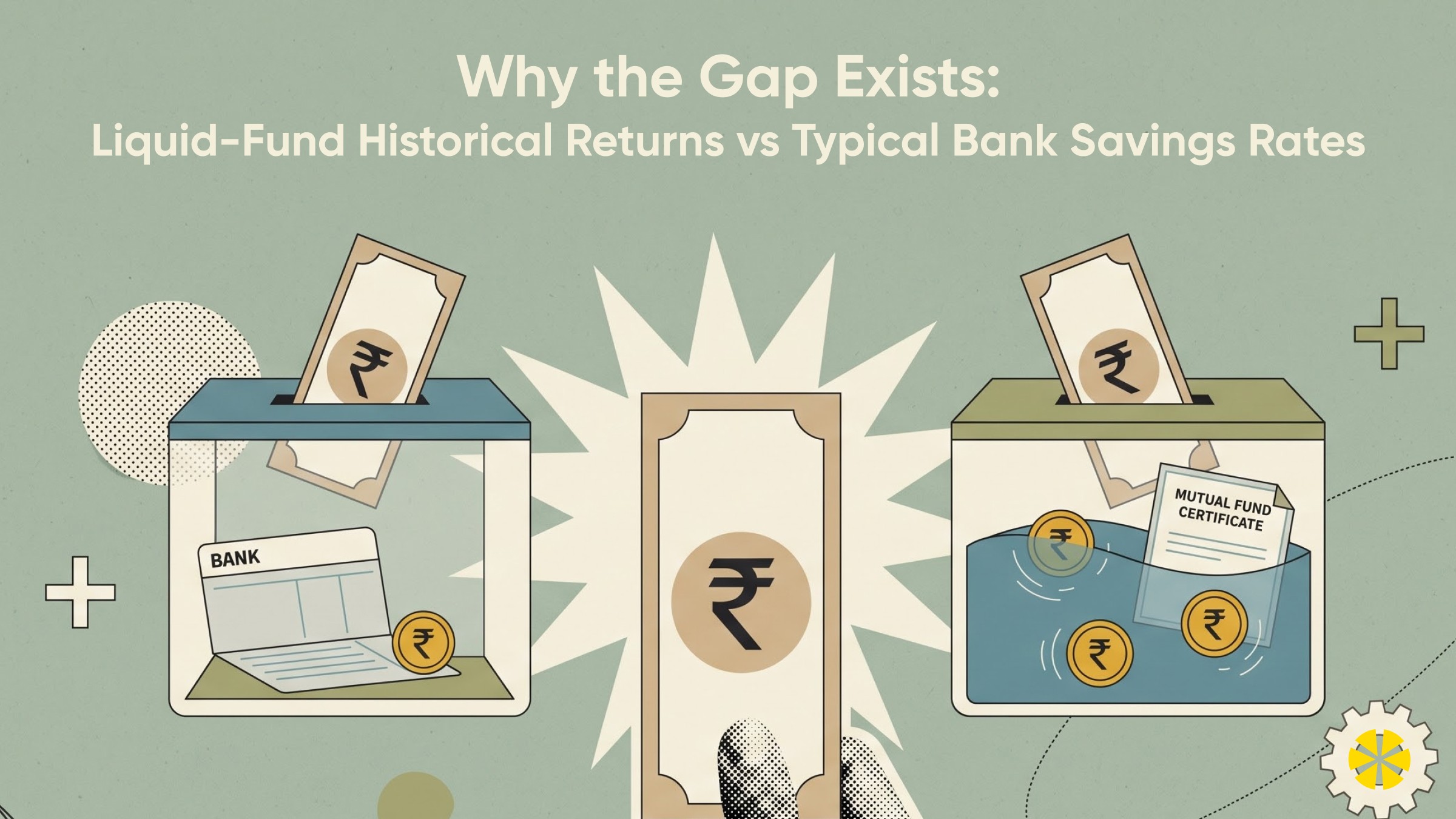
The gap exists because these two products are built differently.
A regular savings account is a bank deposit product built for convenience and daily access. It usually offers modest interest.
Multipl’s HYSA is not a bank savings account. It is a mutual-fund-powered spending account built on liquid mutual funds, which aim to offer liquidity with relatively low volatility for short-term money. That structure is why the return profile can be higher than a typical savings account. But returns are market-linked and not assured. For a category explain-it-like-I’m-busy version, the guide to what a Higher-Yield Spending Account is and the liquid mutual fund explainer help.
To make the comparison concrete, here is the same ₹50,000 over 12 months at different annual rates:
Option | Annual Rate | 12-Month Gain | End Value |
|---|---|---|---|
Savings Account | 2.5% | ₹1,250 | ₹51,250 |
Savings Account | 3.0% | ₹1,500 | ₹51,500 |
Savings Account | 3.5% | ₹1,750 | ₹51,750 |
Multipl HYSA | Up to 7%* | ₹3,500 | ₹53,500 |
Even if you compare Multipl’s illustrative historical yield against the higher end of many savings rates, the spread remains meaningful.
That is why searches like savings account vs Multipl returns calculator and hysa returns on 50000 matter in practice. On modest balances, the ₹500 to ₹2,250 difference may not feel life-changing in one year. On larger balances, regular monthly parking, or goal-based spending through the year, the cumulative effect is easier to notice. The deeper comparison of liquid funds, savings accounts, FDs, and HYSAs breaks down those tradeoffs further.
What Changes If You Spend Some of the Money During the Year
Real life is rarely “park ₹50,000 and touch nothing for 12 months.”
Usually, spending happens in chunks. Say:
₹50,000 is parked at the start
₹20,000 is spent after 6 months
₹30,000 stays parked for the full 12 months
Now the math becomes a weighted holding-period calculation.
Savings Account at 3%
For the ₹20,000 spent after 6 months:
₹20,000 × 3% × 0.5 = ₹300
For the ₹30,000 kept for 12 months:
₹30,000 × 3% × 1 = ₹900
Total Gain = ₹1,200
Multipl HYSA at Up to 7%*
For the ₹20,000 spent after 6 months:
₹20,000 × 7% × 0.5 = ₹700
For the ₹30,000 kept for 12 months:
₹30,000 × 7% × 1 = ₹2,100
Total Gain = ₹2,800
Difference
₹2,800 − ₹1,200 = ₹1,600
So even when part of the money gets spent halfway through the year, the value gap remains material.
This is the more realistic version of how much does idle money earn in Multipl: the answer depends not only on the amount and rate, but also on how long each rupee stays parked before you actually spend it.
That is why Multipl’s framing works well for routine spend pools too, not just one-time goals. If your money sits between payday and actual usage, even for a few weeks or months, the holding-period math still matters. The guide on where salaried Indians can keep money between payday and bill day and the framework for salary cash parking in liquid funds are useful if that is your use case.
Where Brand Discounts Can Increase the Effective Value of Your Parked Money
Now add the second layer: discounts.
Multipl says partner brands can offer roughly 2% to 20% discounts when eligible goals are redeemed. That does not mean cashback on every single transaction, and it should not be treated as guaranteed on all spends. But where applicable, discounts can increase the effective value of your parked money.
Here is a simple illustration.
Assume your ₹50,000 grows to ₹53,500 over 12 months in the up to 7%* scenario.
Now assume you redeem against a brand where your goal qualifies for a 5% discount.
A 5% brand discount on a ₹50,000 purchase is:
₹2,500 in spend savings
So your total effective value can look like this:
Investment Growth: ₹3,500
Illustrative Brand Discount: ₹2,500
Total Effective Benefit: ₹6,000
That does not mean a 12% guaranteed return. It means your money may create value through both growth and redemption savings, depending on the brand, goal, and offer terms.
This is where Multipl starts to feel different from a plain parking product. It is not only about earning on idle cash. It is also about reducing the cost of planned spends. If that angle interests you, the travel savings explainer and the HYSA spending strategy guide show how the model works in real spending categories.
What This Comparison Does Not Mean: HYSA Is Not a Bank Savings Account
This is the most important clarification in the article.
Multipl’s HYSA is not a bank savings account, and this is not a like-for-like bank deposit claim.
It is a spending account experience powered by liquid mutual funds. That means:
Your money is invested in mutual funds, not held as a bank deposit.
Returns are market-linked and can vary.
The up to 7% figure is historical, not guaranteed.*
It is not deposit insurance in the way a bank account is structured.
Mutual fund units are held in the investor’s name at the AMC.
That distinction matters because a better expected return only makes sense if you are comfortable with the product structure. If you want a deeper reality check, the article on whether liquid funds can function like a bank account and the complete guide to managing short-term money in India explain the boundary clearly.
Risks, Liquidity, Taxation, and Return Variability You Should Factor In

Before you do any spendable yield calculation, make room for four practical variables.
1. Risk Is Low, Not Zero
Liquid funds are generally considered low-risk relative to longer-duration or equity funds, but they are not risk-free. NAV movement can happen, and no investment outcome is assured. For perspective on downside behaviour, the 15-year NAV data check on whether liquid funds can lose money and the liquid fund risk explainer are worth reading.
2. Liquidity Matters More Than Headline Return
If you may need the money quickly, withdrawal timelines matter. Multipl positions HYSA as spend-ready, but liquid-fund redemption mechanics still matter operationally. The liquid fund withdrawal timeline explainer and the guide to instant redemption limits in India can help you set realistic expectations.
3. Taxation Can Affect Net Outcome
Mutual fund gains are taxable, and tax treatment can change based on prevailing rules and investor circumstances. AMFI’s tax regime for mutual funds is a better reference point than casual internet summaries. This article is not tax advice. If your parking amount is large or frequent, get guidance specific to your situation.
4. Return Variability Is Real
The phrase up to 7%* is based on historical liquid-fund returns, not an annual promise. In some periods returns may be lower, and in others they may be closer to that historical range. SEBI-regulated mutual funds are required to use standard risk disclosures, and the familiar warning that mutual fund investments are subject to market risks remains essential, as reflected in SEBI’s advertising requirements for mutual funds.
Who Should Use This Framework: Monthly Spenders, Goal Savers, and Debt-Avoiders
This framework is most useful for three groups.
Monthly Spenders
If you routinely keep ₹20,000 to ₹1 lakh aside for food, bills, shopping, local travel, or app spends, then earn while you spend calculation is worth doing. Even a few months of parking can change the outcome versus leaving everything idle.
Think of your usual Swiggy, Zepto, Uber, and bill money sitting for a few weeks before you spend it. That parked money can still earn.
Goal Savers
If you are setting aside money for a vacation, gadget, festival shopping, school fees, or a near-term life event, the math gets clearer because the amount and date are known in advance. It could be a flight, an iPhone, a wedding expense, or school fees due in a few months. The guide to liquid funds for short-term goals and the list of short-term investment options for 3 to 12 months are useful next reads.
Debt-Avoiders
If your usual pattern is “buy now, convert to EMI later,” this framework helps flip the sequence. Park money first, let it earn, then spend from accumulated funds instead of borrowing.
That is really the larger Multipl idea: a friendlier, practical bridge between “doing nothing with cash” and “becoming a serious investor overnight.” You can explore that product framing on the Multipl homepage or the get started page.
Quick Takeaway: How to Calculate Your Own Spendable Yield in 2 Minutes
Here is the simplest version you can reuse anytime.
Step 1: Write Down Your Idle Spend Amount
Example: ₹50,000
Step 2: Estimate How Long It Will Stay Parked
Example: 12 months, or 1 year
Step 3: Compare Two Rates
Example:
Savings account: 3%
Multipl HYSA: Up to 7%* historical liquid-fund range
Step 4: Use This Formula
Gain = Principal × Rate × Time
Step 5: If You Will Spend in Parts, Break It Into Chunks
Example:
₹20,000 for 6 months
₹30,000 for 12 months
Then calculate each chunk separately and add them.
Step 6: Add Any Eligible Brand Discount Separately
That is not the same thing as investment return, but it still increases the effective value of your parked money.
Step 7: Adjust for Real-World Factors
Returns may vary
Taxes may apply
Liquidity timelines matter
Liquid funds are low-risk, not risk-free
If you want a one-line summary, here it is:
For a full-year ₹50,000 example, a 3% savings account earns about ₹1,500, while Multipl at up to 7% historical liquid-fund returns illustrates about ₹3,500, creating a potential ₹2,000 gap before taxes and subject to market-linked variation.*
That is the essence of spendable yield calculation.
FAQs
Is spendable yield the same as interest?
No. In a savings account, the gain is interest. In Multipl’s HYSA, the gain comes from market-linked returns generated by liquid mutual funds, so it is not fixed bank interest. That is why the return can be higher historically, but also why it is not guaranteed.
How much does idle money earn in Multipl on ₹50,000?
Using a simple 12-month illustration, ₹50,000 at up to 7%* historical liquid-fund returns works out to ₹3,500 in gross gain. A regular savings account at 3% works out to ₹1,500. Actual returns can be lower or higher depending on market conditions.
Is this a guaranteed HYSA returns on 50000 calculation?
No. The Multipl side of the comparison is an illustration based on historical liquid-fund returns. It is not an assured or fixed return. Mutual fund investments are subject to market risks, and you should read all scheme-related documents carefully.
What if I spend the money before 12 months?
Then calculate the return only for the time that portion stayed parked. For example, ₹20,000 parked for 6 months at 7%* would illustrate ₹700, not a full-year ₹1,400.
Are brand discounts part of the return?
Not exactly. They are separate spend savings that can improve the effective value you get from parked money when eligible offers apply. Think of them as an additional benefit layer, not as guaranteed investment return.
Is Multipl safer than a savings account?
That is not the right comparison. A savings account is a bank deposit product. Multipl HYSA is a mutual-fund-powered spending account using liquid funds. Liquid funds are low-risk and liquid, but they are not risk-free or identical to bank deposits.
Multipl is a AMFI registered Mutual Fund Distributor (ARN No. 319633).
*Based on historical returns of Liquid Fund category.
Disclaimer: Mutual Fund investments are subject to market risks, read all scheme related documents carefully.