•
1 min read
RBI Approved Savings Alternatives: What Is Actually Regulated?
When people search for RBI approved savings alternatives, they are usually asking a deeper question:
“If I move money out of my savings account, who is watching over that new product—and how safe is it really?”
That is a smart question. It is also where most online comparisons get sloppy.
Many articles throw around words like approved, regulated, safe, and low risk as if they all mean the same thing. They do not. A bank savings account, a fixed deposit, a liquid mutual fund, a wallet, and a government security can all be “regulated,” but they are not regulated by the same authority, and they do not offer the same protections.
This guide explains the difference clearly. By the end, you’ll understand:
what counts as an RBI regulated alternative to a savings account
what falls under SEBI vs RBI regulated investments
which safe regulated options better than savings account may suit short-term money
how to verify whether an app is making misleading claims
how to think about safety beyond just the word “regulated”
If your goal is to earn a little more on idle money without taking reckless risk, clarity matters more than marketing.
TL;DR
“RBI approved” is not a product category. RBI supervises banks, deposits, payment instruments and the Retail Direct platform. SEBI supervises mutual funds, including liquid funds.
Bank savings accounts and FDs come with DICGC deposit insurance up to ₹5 lakh per depositor per bank, covering principal plus interest.
Liquid funds have no deposit insurance and their NAV can move, even if the movement is usually small. Regulated does not mean guaranteed.
Wallets and PPIs sit under RBI’s payment rules. Those rules cover KYC, issuance and operations, not returns or deposit protection.
Government securities through RBI Retail Direct carry sovereign backing on repayment, though prices can move if you sell before maturity.
Before comparing returns, settle three things: what the product legally is, who regulates it, and what protection actually applies.
Why the phrase “RBI approved savings alternatives” is often misleading
The first thing to understand is this: RBI does not “approve” every money product people compare with a savings account.
The Reserve Bank of India regulates banks, payment systems, and certain deposit-taking/payment activities. It also operates platforms such as RBI Retail Direct for government securities. But many common “better than savings account” options in India—especially mutual funds—are regulated by the Securities and Exchange Board of India (SEBI), not RBI. (rbi.org.in)
So when someone asks for RBI approved investment options in India, they may actually mean one of three things:
Banking products regulated by RBI
Investment products regulated elsewhere, but legally offered through registered entities
Low-risk options with strong oversight and transparent rules
Those are not the same thing.
That distinction matters because regulation answers different questions:
Who supervises the institution?
Who writes the conduct rules?
Is your money a deposit, a security, or a payment balance?
What protections exist if something goes wrong?
Can value fluctuate, or is principal contractually fixed?
Before choosing any alternative, separate regulation, risk, and protection mechanism.
How to evaluate a savings alternative: product, platform, and underlying risk
A simple way to evaluate any savings alternative is to break it into three layers.
1. Product regulation
This asks: what kind of financial product is this?
A savings account is a bank deposit.
A fixed deposit is also a bank deposit.
A liquid fund is a mutual fund investment.
A wallet/PPI is a prepaid payment instrument.
A Treasury Bill is a government security.
Each sits in a different legal and regulatory bucket.
2. Platform regulation
This asks: who is offering access?
An app may let you park money in liquid funds, but that does not mean the app itself is an RBI-regulated bank. It may instead work through SEBI-regulated mutual fund infrastructure, payment partners, or broker/distributor arrangements. For example, if you are comparing tools for idle cash management, it helps to understand whether the platform is offering a deposit product, an investment interface, or a spending-linked experience like a Higher-Yield Spending Account guide.
3. Underlying instrument risk
This asks: what is your money actually invested in?
Even within regulated products, risk differs:
Bank deposits generally do not mark to market for retail users.
Liquid funds hold short-term debt instruments and can fluctuate, even if usually modestly.
Government securities carry sovereign backing on repayment, but market prices can move if sold before maturity.
This is why regulated low risk savings alternatives should never be judged by regulation alone.
What is truly RBI-regulated?
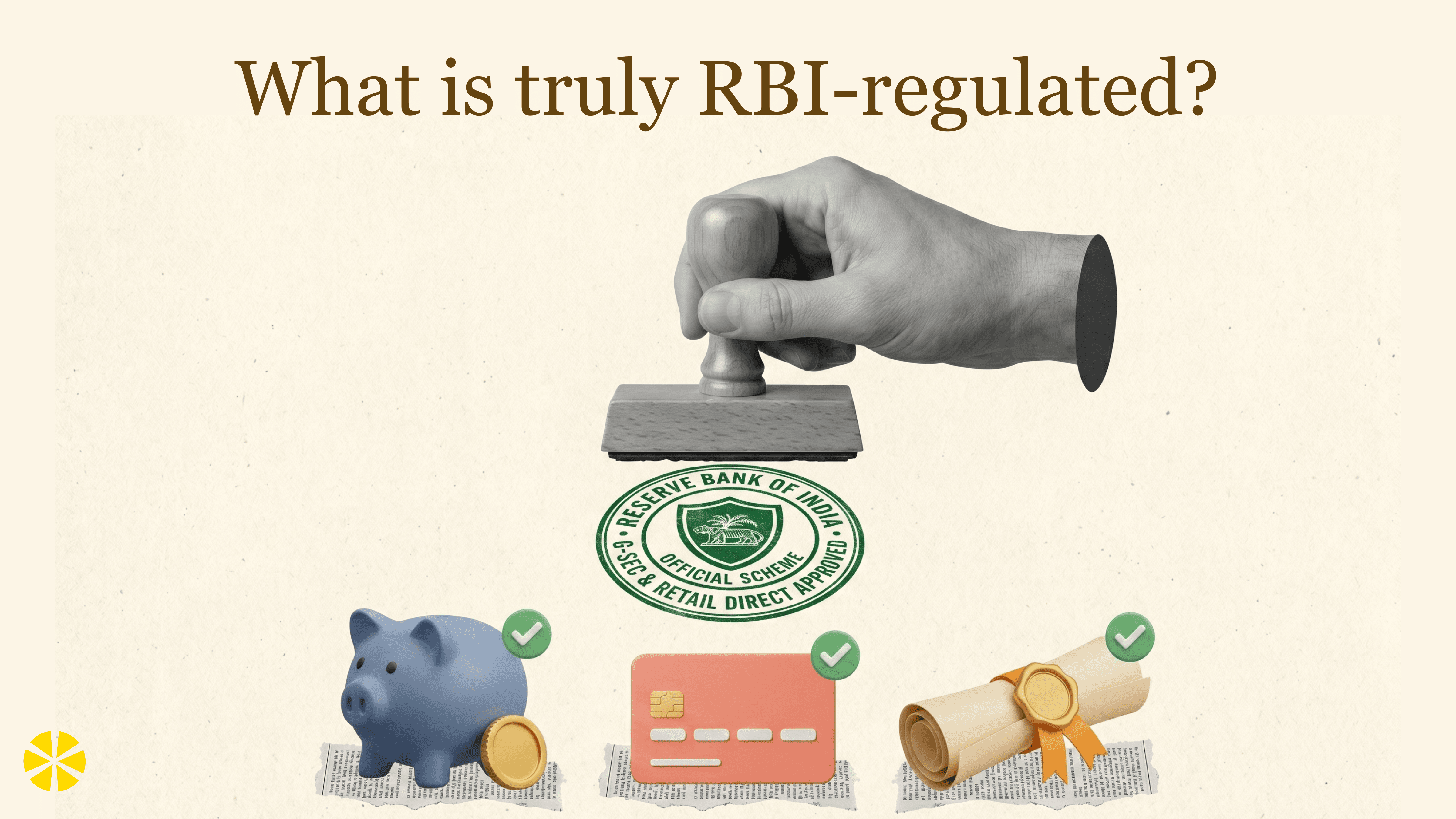
Let’s start with the products people usually assume by default are “RBI approved.”
1. Savings accounts and fixed deposits
This is the cleanest category. Banks are regulated by RBI, and eligible bank deposits are covered by deposit insurance through DICGC up to ₹5 lakh per depositor per bank, including principal and interest, subject to the applicable rules. (dicgc.org.in)
That means if you are choosing between a savings account and a fixed deposit from a bank, you are still within the RBI-banking universe.
What protection exists?
Prudential regulation of banks by RBI
Deposit insurance through DICGC up to the current insured limit (dicgc.org.in)
What are the trade-offs?
Savings accounts usually offer convenience but relatively low returns
FDs may offer better rates, but lock in your money for a period and can involve penalties on early withdrawal
For a broader comparison of idle cash options, Multipl has useful explainers on Savings Account vs Liquid Fund vs HYSA in India 2026: A Side-by-Side Comparison for Working Professionals and Liquid Fund vs Savings Account vs Fixed Deposit vs HYSA: Complete Comparison.
2. Prepaid wallets and PPIs
Prepaid Payment Instruments (PPIs)—such as certain wallets and stored-value payment instruments—are governed by RBI’s Master Directions on PPIs, issued under the Payment and Settlement Systems Act. (rbi.org.in)
That means a wallet can be RBI regulated as a payment instrument, but that does not make it a savings account substitute in the same legal sense as a bank deposit.
Important distinction:
PPI regulation is mainly about payments, KYC, issuer rules, and operations—not about giving you a high-yield savings return or deposit insurance like a bank account. (rbi.org.in)
So if an app implies “RBI regulation” as a shortcut for “your idle cash is fully protected like a bank deposit,” pause and verify what the product actually is.
3. Government securities via RBI Retail Direct
Retail investors in India can access Government securities through RBI Retail Direct, which RBI describes as a one-stop solution for investment in government securities by individual investors. The platform includes instruments such as Treasury Bills and dated G-Secs. (rbiretaildirect.org.in)
This is one of the strongest examples of a genuinely RBI-facilitated regulated route for conservative investors.
Why it matters:
It is directly tied to government securities infrastructure
It is appropriate for investors who specifically want sovereign instruments
It is not the same as a bank deposit, and liquidity/price behavior may differ depending on instrument and holding period
For very short-term cash, however, many working professionals still prefer easier-access options before moving to direct securities.
What is SEBI-regulated, not RBI-regulated?
This is where much of the confusion around rbi regulated alternatives to savings account begins.
Liquid funds and other mutual funds
Liquid funds are mutual funds, and mutual funds in India are regulated by SEBI, not RBI. SEBI sets regulatory frameworks for mutual funds, including risk controls and investor protections, while AMFI provides investor education and industry support. (sebi.gov.in)
So if someone says, “This app gives you an RBI-approved liquid fund,” that wording is usually inaccurate.
The more accurate statement would be:
the mutual fund industry is SEBI-regulated
the fund house operates under the mutual fund regulatory framework
the app may act as a distributor, partner, or interface
the underlying portfolio can still carry market-linked risk
Liquid funds are often discussed as a potentially smarter place for idle cash than a low-yield savings account because they invest in short-duration debt instruments. But they are still investments, not insured bank deposits. If you want a deeper foundation, see Liquid Mutual Fund Meaning: How It Works in India, What Are Liquid Funds? A Complete Guide for 2026, and Liquid Fund Safety: Can Liquid Funds Lose Money?.
That last question is especially important.
Because yes—regulated does not mean guaranteed.
SEBI vs RBI regulated investments: what changes for you?
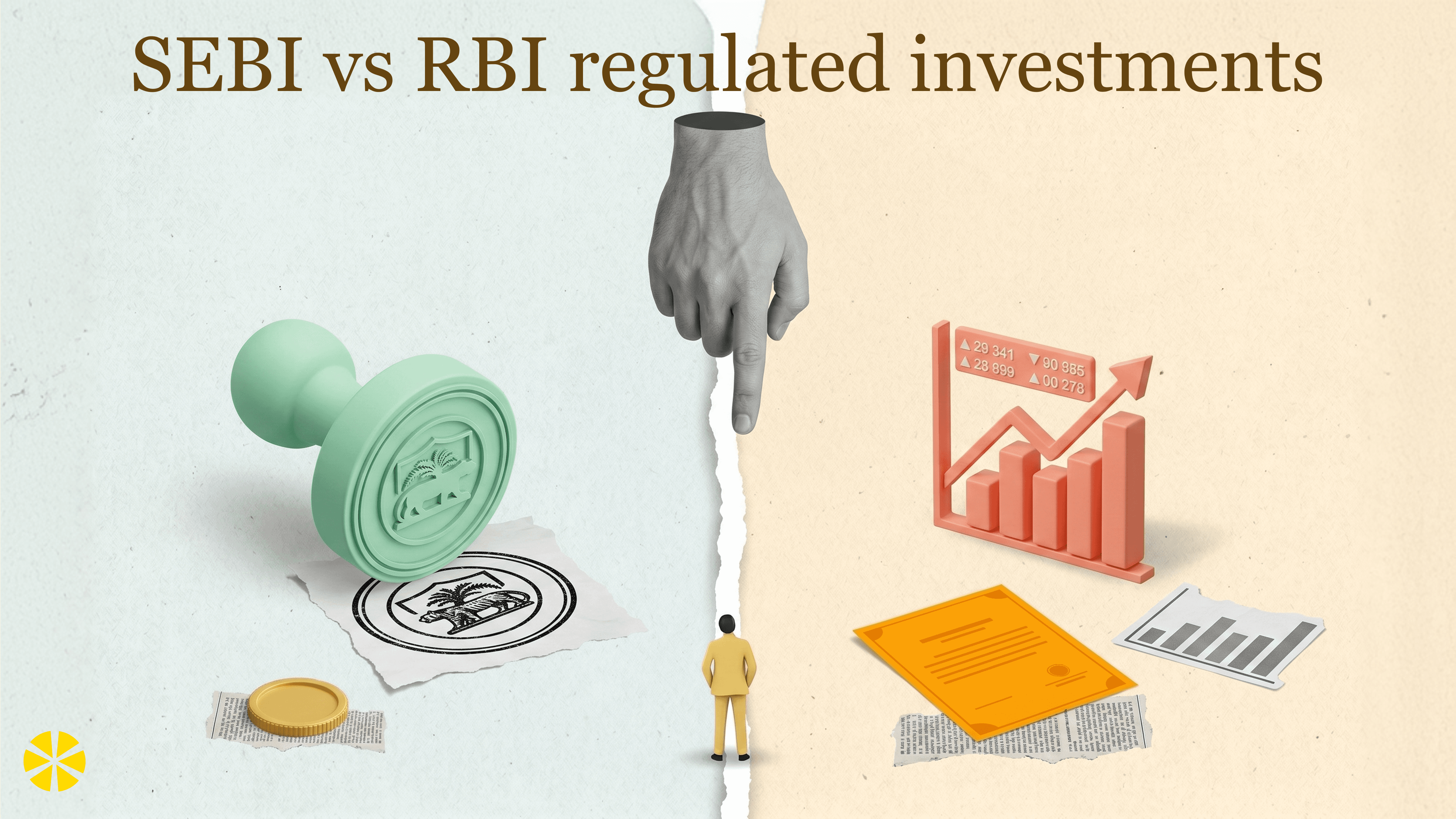
Here is the simplest practical distinction.
If it is RBI/bank regulated:
You are usually dealing with a deposit or payment system product.
Examples:
savings account
fixed deposit
recurring deposit
certain PPIs/wallets
government securities access through RBI channels
If it is SEBI regulated:
You are usually dealing with a market-linked investment product.
Examples:
liquid mutual funds
overnight funds
debt mutual funds
equity mutual funds
Why users care about this difference
Because the risks and protections are different:
Question | RBI-regulated bank deposit | SEBI-regulated mutual fund |
|---|---|---|
Is principal fixed by contract? | Usually yes, subject to bank terms | No, NAV can change |
Deposit insurance? | Yes, up to DICGC rules and limits | No deposit insurance |
Market risk? | Minimal for depositor experience | Yes, even if low in some categories |
Liquidity | Often immediate/defined by product | Depends on scheme and cut-off/redemption rules |
Return type | Interest | Market-linked accrual/NAV-based |
This is why articles that simply promise safe regulated options better than savings account without naming the regulator are not helping the reader.
So what are the safest regulated options better than a savings account?
There is no universal winner. The right answer depends on what “safe” means to you.
If “safe” means capital familiarity + insurance + simplicity
A bank savings account or fixed deposit stays the most straightforward answer. It is boring, but clear.
If “safe” means low risk but potentially better idle-cash efficiency
A liquid fund may be considered by some investors for short-term parking—but only if they understand that it is a SEBI-regulated investment product, not an RBI-insured deposit. This is the logic behind comparisons like Idle Cash Strategy: Savings Account or Liquid Fund?, Where Should Salaried Indians Keep Money Between Payday and Bill Day? 5 Smarter Parking Spots, and Short-Term Investment Options in India for 1 to 90 Days.
If “safe” means sovereign backing
Government securities through RBI Retail Direct may fit—but they require a different level of product understanding and may not feel as frictionless as daily cash parking. (rbiretaildirect.org.in)
The key is to match the product to the job:
daily transactions → savings account
known lock-in cash → FD
short-term idle money with some market-linked tolerance → liquid fund
direct sovereign investing → RBI Retail Direct/T-Bills
How to verify whether an app is really regulated
If you are evaluating an app claiming to be one of the best rbi approved savings alternatives, use this checklist.
1. Ask: what is the actual product?
Is it:
a bank account?
a fixed deposit?
a mutual fund?
a wallet?
a government security?
a hybrid experience layered on top of one of these?
Never stop at the app name.
2. Ask: who is the regulator for that product?
Bank deposits and PPIs: generally RBI domain
Mutual funds: SEBI framework
Mutual fund ecosystem support and education: AMFI
Government securities via Retail Direct: RBI-facilitated access (rbi.org.in)
3. Ask: is there deposit insurance?
If yes, is it a bank deposit eligible under DICGC rules? DICGC’s official guide states deposit insurance is available up to ₹5 lakh per depositor per bank under the current framework. (dicgc.org.in)
4. Ask: can returns fluctuate?
If the answer is yes, you are likely in investment territory, not pure deposit territory.
5. Ask: what happens on withdrawal?
Redemption timeline is a major part of safety perception. For liquid funds, understanding exit timing matters as much as understanding returns. See Liquid Fund Withdrawal: When Can You Get Your Money? and Instant Redemption Liquid Funds: Best Options and Limits in India.
6. Ask: is the claim “RBI approved” being used vaguely?
That is a red flag. Good financial products explain:
regulator
structure
risk
liquidity
limits
taxation
complaint path
Not just “trusted” or “approved.”
A smarter way to think about regulated low risk savings alternatives
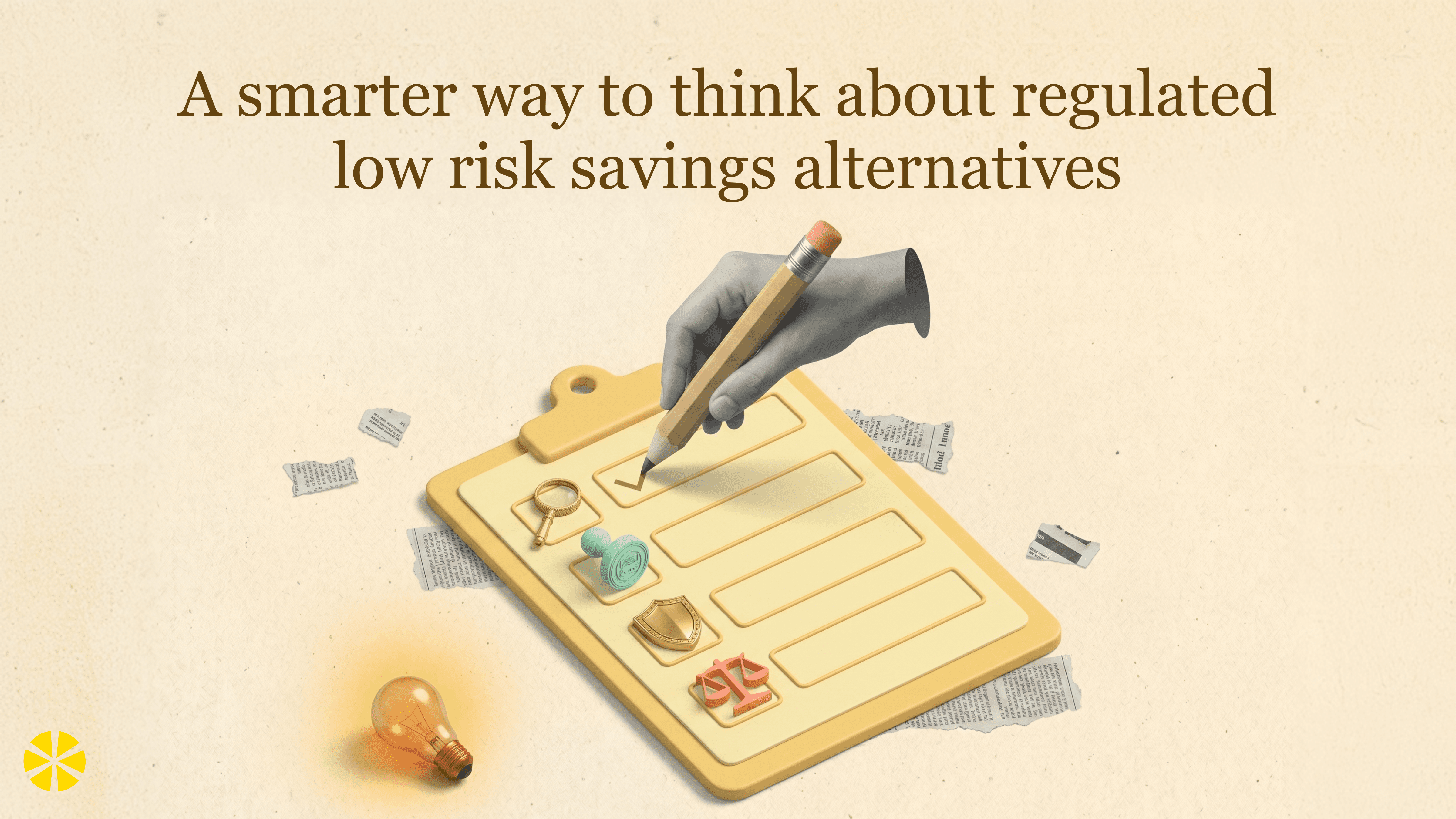
Instead of asking only, “Is it RBI approved?”, ask these four questions:
Is the product type clear?
Who regulates the product itself?
What exact protection exists—insurance, segregation, disclosure, or sovereign backing?
What is the trade-off for getting a better return than a savings account?
That approach leads to better decisions than headline chasing.
For example, if your concern is simply that your salary sits idle for days or weeks before you spend it, you may not need a long-term investment at all. You may just need a better short-term money system. That is the broader idea behind resources like The Complete Guide to Managing Short-Term Money in India (2026): Savings Accounts, Liquid Mutual Funds, and Higher-Yield Spending Accounts and What Is a Higher-Yield Spending Account (HYSA) and How Does Multipl Work? A Complete 2026 Guide.
The bottom line
The phrase RBI approved savings alternatives sounds reassuring, but it often hides the real question.
The real question is:
What exactly is this product, who regulates it, and what protections apply to my money?
Here is the clean summary:
Savings accounts and bank FDs are in the RBI-banking world, with DICGC insurance up to the applicable limit. (dicgc.org.in)
PPIs/wallets may be RBI-regulated as payment instruments, but they are not the same as insured savings products. (rbi.org.in)
Liquid funds are not RBI products; they are SEBI-regulated mutual funds with low-risk positioning but market-linked behavior. (sebi.gov.in)
Government securities via RBI Retail Direct are a legitimate RBI-facilitated route for sovereign instruments, but they serve a different purpose than everyday cash parking. (rbiretaildirect.org.in)
So if you are comparing rbi regulated alternatives to savings account, do not settle for a vague trust badge. Look for product clarity, regulatory clarity, and protection clarity.
That is how you choose an option that is not just regulated—but actually right for your money.
FAQs
What are RBI approved savings alternatives?
Usually, people mean alternatives to a bank savings account that are legally regulated and relatively low risk. Strictly speaking, bank deposits, fixed deposits, PPIs, and RBI Retail Direct-linked government securities sit closer to the RBI universe, while mutual funds are regulated by SEBI, not RBI. (rbi.org.in)
Are liquid funds RBI approved?
No. Liquid funds are mutual funds, and mutual funds in India are regulated by SEBI. They may be offered through apps that feel bank-like, but the underlying product is not an RBI-insured bank deposit. (sebi.gov.in)
What is the difference between SEBI vs RBI regulated investments?
RBI generally oversees banks, deposits, payment systems, and certain monetary/financial system functions. SEBI regulates securities markets and products like mutual funds. In practical terms, a savings account and a liquid fund may both be regulated, but under different systems with different investor protections. (rbi.org.in)
Is DICGC insurance ₹5 lakh per account or per bank?
Per bank, not per account. DICGC cover applies to a depositor’s eligible deposits held in the same right and capacity across all branches of one bank, added together, up to ₹5 lakh including principal and interest. Holding four accounts at one bank does not multiply the cover. Splitting money across separate banks is what increases total insured exposure. (dicgc.org.in)
Are there safe regulated options better than savings account?
Possibly, depending on your goal. For insured simplicity, bank deposits remain strongest. For short-term idle cash, some investors consider liquid funds or other short-term instruments—but those come with different risks and no deposit insurance. You can compare broader options in Short-Term Investment Options in India: 8 Safe Places for Idle Money and Best Savings Account Alternatives in India 2026: Higher-Yield Options That Actually Work.
How do I verify if an app claiming RBI approval is genuine?
Check the product type, the actual regulated entity, whether insurance applies, and what happens during withdrawal. If the app only says “approved” but does not clearly explain regulator, structure, and risk, treat that as a warning sign.
Multipl is a AMFI registered Mutual Fund Distributor (ARN No. 319633).
*Based on historical returns of Liquid Fund category.
Disclaimer: Mutual Fund investments are subject to market risks, read all scheme related documents carefully.