•
1 min read
Short-Term Investment Options in India: 8 Safe Places for Idle Money

TL;DR
The best short-term investment is not the one with the highest return — it’s the one that matches when you need your money and how quickly you need access.
Need money anytime → Savings / Higher-Yield Spending setups
Need it within days → Liquid funds
Can lock for months → FDs, T-bills
Check the after-tax number: FD interest and debt fund gains are both taxed at your slab rate
The Mistake Most People Make
When people look for short-term investment options in India, they start with:
“Which option gives the highest return?”
That’s the wrong question.
Short-term money is not about maximizing returns.
It’s about not losing flexibility while earning something better than idle cash.
Here’s the better way to think about it:
- Start with time horizon + access needs
- Then choose the product
Step 1: Decide Based on When You Need the Money

Category 1: Need Money Anytime (0–7 days)
This is your active money:
Monthly expenses
Bills
Emergency buffer
Money between salary and spending
Best Options:
Savings Account
Higher-Yield Spending setups (built on liquid funds)
Category 2: Need Money Within Days (7–30 days)
This is waiting money:
Upcoming travel
Insurance premiums
Rent reserves
Best Options:
Liquid Mutual Funds
Overnight Funds
Category 3: Can Lock for 3–12 Months
This is predictable money:
Known future expenses
Short-term savings goals
Best Options:
Fixed Deposits (FDs)
Treasury Bills (T-Bills)
Ultra Short Duration Funds
The 8 Best Short-Term Investment Options in India

Let’s break them down properly.
1. Savings Account
Best for: Daily use, instant access
Liquidity: Instant
Returns: ~2.5–4%
Risk: Very low
Tax: Fully taxable
Reality: Safe, but inefficient for idle money.
2. Higher-Yield Spending Account
Best for: Everyday money that is waiting to be spent
Liquidity: Instant / near-instant
Returns: Linked to liquid funds (~6–7% historically)
Risk: Low (market-linked)
Tax: As per debt funds
What it solves:
Keeps spending money productive without changing behaviour.
3. Liquid Mutual Funds
Best for: Short-term parking (days to months)
Liquidity: T+1 (often faster depending on platform)
Returns: ~6–7% historically
Risk: Low
Instruments: Treasury bills, CPs, CDs
Key advantage:
Better efficiency than savings accounts without locking money.
4. Overnight Funds
Best for: Ultra-short holding periods (1–3 days)
Liquidity: T+1
Returns: Slightly lower than liquid funds
Risk: Very low
Used for extremely short parking durations.
5. Fixed Deposits (FDs)
Best for: Known timelines with no need for liquidity
Liquidity: Locked (penalty on early withdrawal)
Returns: ~5–7%
Risk: Low
Tax: Fully taxable
Downside:
Penalty kills flexibility.
6. Sweep-in Fixed Deposits
Best for: Bank users wanting auto-optimization
Liquidity: Linked to savings account
Returns: FD-like
Risk: Low
Reality:
Convenient, but still bank-centric and less flexible than funds.
7. Treasury Bills (T-Bills)
Best for: Low-risk investors comfortable with direct instruments
Liquidity: Medium
Returns: Market-driven
Risk: Sovereign-backed
Used more by experienced investors.
8. Ultra Short Duration Funds
Best for: Slightly longer short-term horizons (3–6 months)
Liquidity: High
Returns: Slightly higher than liquid funds
Risk: Moderate (vs liquid funds)
Slightly more volatility than liquid funds.
Quick Comparison Table
Option | Liquidity | Risk | Returns | Best Use Case |
Savings Account | Instant | Very Low | 2.5–4% | Daily transactions |
Higher-Yield Spending | Instant | Low | ~6–7%* | Spending money |
Liquid Funds | T+1 | Low | ~6–7%* | Short-term parking |
Overnight Funds | T+1 | Very Low | Lower | Ultra-short parking |
FD | Locked | Low | 5–7% | Fixed timelines |
Sweep FD | Medium | Low | 5–7% | Passive users |
T-Bills | Medium | Very Low | Market-linked | Advanced users |
Ultra Short Funds | High | Moderate | Slightly higher | 3–6 month horizon |
*Based on historical performance, not guaranteed.
How Short-Term Investments Are Taxed
Returns look different once tax is applied, and short-term money is where the gap shows up most.
Debt and liquid mutual funds: units bought on or after 1 April 2023 are taxed at your income slab rate whenever you redeem, with no indexation and no holding-period benefit.
Fixed deposits: interest is added to your income and taxed at slab rate every year, even if the FD has not matured. Banks deduct TDS once interest crosses ₹50,000 in a year for most depositors.
Savings account interest: taxed at slab rate, though the old tax regime still allows a deduction of up to ₹10,000 under Section 80TTA.
T-Bills: the discount you earn is treated as income and taxed at slab rate.
Since almost everything in this list ends up at your slab rate, the real tiebreakers are access, exit penalties, and whether the money keeps earning while it waits.
Liquid Funds vs FD vs Savings: What Actually Matters
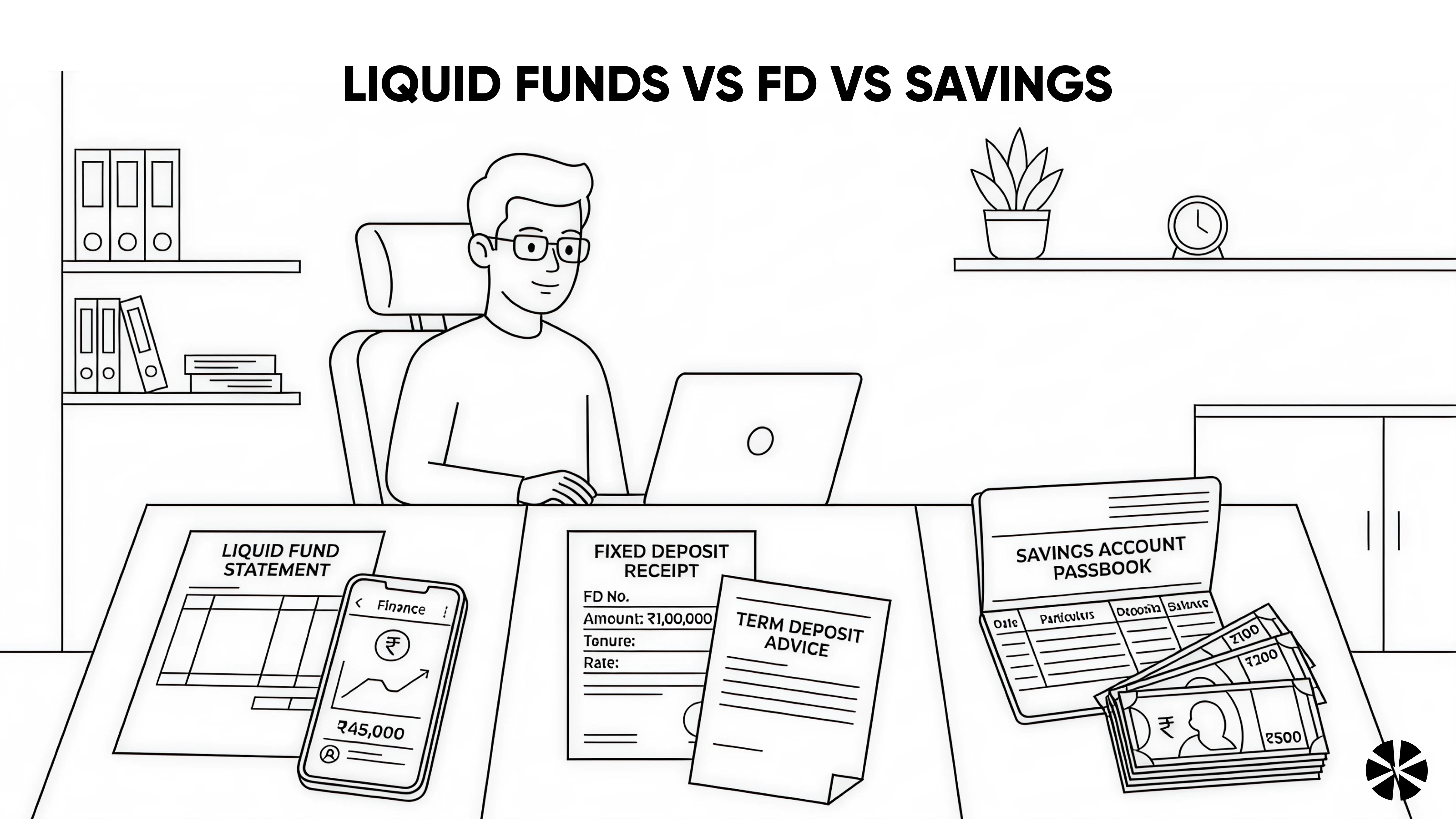
Most comparisons focus on returns.
But in real life, these factors matter more:
Can you access money when needed?
Will you pay a penalty to exit?
Does it match your timeline?
What happens after tax?
That’s why liquid funds sit in a unique position:
They are:
More flexible than FDs
More efficient than savings accounts
Where Most People Go Wrong
❌ Keeping everything in savings accounts
Mixes spending, emergency, and investment money.
❌ Using FDs for short-term money
Locks money unnecessarily.
❌ Ignoring idle cash
Money sits for weeks/months doing nothing.
A Simpler Way to Decide
Use this:
Need money today? → Savings / Spending account
Need money soon? → Liquid funds
Can lock it? → FD or T-Bills
That’s it.
What Has Changed in Short-Term Investing in India

Earlier, you had only:
Savings accounts
Fixed deposits
Now you have:
Liquid funds
Higher-yield spending setups
Which means:
Your money doesn’t have to sit idle anymore.
It can stay accessible and productive.
FAQs
Which short-term investment gives the highest return in India?
Over 3 to 12 months, ultra short duration funds and FDs usually sit at the top of the range, but the gap over liquid funds is small. For money you might need next week, that extra fraction of a percent is rarely worth the lock-in.
Are liquid funds safe for short-term money?
They carry low risk, not zero risk. Liquid funds hold debt instruments maturing within 91 days, which keeps price swings small, though returns are never guaranteed.
How quickly can I withdraw from a liquid fund?
Normal redemptions settle on T+1. SEBI also allows instant redemption of up to ₹50,000 or 90% of your folio value per day per scheme, whichever is lower, so a small withdrawal can hit your bank account in minutes.
Is an FD better than a liquid fund for 6 months?
If you are certain about the date and will not touch the money, an FD works and the rate is fixed upfront. If there is any chance you need it earlier, the premature withdrawal penalty usually wipes out the advantage.
Where should I keep my emergency fund?
Split it. Keep one month of expenses in a savings account for instant access, and park the rest in a liquid fund so it earns more while staying reachable within a day.
Final Thought
Most people focus on how to invest.
Very few think about where their money sits before it gets invested or spent.
But that’s where a surprising amount of money leaks happen.
If your money is waiting, it should be working.
Multipl is a AMFI registered Mutual Fund Distributor (ARN No. 319633). *Based on historical returns of Liquid Fund category.
Disclaimer: Mutual Fund investments are subject to market risks, read all scheme related documents carefully.