•
1 min read
Inside a Liquid Fund: What Your Money Is Invested In

What Sits Inside a Liquid Fund? Treasury Bills, Commercial Paper, and Why Your Spending Money Can Still Stay Liquid
You got paid. Rent is due in a few days. SIPs go out next week. Your Swiggy, Uber, shopping, and UPI spends will happen all month. Maybe a flight gets booked in between.
So where should that monthly expense money sit until you actually spend it?
For most people, it lands in a savings account and just waits there. That feels safe, familiar, and convenient. But it also means a chunk of your short-term money may spend days or weeks earning very little. In India, savings accounts often pay around 2% to 3.5%, which is why many working professionals now look for savings account alternatives with higher yield potential when they want access plus a better return potential.
That is where liquid funds come in.
If you have ever wondered what does a liquid fund invest in, the short answer is: very short-term debt and money-market instruments such as Treasury Bills, Commercial Paper, Certificates of Deposit, and other high-quality instruments with very short maturities. Under SEBI’s scheme classification, liquid funds invest in debt and money market securities with maturity of up to 91 days, which makes them structurally different from longer-duration debt funds. (SEBI master circular)
That one detail matters more than it looks.
When the underlying instruments mature quickly, a fund is generally better suited for money you may need soon. Not guaranteed. Not risk-free. But built for short-term liquidity with relatively low volatility.
That is exactly why liquid funds often come up in conversations about salary parking, bill money, near-term goals, and idle cash management. If you are exploring options for keeping money between payday and bill day, understanding what sits inside the fund is the practical place to start.
Why idle cash feels safe but often earns very little
Idle cash solves one problem beautifully: accessibility.
You can see it. You can transfer it. You can spend it instantly. There is emotional comfort in knowing your spending money is not “invested somewhere far away.”
But idle cash also has a hidden cost: low yield. If money meant for monthly expenses, upcoming travel, shopping, annual insurance premiums, or near-term purchases sits unused in a low-interest account, it may remain liquid while doing very little for you. That trade-off sits at the centre of the short-term money question, and it is one reason more people are reading about the hidden cost of idle cash and keeping idle money in a savings account.
The point is not that savings accounts are bad. They are useful. They are essential for payments and banking access. The point is narrower: not every rupee that sits briefly before being spent needs to stay in the lowest-yield bucket available.
If your money is waiting anyway, the real question is simple: can it stay accessible while aiming to earn more?
What does a liquid fund invest in, and why that makes it different from a savings account
Here is the direct answer.
What does a liquid fund invest in?
A liquid fund typically invests in short-term money-market and debt instruments that mature in up to 91 days. These commonly include:
Treasury Bills issued by the Government of India
Commercial Paper issued by eligible corporates
Certificates of Deposit issued by banks
Other short-term money-market or debt instruments permitted by regulations
SEBI’s classification framework states that liquid funds invest in debt and money market securities with maturity up to 91 days. AMFI also classifies liquid schemes under the liquidity-oriented end of mutual fund offerings. (SEBI master circular)
That makes a liquid fund very different from a savings account.
A savings account is a bank deposit relationship. A liquid fund is a mutual fund product that holds a portfolio of short-term instruments. It is market-linked, so returns are not fixed or guaranteed. It is also not a bank deposit and does not come with bank-deposit insurance. Because the portfolio is built from short-duration instruments, it is generally designed to reduce interest-rate sensitivity and support quicker access than longer-term debt funds. (SEBI master circular)
So when people say liquid funds are meant for short-term money, they are being precise. They are describing how the portfolio is built.
The 3 jobs a good parking place must do: preserve access, aim for better yield, and keep volatility low

When you are deciding where to keep spending money, three jobs matter.
1. Preserve access
This money is not retirement money. You may need it this week. Or next Tuesday. Or at the end of the month. So the first job is simple: do not trap it.
2. Aim for better yield
If the money is sitting for days or weeks, it should at least have a chance to do more than a typical low-yield savings account. That does not mean chasing high returns. It means not leaving short-term cash underused.
3. Keep volatility low
This is not the bucket for equity-like swings. If your bill money can drop sharply right before rent day, it is in the wrong place.
That is why liquid funds attract attention. They try to balance all three: access, low volatility, and return potential higher than idle bank cash. Returns vary with market conditions and are never assured.
A side-by-side comparison of liquid funds, savings accounts, fixed deposits, and HYSAs can help frame these trade-offs clearly.
How Treasury Bills, Commercial Paper, and Certificates of Deposit work together for short-term cash management
To understand liquid fund instruments in India, it helps to think of the portfolio as a short-term cash toolkit, not one single bet.
Treasury Bills
Treasury Bills, or T-bills, are short-term debt instruments issued by the Government of India. RBI notes that T-bills are money market instruments issued in tenors such as 91-day, 182-day, and 364-day, and they are zero-coupon securities. Because they are government-issued and short-dated, they are widely used for liquidity management. (RBI FAQ on T-bills)
In a liquid fund, T-bills can add a high-quality sovereign component to the portfolio.
Commercial Paper
Commercial Paper, or CP, is a short-term money market instrument used by eligible corporates to raise funds. RBI’s directions group Commercial Paper among core money market instruments with original or initial maturity up to one year. (RBI Master Directions)
In a liquid fund, CP can help improve yield relative to purely sovereign holdings, though it also brings issuer credit considerations. That is why portfolio quality matters.
Certificates of Deposit
Certificates of Deposit, or CDs, are short-term instruments issued by banks, also covered under RBI’s money market framework. (RBI Master Directions)
In a liquid fund, CDs can sit between safety, liquidity, and yield considerations, depending on the issuing bank and market conditions.
Why the mix matters
A well-built liquid fund portfolio does not rely on one instrument alone. It typically combines sovereign paper, bank paper, and corporate paper in a way that aims to manage liquidity needs, maturity profile, and credit quality.
That is the practical meaning behind the phrase treasury bills commercial paper liquid fund: these instruments work together to keep the portfolio short-duration and relatively stable, while still trying to generate a market-linked return.
Why liquid funds are used for money you may need in days or weeks, not years
Liquid funds are built for short horizons. That is not just a marketing line. It follows from the assets inside them.
When a fund holds instruments that mature quickly, it is generally better positioned for cash management than for long-term wealth creation. Over longer periods, other categories may be a better fit depending on your goal, time horizon, and risk appetite.
So liquid funds are usually discussed for:
salary parking
monthly expense buffers
emergency-access buckets
upcoming travel money
shopping or gadget funds
near-term goal planning
They are usually not the first choice for:
retirement
buying a house five years away
inflation-beating wealth creation over long periods
high-growth objectives
That is why the salary parking framework and guide to short-term money parking are useful. They help match the product to the job.
When a liquid fund is a better fit than a savings account, FD, or current account buffer
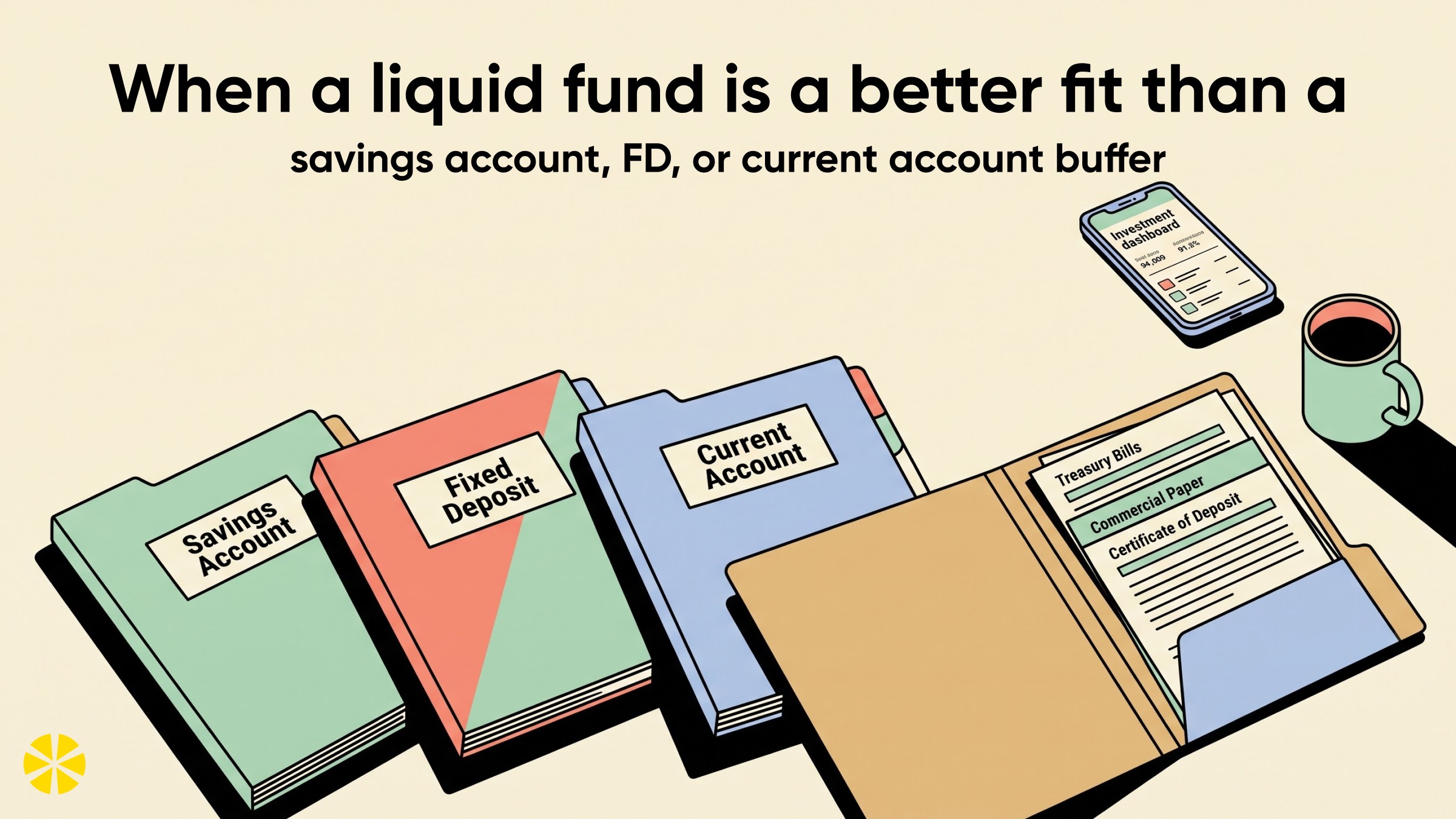
A liquid fund may be a better fit when:
You need access, but not necessarily second-by-second access to every rupee
If your money may be needed soon, but not every bit of it must remain in your transaction account at all times, a liquid fund can work as a parking layer.
You want your short-term money to aim for more than standard savings-account rates
Multipl often frames this as a smarter home for spend-ready money. Historically, liquid funds have sometimes delivered returns that are meaningfully higher than the 2% to 3.5% many savings accounts pay, though that gap can narrow or widen with market conditions. Multipl’s HYSA positioning uses an up to 7%* figure based on historical liquid-fund returns, not a guarantee.
You are comparing against an FD but dislike lock-ins or premature withdrawal friction
FDs can work for defined periods, but if spend timing is uncertain, flexibility matters.
You keep extra money in a current or savings account “just in case”
A liquid fund can work as a smarter buffer for money that is near-term but not instantly required in full.
For a more nuanced comparison, the savings account vs liquid fund vs HYSA comparison and the cash sweep vs liquid fund comparison are both useful frameworks.
When a liquid fund is not the right home for your money
A liquid fund is not right for every rupee.
Not ideal for money you may need instantly for all emergencies
You should still keep some money in a bank account for true same-minute access.
Not ideal if you cannot tolerate even small market-linked fluctuation
Liquid funds are low-risk, not zero-risk. NAVs can move. Credit events, though uncommon, are possible. Multipl’s own 15-year NAV data on whether liquid funds can lose money exists because this is a real question, not a theoretical one.
Not ideal for long-term growth goals
For long-term goals, short-term parking instruments can be too conservative.
Not ideal if you want fixed, guaranteed returns
Liquid fund returns change with market yields and portfolio conditions. If you specifically want a known payout, this may not match your expectation.
How to think about liquidity in practice: redemption timelines, emergency access, and spend planning
“Liquid” does not mean “works exactly like your savings account.” It means relatively easy access, usually faster than many longer-term products, but with practical timelines and processes you should understand.
In mutual funds, redemption proceeds usually follow the scheme’s process and cut-off timings. Some funds and platforms may also offer instant redemption features subject to limits and conditions, but that is not universal. If access timing is central to your use case, it is worth reading a practical explainer on liquid fund withdrawal timelines and instant redemption liquid funds in India.
A simple rule of thumb works well:
Keep immediate emergency cash in the bank
Keep near-term but not same-minute money in a liquid layer
Keep long-term goals in products meant for long horizons
That way, liquidity is planned, not assumed.
Using liquid funds for ‘spending + returns’: monthly bills, travel budgets, shopping funds, and planned purchases
This is where the idea becomes useful.
Most people do not think of their spending money as an investable category. They think of investing and spending as opposites. But short-term cash management works better when you separate money by purpose:
money for this week’s transactions
money for this month’s bills
money for an upcoming trip
money for a festival shopping budget
money for a planned purchase in 2 to 6 months
The last three categories often sit idle for a while. That makes them natural candidates for liquid-fund-based parking.
This is also why Spendvesting connects with people. Instead of waiting for a big “investing mindset,” you start with a familiar problem: the money you already plan to spend. If you are setting aside funds for a trip, a travel-saving workflow or use of liquid funds for short-term goals is often more relatable than a generic investment plan.
How Multipl turns liquid funds into a high-yield spending workflow instead of a separate investing habit

Multipl’s angle is simple and practical: your spending money does not have to sit idle while waiting to be spent.
With Multipl’s Higher-Yield Spending Account, money set aside for near-term spending is invested in expert-selected liquid mutual funds, aiming to help it earn more than a standard savings account while remaining spend-ready. The brand positions this as a mutual-fund-powered spending account, not a bank account. Historically, liquid-fund returns have sometimes gone up to around 7%, and Multipl uses that up to 7% framing with the required caveat that returns are historical, market-linked, and not guaranteed.
That matters because the experience is built around spending goals, not portfolio details.
Instead of asking, “Should I become an investor?”, the app asks:
What are you planning to spend on?
When will you need the money?
Can that money earn in the meantime?
Can you avoid debt or EMIs by planning ahead?
That is the difference between a separate investing habit and a spending workflow. Multipl wraps liquid funds into a system built for real-life use cases like bills, travel, gadgets, school fees, weddings, an iPhone, and everyday planned expenses. The Higher-Yield Spending Account model and earning while you shop with HYSA explain the broader picture in more detail.
Multipl Wealth Management Private Limited is a SEBI-Registered Investment Adviser (INA200014681) and AMFI-Registered mutual fund distributor (ARN-319633). Mutual fund units are held in the name of the user at the AMC. SEBI registration does not guarantee returns, and mutual fund investments are subject to market risks.
Final takeaway
If you are asking what does a liquid fund invest in, the answer is not just academic. It explains why liquid funds are used for short-term money.
Because they hold very short-duration instruments like Treasury Bills, Commercial Paper, and Certificates of Deposit, liquid funds are designed for cash that needs to stay relatively accessible, aim for better yield than idle cash, and avoid equity-like volatility. SEBI’s 91-day maturity framework and RBI’s money market definitions are the structural backbone behind that use case. (RBI FAQ on T-bills)
For many people, that makes liquid funds a sensible middle ground between “leave everything in savings” and “invest everything for the long term.”
And if your use case is not just saving, but spending + returns, the idea gets even more practical: keep money liquid, let it try to earn until you need it, and spend without letting every near-term rupee sit idle.
FAQs
Can I lose money in a liquid fund?
Yes, it is possible. Liquid funds are low-risk, but not risk-free. They are market-linked mutual funds, and returns are not guaranteed. While liquid funds are designed to keep volatility relatively low because they hold very short-term instruments, NAV can still be affected by credit events, liquidity conditions, or market stress. That is why they should be treated as a short-term cash-management tool, not as a guaranteed-return product.
How soon can I withdraw money from a liquid fund?
Withdrawal timing depends on the fund, platform, cut-off time, and whether any instant redemption feature is available. In many cases, redemptions are processed quickly compared with other investment products, but it is still important to check operational timelines before assuming same-minute access. If instant access is critical, keep a portion in your bank account.
Is a liquid fund suitable for salary parking?
It can be suitable for part of your salary that will be spent over the coming days or weeks, especially if you want a low-volatility parking option for near-term money. But not all salary money should go there. A practical approach is to keep immediate transaction cash and urgent emergency money in your bank account, and consider a liquid-fund layer for the rest of the short-term buffer. That is why many working professionals use a split approach rather than an all-or-nothing one.
Is a liquid fund better than a savings account?
Not universally. A savings account is better for instant banking convenience and guaranteed account balance access. A liquid fund may be better for money that does not need to remain in the bank every second and that you want to aim for better market-linked returns on. The right answer depends on your time horizon, access needs, and comfort with low but non-zero risk.
How is Multipl different from just investing in a liquid fund directly?
Multipl turns liquid funds into a goal-based spending workflow. Instead of treating short-term investing as a separate habit, it helps users park spend-ready money in liquid mutual funds so it can potentially earn until the day they actually spend it. The experience is built around real-world use cases like monthly spending, travel, shopping, and planned purchases, with brand offers layered on top.
Multipl is a AMFI registered Mutual Fund Distributor (ARN No. 319633).
*Based on historical returns of Liquid Fund category.
Disclaimer: Mutual Fund investments are subject to market risks, read all scheme related documents carefully.