•
1 min read
Use Daily Surplus to Build a Smarter Spend Buffer

The Daily Surplus Method: How to Move Small Amounts Into a Returns-Earning Spend Buffer
Every month, the same money problem shows up quietly.
Your salary comes in. You set aside money for rent, bills, UPI spends, food delivery, shopping, subscriptions, maybe a weekend trip. Then that money just sits there until you use it.
The real question is simple: where should your monthly expense money sit before you spend it?
For most people, the answer is still a regular savings account. It feels safe, familiar, and liquid. But it also means your spend-ready money may earn only around 2% to 3.5% a year in many bank savings accounts, even though that cash could stay accessible elsewhere while potentially earning more. That is where the idea behind a daily savings app India market linked starts to make sense.
Instead of thinking only in terms of “saving” versus “investing,” there is a middle category worth understanding: short-term, liquid, market-linked parking for money you expect to spend soon. Not long-term wealth building. Not locking money away. Just a smarter place for your daily surplus to rest until you need it.
That is the logic behind the Daily Surplus Method: regularly moving small amounts of unspent cash into a liquid, returns-earning buffer instead of letting everything idle in a low-yield account.
1. The real question: where should your monthly expense money sit before you spend it?
Most money decisions are framed too dramatically.
People ask:
Should I invest?
Should I keep cash in the bank?
Should I open an FD?
Should I move everything into mutual funds?
But monthly expense money is a different bucket altogether. This is not emergency corpus money. It is not your 10-year retirement portfolio either. It is the money that sits between payday and spending day.
That gap may be 2 days, 12 days, or 30 days. Across the month, that idle money can add up. If your spending money routinely sits untouched for days or weeks, it is fair to ask whether it should do a little more than just wait. That is also why many working professionals now compare a bank account with newer short-term money parking options, including savings account alternatives in India and a more structured salary-to-spending parking framework.
The goal is not to maximise returns at all costs. The goal is to balance:
liquidity
low volatility
ease of access
transparency
better use of idle money
2. Option 1: savings account money that stays liquid but earns little
The main strength of a savings account is obvious: convenience.
Your money is available, easy to track, and familiar. For salary credits, bill payments, ATM use, UPI setup, and autopay mandates, the bank account remains the default operating hub.
But for surplus money waiting to be spent, the drawback is just as obvious: low yield.
If part of your monthly balance is simply parked for upcoming expenses, the account gives you liquidity but often not much else. Over time, that means the real value of idle money may lag inflation. This is exactly why many savers have started questioning the true cost of idle cash and comparing it with what happens when money sits in a savings account too long.
A savings account still has a role. But it may not need to hold all of your spend-ready cash all month.
A more useful approach is to separate:
operating cash: money needed immediately
near-term spend cash: money you will likely use soon, but not today
That second bucket is where alternatives start to matter.
3. Option 2: FDs and other places that can limit flexibility
The next instinct for many savers is a fixed deposit.
That makes sense if the goal is predictability. FDs are familiar and can offer a known rate for a fixed tenure. But they are often better suited to money you genuinely do not need to touch for that period.
For monthly spending money, that can create friction.
Common trade-offs include:
money being tied to a tenure
premature withdrawal penalties or reduced returns
poor fit for variable monthly cash needs
awkward use for frequent in-and-out movement
Even sweep FDs can help only in certain cases, and they still do not always create the kind of flexible, app-friendly spend buffer many users want. If your money may be needed for groceries, school fees, travel bookings, or shopping at short notice, too much rigidity can defeat the purpose.
That is why short-term comparisons now include not just bank products but also liquid fund vs sweep FD and broader mutual funds vs fixed deposits discussions for idle cash.
FDs are not “bad.” They are just not always a natural home for money that needs to stay flexible.
4. Option 3: market-linked short-term parking through liquid-fund-based apps
This is where a third path comes in.
Some apps let users park short-term money in liquid mutual funds, which are designed for short-duration parking and invest in short-term money-market instruments. They are commonly used for money that needs to stay relatively accessible while aiming for better potential returns than a traditional savings account.
That does not mean guaranteed returns. It also does not mean zero risk. Liquid funds are generally seen as low risk and low volatility, but they are still market-linked products and returns vary with conditions. The Association of Mutual Funds in India and the Securities and Exchange Board of India both make the broader point that mutual fund investments are subject to market risks and should be understood before investing.
Still, for many users, this category is attractive because it sits between two extremes:
better flexibility than locking money away
better earning potential than leaving everything idle
That has led to rising interest in liquid fund apps in India, mutual fund apps for parking money, and newer spend-linked formats powered by liquid funds.
5. What “daily savings app India market linked” really means
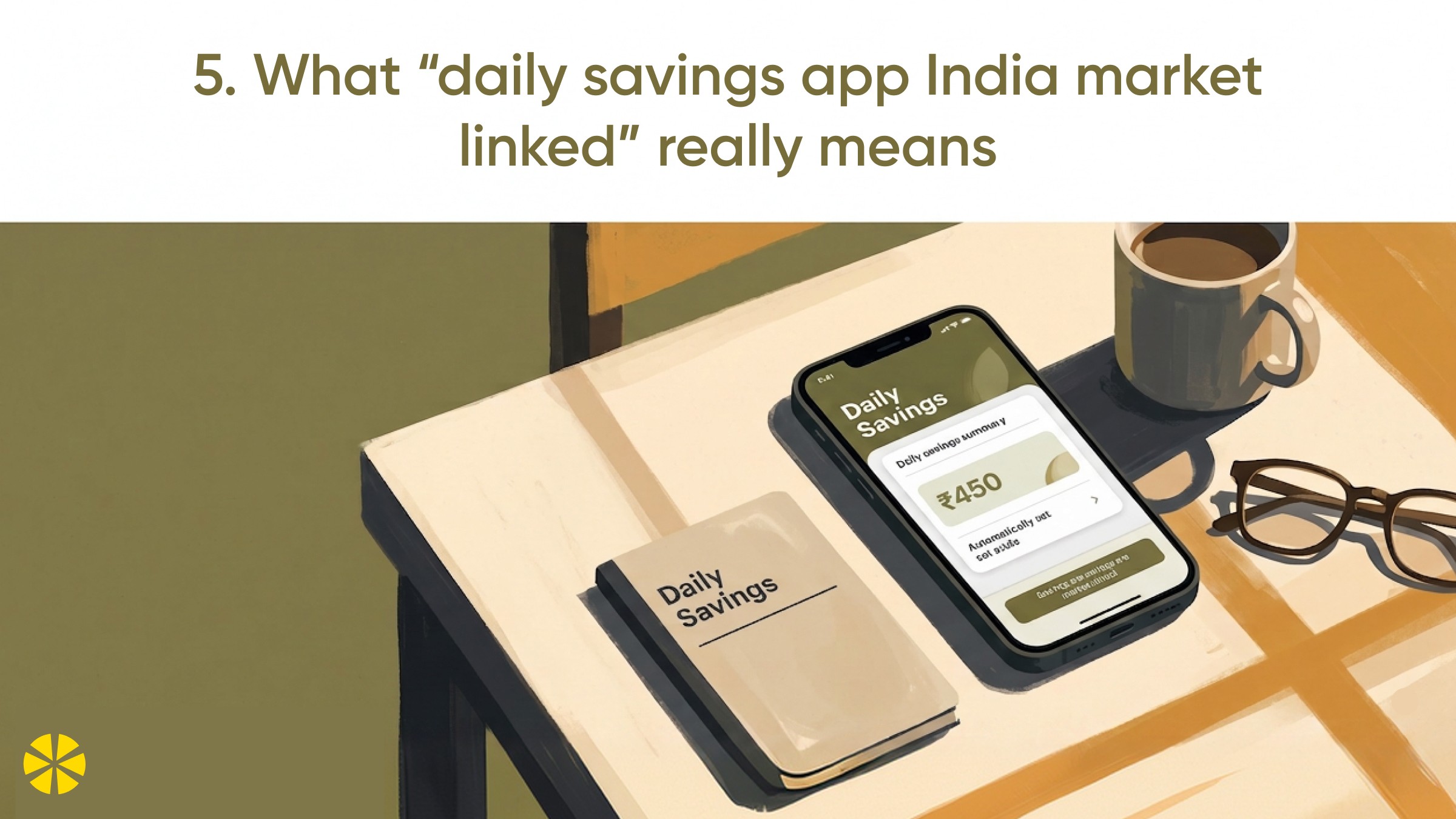
This keyword sounds technical, but the user intent behind it is very practical.
When someone searches for daily savings app India market linked, they are usually not asking for a high-risk investing app. They are asking for some combination of:
a place to save small amounts daily India
an app-first experience
easy deposits in small chunks
the potential to earn on spare cash without lock in
access when spending needs arise
better outcomes than lazy idle balances
In other words, they want a digital habit layer on top of short-term money management.
The phrase “daily savings” matters because not everyone saves in big monthly lumps. Many people save:
what is left after a meal budget
unspent cab money
cashback-like surplus
round-down or weekly leftovers
a few hundred rupees between planned purchases
The phrase “market linked” matters because the return is not fixed like a deposit. It depends on the underlying instrument, usually a mutual fund in this context. That makes disclosure, risk framing, and liquidity terms very important.
A good app in this category should not oversell the “highest return.” It should help users understand what kind of money belongs there.
6. How liquid funds differ from a bank savings account
A lot of confusion comes from treating these as interchangeable. They are not.
A bank savings account is a deposit account. A liquid fund is a mutual fund scheme investing in short-term debt and money-market instruments. One is a banking product; the other is a market-linked investment product.
That distinction matters.
Savings account
deposit-based
usually offers lower returns
instant transactional utility
typically used as the core money hub
not designed primarily to improve idle cash returns
Liquid fund
market-linked mutual fund
low-risk category, but not risk-free
aimed at short-term parking
returns are variable, not fixed
redemption timelines depend on platform and scheme process
The Reserve Bank of India governs banks, while mutual fund products operate within the mutual fund regulatory framework overseen by SEBI and industry bodies like AMFI. That is why users should not confuse a liquid-fund-based spending buffer with a bank savings account or insured bank deposit.
If you want a deeper practical comparison, this becomes clearer in a liquid fund vs savings account vs FD vs HYSA comparison and a more focused savings account vs liquid fund vs HYSA side-by-side comparison.
7. How to compare daily surplus apps without chasing the highest number
One of the easiest mistakes is treating every market-linked money app as a rate table.
That misses the point.
For near-term spending money, the “best” app is not automatically the one showing the biggest number. What matters more is whether the product fits the job.
Here is what to compare instead:
1. What powers the returns?
Is the app using liquid funds, overnight funds, a sweep product, or something else? If the source of return is not explained in plain language, that is a warning sign.
2. What kind of money is it meant for?
Is this for 1 to 90 days? A few months? Long-term investing? Daily surplus money should not be parked in products meant for long horizons or higher volatility.
3. How easy is redemption?
Can you withdraw anytime? How long does money take to reach your bank? Does the app clearly explain redemption timelines?
4. Are risks properly disclosed?
If an app talks only about returns and barely mentions market risk, that is not a good sign.
5. Are costs and fund details visible?
Users should be able to understand the structure, not just the marketing.
This is also why any serious comparison of cash management apps or liquid-fund-based alternatives should focus on fit, not just headline yield.
8. A practical checklist: liquidity, risk, redemption time, disclosures, and costs

Before moving spending money into any market-linked app, use this simple checklist.
Liquidity
Can you access your money when you need it? “No lock-in” is useful, but users should still understand the practical withdrawal process.
Risk
No investment is zero-risk. For short-term money, lower-volatility products matter. But lower risk does not mean guaranteed capital protection in all scenarios.
Redemption time
This matters more than people think. If an app is for spending money, delayed redemption can become a real issue. A useful starting point is understanding liquid fund withdrawal timelines and how some products approach instant redemption limits and conditions.
Disclosures
Is the product transparent about:
historical versus guaranteed returns
fund category
regulatory entity
investment structure
tax treatment in general terms
Costs
Expense ratios, platform design, and hidden complexity all matter. Even when users are not selecting a fund manually, they should still know what sits underneath the experience.
A strong filter is to use a credible liquid fund app safety checklist before treating any app like a serious money tool.
9. The Daily Surplus Method as a smarter middle path
The Daily Surplus Method is not about moving every rupee out of your bank.
It is about creating three layers:
Layer 1: instant operating cash
Keep enough in your bank for immediate payments, autopays, and day-to-day transactions.
Layer 2: returns-earning spend buffer
Move the near-term surplus you expect to spend this month or soon after into a liquid, market-linked buffer designed for short-term parking.
Layer 3: longer-term goals
Keep money for future milestones in products aligned to a longer time horizon.
This method works because it respects the actual role of different money buckets.
It also suits people who prefer habit-based saving. If you regularly move small amounts instead of waiting for one big monthly transfer, you build a system that helps you save small amounts daily India style without turning money management into a complex investing exercise.
Used well, it can help you:
reduce idle cash drag
keep spending money accessible
avoid forcing all spare cash into either ultra-low-yield or long-lock-in products
stay more intentional about spending
10. Use cases: salary parking, UPI spends, bills, shopping, and near-term goals
This method is especially useful when your monthly cash flow has visible spending clusters.
Salary parking
Suppose your salary lands on the 1st, but a meaningful part of it will only be used gradually over the month. A Spendvesting buffer can help that parked money stay productive while remaining close to use. That idea is explained in more detail through a salary in liquid fund framework.
UPI spends
Routine digital spending is one of the biggest sources of idle cash inefficiency. If money can earn until it is actually needed, your everyday spending stack gets a little smarter.
Bills and subscriptions
Electricity, Wi-Fi, OTT subscriptions, school fees, insurance premiums, and recurring household costs often arrive on predictable dates. Money allocated in advance does not always need to sit idle in a low-yield bucket until then.
Shopping and festival spending
Planned shopping is exactly where a spend buffer helps. Whether it is festive budgeting, an iPhone purchase, or a gadget upgrade, short-term earmarked money can do better in a more intentional home than in a generic savings account.
Near-term goals
Travel, wedding expenses, event planning, flights, and annual renewals often sit in that 1-to-12-month zone where flexibility still matters. These are not emergency uses, but they are not long-term investments either.
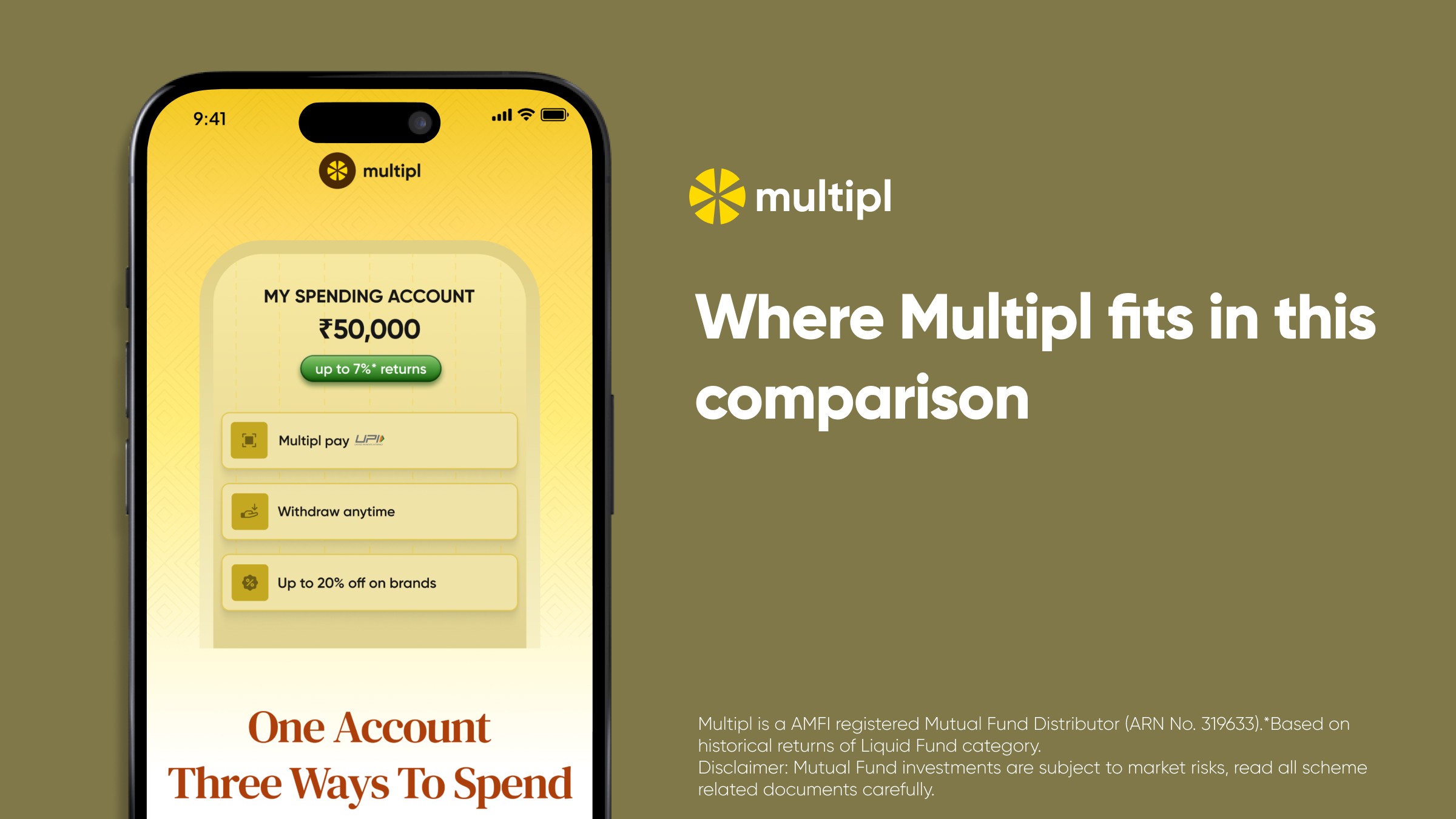
11. Where Multipl fits in this comparison
Multipl fits into this middle category through its Higher-Yield Spending Account (HYSA), a mutual-fund-powered spending account designed to make idle spending money work harder.
Instead of framing all money as either “savings” or “investment,” Multipl’s idea of Spendvesting is that future spending money can be parked in expert-selected liquid mutual funds and remain spend-ready. Historically, liquid funds have delivered more than many savings accounts, which is why Multipl describes the category as capable of earning up to 7%* based on historical liquid-fund returns, while reminding users that returns are market-linked and not guaranteed.
In practical terms, that means Multipl is built for people who want:
a better-than-idle-cash home for spend-ready money
no lock-in for this category
a goal-based way to fund spends without EMIs
potential brand discounts when redeeming eligible goals
This is also what makes the product different from a plain savings account. It is not a bank deposit. It is a market-linked, liquid-fund-powered system for short-term spending money. If you want the full product breakdown, the clearest starting point is what a Higher-Yield Spending Account is and how Multipl works and the broader concept page on Spendvesting.
Multipl Wealth Management Private Limited is a SEBI-Registered Investment Adviser and AMFI-Registered mutual fund distributor, and the mutual fund units are held in the user’s name at the respective AMC. That matters because it makes clear that the product is investment-linked rather than deposit-based. Still, as with any mutual fund product, users should read scheme-related documents carefully and understand that market risks apply.
12. Common mistakes to avoid with market-linked spending money
A returns-earning spend buffer can be useful. But only if used properly.
Mistake 1: moving emergency cash without thinking
Emergency money needs a separate strategy based on access, certainty, and your comfort level. Do not blindly mix all cash buckets together.
Mistake 2: chasing the highest headline return
For short-term money, consistency, transparency, risk profile, and access often matter more than one flashy number.
Mistake 3: treating liquid funds as risk-free
They are generally low risk, but not risk-free. If you want detail, it helps to understand whether liquid funds can lose money and the broader risk profile of liquid funds.
Mistake 4: ignoring redemption realities
“No lock-in” does not always mean “every rupee is in your bank instantly.” Understand the actual withdrawal process.
Mistake 5: putting long-term goals into short-term products
A spend buffer is for short-term money. Long-term wealth creation needs a different strategy and time horizon.
Mistake 6: overcomplicating the habit
The best system is the one you will actually use. A simple daily or weekly surplus sweep can work better than a perfect spreadsheet you abandon after 10 days.
Why this approach works for modern spenders
The Daily Surplus Method works because it reflects how people actually live:
money comes in monthly
spending goes out daily
some cash sits idle in between
flexibility matters
returns still matter
That is the sweet spot.
If your goal is to earn on spare cash without lock in, a market-linked spend buffer can be a smarter middle path than doing nothing with idle money or locking too much away. And if you want a daily savings app India market linked option, the right question is not “what pays the most?” but “what helps my short-term money stay accessible, low-friction, and better used?”
For many Indians, that shift alone matters: not investing more aggressively, but simply managing spend-ready money more intentionally.
Mutual fund investments are subject to market risks. Read all scheme-related documents carefully before investing. Returns discussed here are historical or illustrative in nature and are not guaranteed. Tax on mutual fund gains may apply; for individualized tax guidance, consult a qualified tax professional.
FAQs
Is a market-linked daily savings app the same as a bank savings account?
No. A bank savings account is a deposit product, while a market-linked app may route money into products like liquid mutual funds. That means the return is variable, not fixed, and the product carries market risk.
Can I save small amounts daily in India through these apps?
Yes, many app-based products are designed for frequent, small transfers. That is one reason they appeal to users who want to save in short, regular bursts instead of one large monthly deposit.
Is there a lock-in on liquid-fund-based spend buffers?
Usually, liquid funds do not come with a lock-in in the way FDs often do, but access depends on the app’s redemption process and the scheme’s operational timelines. Always check withdrawal terms before using one for spending money.
Are returns guaranteed?
No. If an app says money can earn up to 7%*, that should be understood as a historical, market-linked figure, not a promise. Liquid funds are low risk, but not risk-free.
Who should use the Daily Surplus Method?
It is useful for salaried users, freelancers, and regular digital spenders who keep short-term money aside for UPI payments, bills, shopping, travel, or near-term goals and want that money to do more than sit idle.
Where does Multipl fit?
Multipl fits as a mutual-fund-powered spending account approach for short-term spending money. It is designed for Spendvestors who want their idle spending balance to potentially earn through liquid funds while keeping the money accessible for future spends.
Multipl is a AMFI registered Mutual Fund Distributor (ARN No. 319633).
*Based on historical returns of Liquid Fund category.
Disclaimer: Mutual Fund investments are subject to market risks, read all scheme related documents carefully.