•
1 min read
UPI Pay With Mutual Fund: How It Works

UPI Pay With Mutual Fund: How It Works in India
UPI changed how India pays. Mutual funds changed how many Indians think about idle money. Now, the phrase “UPI pay with mutual fund” is bringing those two worlds together.
But this is also where confusion starts.
Many users hear terms like pay with mutual fund UPI, instant redemption for UPI spends, or liquid fund UPI payments and assume one simple thing: “My invested money can now behave exactly like cash.” That is not always true.
The reality is more nuanced. UPI is still a payment rail built for instant money movement between linked accounts, while mutual funds are investment products governed by a different operational flow. Any UPI mutual fund payment feature sits on top of these two systems and depends on how the app, fund house, payment partner, and redemption process are designed. In some setups, spending may feel seamless. In others, there may be limits, delays, cut-off dependencies, or redemption constraints.
This guide explains the full journey end to end: what “pay with mutual fund” usually means, why liquid funds are central to the idea, where instant redemption matters, and what users should verify before assuming their money is always spend-ready.
If you are new to idle-cash management, it also helps to understand how liquid mutual funds work in India and why many savers compare them with savings accounts for short-term money. For a broader comparison, Multipl has already broken down savings, liquid funds, FDs, and HYSA-style options.
What does “UPI pay with mutual fund” actually mean?
At a basic level, UPI pay with mutual fund refers to a setup where your spending experience is connected, directly or indirectly, to money you have parked in a mutual fund instead of leaving all of it idle in a low-yield savings account.
That does not usually mean UPI is deducting units from any random mutual fund scheme in real time.
Instead, the idea typically works like this:
You park money in a suitable mutual fund, usually a short-duration, low-volatility cash-management category such as a liquid fund.
A connected app or platform layers a spend mechanism on top.
When you make a UPI payment, the platform either:
uses an available bank balance already maintained for spends,
auto-redeems an eligible investment balance behind the scenes, or
sweeps money between investment and payment layers according to its own rules.
NPCI describes UPI as an instant payment system that lets users link participating bank and other allowed accounts in UPI apps for real-time payments. (npci.org.in) That last part matters: UPI itself is the payment infrastructure. The investment-linked experience depends on the product built around it, not on UPI magically turning all mutual funds into payment balances.
So when someone asks how to use mutual fund balance for UPI, the right answer is: only through a supported product design, and only within its operational rules.
Why liquid funds are usually the fund of choice
If an app wants to support spending from invested money, it cannot use just any mutual fund category. Equity funds fluctuate too much. Long-duration debt funds bring mark-to-market risk and a less cash-like experience. ELSS has lock-ins. Many categories simply do not fit day-to-day spending behaviour.
That is why most conversations around liquid fund UPI payments focus on liquid funds or similar ultra-short cash parking options.
Liquid funds generally invest in short-maturity debt and money market instruments, making them one of the more practical categories for near-term cash management. AMFI notes that liquid funds are often considered for short-term money, and redemption payment is typically made within one working day of placing the request. (uat.amfiindia.com)
That “typically” is important. It is not the same as saying every rupee is spendable instantly at every moment.
If you want a simpler foundation before thinking about payments, these related reads help:
The core difference: payment rail vs investment layer
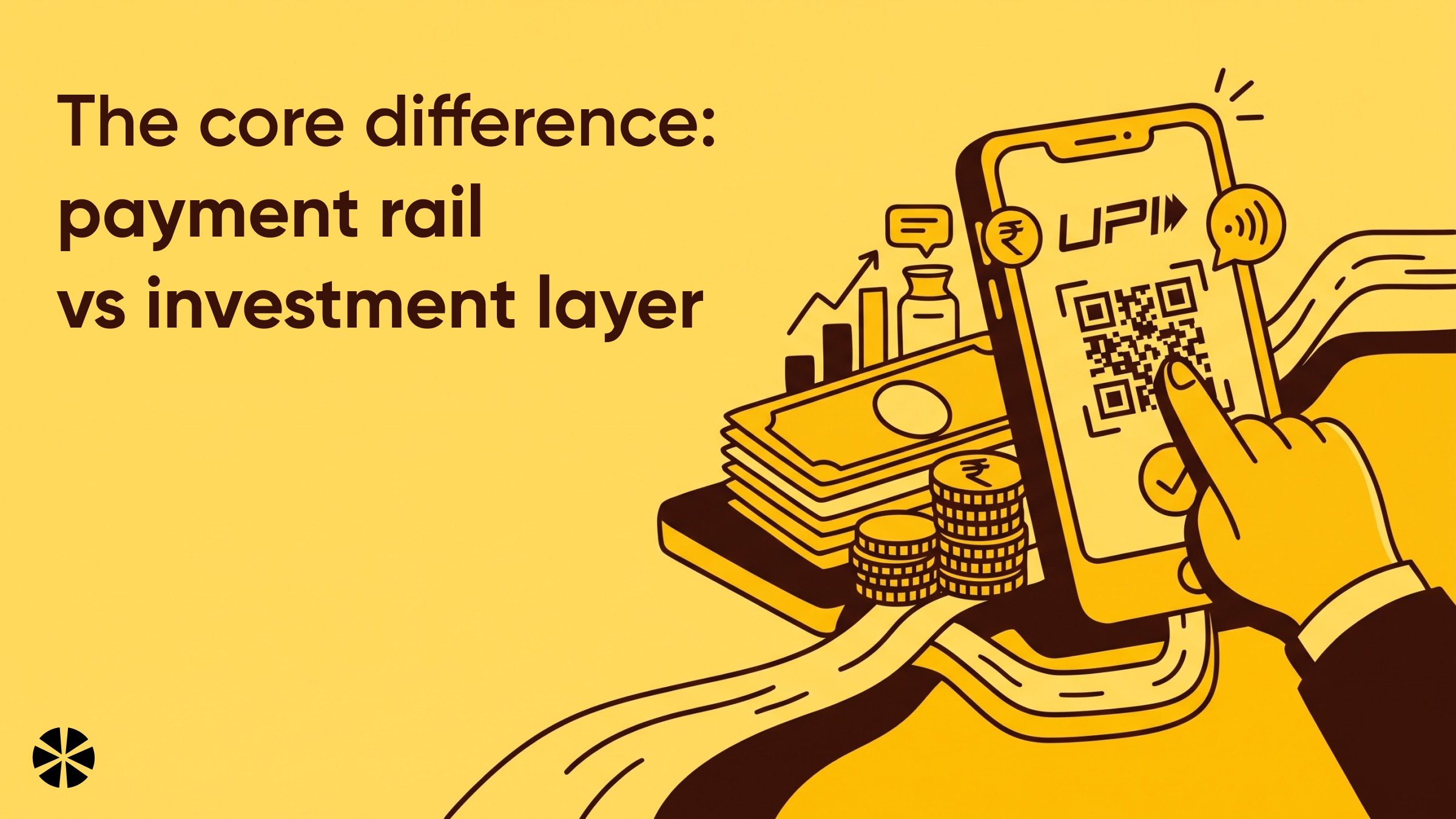
This is the key distinction most articles skip.
UPI is a payment rail.
A mutual fund is an investment product.
Those two systems operate under different rules, stakeholders, and timelines.
UPI transactions are designed to be immediate between linked accounts on the NPCI network. (npci.org.in) Mutual fund redemptions, on the other hand, involve fund units, applicable NAV, cut-off logic, settlement norms, and fund-house processing under SEBI’s mutual fund framework. (sebi.gov.in)
So a UPI mutual fund payment feature only feels instant when an intermediary product solves that gap for you.
That can happen in a few ways:
1. Pre-funded spend account model
The app may ask you to keep a separate payment balance available. Your investment sits in a liquid fund, but part of your money is kept ready in a bank or wallet-like layer for immediate UPI use.
2. Auto-redemption model
The app may redeem from an eligible mutual fund when you initiate a spend. This is where instant redemption rules, caps, and availability matter.
3. Sweep or buffer model
The app may maintain a dynamic buffer. Invested funds stay mostly deployed, while a small amount remains accessible for immediate spending. Rebalancing happens in the background.
From a user point of view, all three may look like “I paid by UPI using my mutual fund.” Operationally, they are very different.
How the user journey usually works
To understand pay with mutual fund UPI, imagine a practical flow.
Step 1: You add money
You transfer money from your bank account into a supported app or investment layer.
Step 2: Money gets parked
The app allocates the money into an eligible liquid fund or similar short-term instrument. This is where your idle money may begin earning returns instead of sitting entirely in a plain savings account.
Multipl’s educational content covers this broader idea in The Complete Guide to Managing Short-Term Money in India and Idle Cash Strategy: Savings Account or Liquid Fund?.
Step 3: You initiate a UPI payment
You scan a QR code, enter a UPI ID, or pay a merchant through the app.
Step 4: The platform checks spend eligibility
Before the payment succeeds, the system needs to determine:
Is there a pre-available spend balance?
Is the underlying fund eligible for instant or same-day access?
Is the requested amount within any transaction or redemption limit?
Is redemption available at that time?
Are there settlement or operational constraints?
Step 5: Redemption or funding happens
If the product supports auto-access, the app may redeem investment units or trigger a funding movement into the payment layer.
Step 6: Merchant gets paid
From the merchant’s side, it still looks like a normal UPI payment. What changed is the source architecture behind your spend.
That is the bridge most users need explained: the merchant is not receiving mutual fund units. The merchant receives money through UPI. The mutual fund part happens in the background.
Where instant redemption matters
If you remember just one concept, make it this one: not all redemptions are truly instant, and not all instant access is unlimited.
AMFI’s investor material says liquid fund redemption is typically paid within one working day. (uat.amfiindia.com) That alone tells you standard redemption is not equal to live spending.
For a truly smooth instant redemption for UPI spends experience, the product usually needs one of the following:
a pre-funded spending buffer,
a specific instant redemption facility,
a partnered mechanism with amount caps,
or a sweep structure that keeps enough liquidity ready.
SEBI has also published a circular on instant access facility in overnight funds, showing that “instant access” in mutual fund structures exists within defined regulatory and operational frameworks, not as a blanket promise for every scheme. (sebi.gov.in)
This is why product claims should be read carefully. If a platform says “pay using your invested balance,” check what that means in practice:
immediate for all spends,
immediate up to a cap,
same-day on business days,
or next working day after redemption?
That difference can matter a lot if you are paying rent, hospital bills, or travel expenses at odd hours.
Can any mutual fund be used for UPI payments?
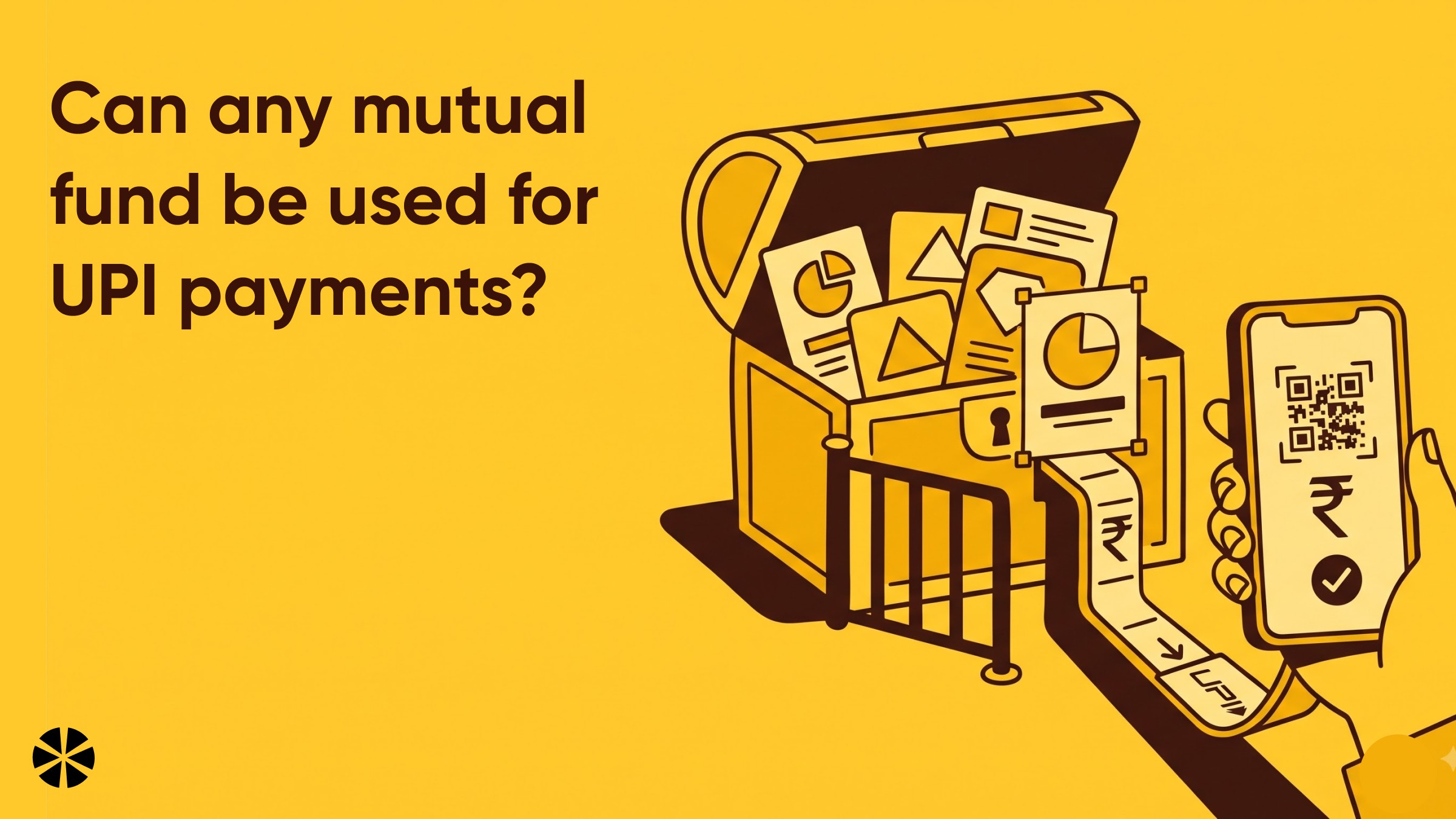
No. And this is one of the biggest misconceptions.
A practical UPI pay with mutual fund setup is usually limited to selected short-term fund categories. The reason is simple: spend money needs high liquidity, lower volatility, and predictable access.
In general, users should not assume that:
equity mutual funds can be used for day-to-day UPI spends,
all debt funds behave like cash,
all fund houses support instant access,
or every app offering UPI also offers investment-backed payments.
This is also why educational comparisons matter. If you are evaluating whether short-term parked money belongs in savings, liquid funds, or another structure, these explainers are useful:
What users should check before using mutual fund balance for UPI
If you are wondering how to use mutual fund balance for UPI safely, do not stop at the headline feature. Check the operational details.
1. Is it true pay-via-investments or just a smart cash layer?
Some apps market the experience as investment-linked, but the actual payment may happen from a bank balance or shadow balance that is merely funded by prior redemptions.
2. Which fund category is used?
Liquid funds and overnight-style structures are more aligned with short-term access than longer-duration or volatile funds. SEBI and AMFI materials make clear that mutual funds differ significantly by structure, liquidity, and risk. (sebi.gov.in)
3. Is there instant redemption, and what are the limits?
The phrase “instant” may apply only:
on working days,
up to a specified amount,
for selected schemes,
or during certain hours.
4. Are there cut-off and settlement considerations?
Even if the spending app feels modern, mutual fund operations still sit on regulated redemption processes.
5. Can the fund lose value?
Liquid funds are generally lower risk than many other fund categories, but they are not the same as guaranteed bank deposits. They can carry interest-rate risk, credit risk, and liquidity risk, even if usually lower than longer-duration debt categories. (amfiindia.com)
6. What happens if the payment fails?
You should know whether the money remains invested, moves to a holding balance, or gets reversed after a failed transaction.
7. What are the UPI-side limits?
UPI itself operates within product and bank-specific transaction rules on supported accounts and payment flows. NPCI states that UPI enables instant payments using linked accounts, but final app experience can still vary by participating institution and product setup. (npci.org.in)
Benefits of a mutual-fund-linked UPI spending model
When implemented well, this model can solve a real money problem: idle cash.
A lot of users keep too much money sitting unused in low-yield accounts simply because they want liquidity. A mutual-fund-linked payment setup tries to reduce that trade-off by making at least part of near-term money work harder while preserving reasonable access.
Potential benefits include:
better use of short-term parked money,
smoother separation between long-term investing and near-term spending,
reduced idle cash drag,
and a more intentional money-management system.
That is also the larger thesis behind many of Multipl’s educational pieces on smarter cash parking, including Why Most People Lose Money Without Realising It - The Hidden Cost of Idle Cash and Short-Term Investment Options in India: 8 Safe Places for Idle Money.
Risks and assumptions that can break
This is where users need to stay realistic.
A UPI mutual fund payment feature can sound like a perfect fusion of spending and investing, but it is only as reliable as the redemption design behind it.
Common assumptions that can break:
“It works like a savings account.”
Not exactly. A savings account balance is deposit money. Mutual fund value sits in market-linked units.“All my invested money is instantly spendable.”
Usually false. Access may depend on fund type, timing, limits, and app rules.“Returns are guaranteed.”
No. Mutual fund returns are market-linked.“UPI approval means all mutual-fund-linked payment apps work the same way.”
No. UPI is the rail; each product layer can differ.“There is no redemption lag at all.”
Not always. Standard mutual fund redemption timelines still matter unless a special access facility is in place.
For anyone managing salary flows, emergency buffers, or short-term goals, the right setup often depends on the purpose of the money. Multipl’s perspectives on salary parking frameworks, emergency funds in liquid funds, and liquid funds for short-term goals can help you think in layers rather than chasing one “all-in-one” hack.
So, is UPI pay with mutual fund a good idea?

It can be a smart idea for the right type of money.
Not for your entire emergency reserve if you need guaranteed immediate access at all times.
Not for long-term wealth-building money that should stay invested without spending temptation.
Not if you have not understood the redemption mechanics.
But for planned short-term cash, predictable spending pools, and money that would otherwise sit idle, the model can be useful. The real advantage is not novelty. It is efficiency: getting better use out of money that is waiting to be spent.
The best way to evaluate any such product is to ignore the marketing headline and ask:
What exactly is invested?
Where is it invested?
What part is spend-ready?
What are the redemption rules?
What happens during off-hours, holidays, or failed transactions?
Those answers tell you whether a product genuinely supports pay with mutual fund UPI or whether it is simply wrapping a conventional payment balance in investment language.
FAQs
What is UPI pay with mutual fund?
It usually means a payment experience where your UPI spend is connected to money parked in an eligible mutual fund, often a liquid fund, through a supported app or platform. The merchant still receives money through UPI, not mutual fund units.
Can I use any mutual fund balance for UPI payments?
No. Usually only selected short-term, high-liquidity fund structures are suitable. Equity funds, locked-in schemes, and many other categories are not designed for daily payment use.
How to use mutual fund balance for UPI?
You typically need a platform that supports investment-backed spends. The app may maintain a spend buffer, auto-redeem eligible units, or sweep money between investment and payment layers.
Are liquid fund UPI payments instant?
Not always. Standard liquid fund redemption is typically processed within one working day, while “instant” access depends on product design, supported schemes, limits, and timing. (uat.amfiindia.com)
Is UPI mutual fund payment feature risk-free?
No. UPI is a payment rail, but the mutual fund portion remains market-linked. Liquid funds are generally lower risk than many fund categories, yet they are not guaranteed like insured bank deposits.
What should I check before using pay with mutual fund UPI?
Check the fund type, redemption timeline, instant access limits, applicable charges, failure handling, and whether the app is truly enabling investment-backed spends or just routing through a pre-funded payment balance.
Conclusion
UPI pay with mutual fund is best understood as a bridge, not a shortcut.
It bridges idle money and daily spending. It bridges payment convenience and short-term investing. But it does not erase the difference between a bank balance and a mutual fund unit.
If you understand that distinction, the feature becomes easier to evaluate. You stop asking, “Can I spend my mutual fund like cash?” and start asking the better question: “Which part of my short-term money can be structured to stay accessible while working harder than idle cash?”
That shift is what makes this idea genuinely useful. Not the jargon, not the hype, and not the illusion that every investment is instantly spendable.
Multipl is a AMFI registered Mutual Fund Distributor (ARN No. 319633).
*Based on historical returns of Liquid Fund category.
Disclaimer: Mutual Fund investments are subject to market risks, read all scheme related documents carefully.