•
1 min read
Liquid Funds vs Overnight Funds: Which Is Better for Idle Cash?

If you’ve ever wondered where to park idle cash safely without leaving it underused in a low-interest savings account, you’re not alone. Many Indian investors now look beyond traditional bank balances and fixed deposits when deciding what to do with money they may need soon.
That usually leads to one common comparison: liquid funds vs overnight funds.
Both are debt mutual fund categories. Both are considered relatively low risk compared to equity funds. Both can be useful for short-term money. But they are not interchangeable.
In fact, choosing the wrong one can mean either:
taking slightly more volatility than you’re comfortable with, or
settling for lower return potential when your money could have worked a bit harder.
This guide breaks down overnight funds vs liquid funds in plain English so you can decide what fits your money best. Whether you’re parking your salary before bills, holding a bonus temporarily, building an emergency buffer, or setting aside money for a near-term goal, this comparison will help you choose the better option.
If you’re new to short-term money management, you may also want to read The Complete Guide to Managing Short-Term Money in India (2026), which explains the broader landscape of savings accounts, liquid funds, and higher-yield spending options.
Why this comparison matters
A lot of people compare only savings accounts, fixed deposits, and liquid funds. But there’s a missing layer in that conversation: overnight funds for short term parking.
That gap matters because not all idle cash has the same role.
For example:
Money needed in 2–7 days is different from money needed in 1–3 months
Emergency cash for immediate access is different from emergency cash you may need only occasionally
Salary float before rent and EMIs is different from surplus money after a bonus
So the real question is not just “Which gives higher returns?”
It is: Which is the best fund for idle cash in India based on when I need the money and how much fluctuation I can tolerate?
What are overnight funds?
Overnight funds are debt mutual funds that invest in securities with a maturity of one day. Because the securities mature daily, these funds carry very low interest-rate risk compared to other debt fund categories.
In practical terms, overnight funds are designed for ultra-short parking of money.
They are typically considered when:
you want to hold money for a few days to a few weeks
capital stability matters more than squeezing out higher returns
you want a parking option with minimal duration risk
Because their portfolios reset every day, overnight funds are among the least volatile categories within debt mutual funds.
What are liquid funds?
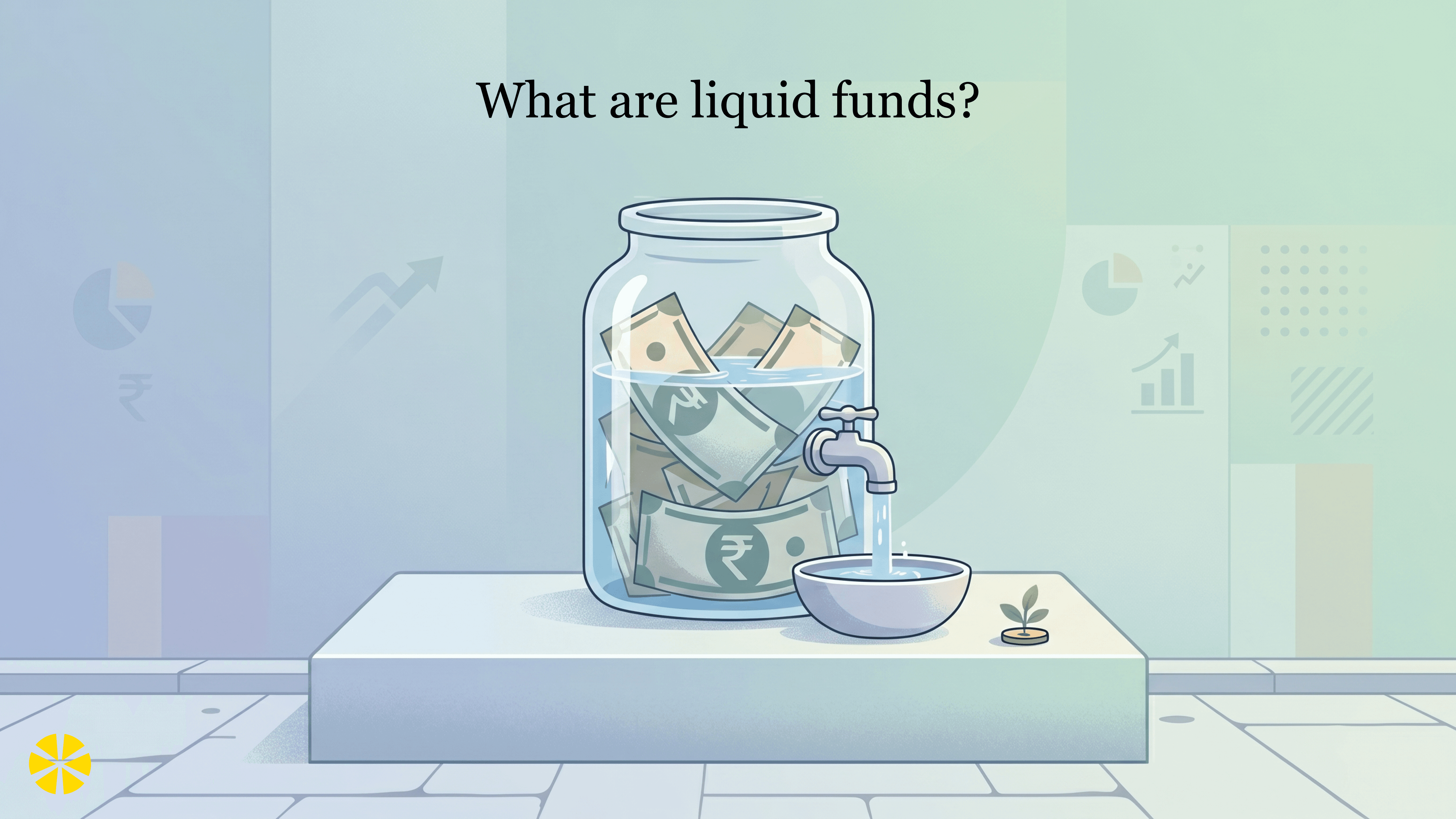
Liquid funds are debt mutual funds that invest in short-term money market and debt instruments with maturities of up to 91 days.
They are built for short-term cash management and are commonly used for:
emergency buffers
salary surplus
temporary parking for goals in the next few months
replacing part of idle savings account balances
Compared to overnight funds, liquid funds usually carry slightly more interest-rate and credit exposure, though still low relative to most other debt fund categories. That extra flexibility often allows them to generate slightly better returns over time, though returns are never guaranteed.
If you want a broader look at how liquid funds work, Liquid Funds for Short-Term Goals: Vacation, Wedding & More is a useful companion read.
Liquid funds vs overnight funds: the core difference
The simplest way to understand liquid funds vs overnight funds is this:
Overnight funds prioritize maximum stability for ultra-short holding periods
Liquid funds aim for slightly better return potential for short holding periods
That means overnight funds usually suit money you may need almost immediately, while liquid funds often suit money you can leave untouched for at least a little longer.
Side-by-side comparison: overnight fund vs liquid fund
Here’s a practical comparison for Indian investors deciding where to park idle cash safely.
Factor | Overnight Funds | Liquid Funds |
Typical maturity profile | 1 day | Up to 91 days |
Risk level | Very low | Low |
Interest-rate sensitivity | Minimal | Low, but higher than overnight funds |
Return potential | Lower to moderate | Moderate, often slightly higher than overnight funds |
Suitable holding period | Few days to few weeks | Few weeks to few months |
NAV fluctuation | Very low | Low |
Best use case | Ultra-short parking | Short-term surplus cash |
Ideal for | Salary float, redemption waiting money, temporary holding | Bonus parking, emergency layer-two, near-term goals |
When overnight funds are the smarter choice
Overnight funds are not always more exciting, but they can be smarter in specific situations.
1. You may need the money in a few days
If your holding period is extremely short, preserving capital matters more than marginally higher returns.
Example:
You received reimbursement money today
Your credit card bill is due next week
You want to avoid leaving the amount idle in your savings account
That is a classic overnight-fund use case.
2. You want the lowest possible volatility in mutual-fund form
If even small NAV movement makes you uncomfortable, overnight funds can feel easier to hold because of their very short maturity profile.
3. You are parking temporary float money
This includes:
money sitting between salary day and bill day
redemption proceeds waiting to be deployed elsewhere
funds held before a down payment or travel booking
For a related use case, see Where Should Salaried Indians Keep Money Between Payday and Bill Day?, which explores smart options for salary float.
4. You care more about predictability than return optimization
Sometimes the best decision is not the one with the highest expected return. It’s the one that aligns with the job your money needs to do.
If the job is “just stay safe for a few days,” overnight funds may be better.
When liquid funds are the smarter choice
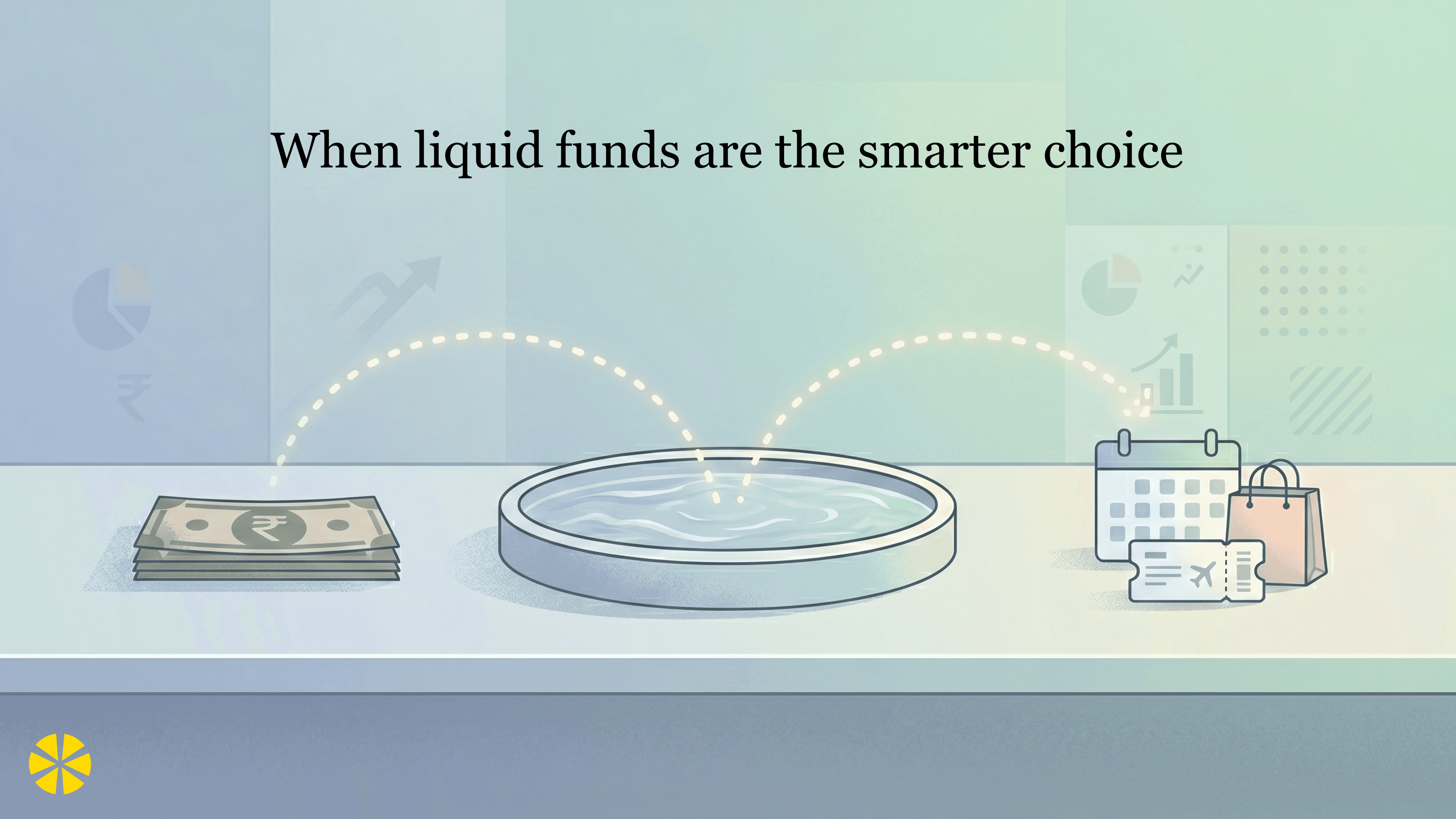
Liquid funds often become the better option when your money is not needed immediately and can stay parked for a somewhat longer period.
1. You have surplus cash for a few weeks or months
If you have idle money sitting in your bank account and you don’t expect to use it right away, liquid funds can be a more efficient parking option.
This is especially true for:
quarterly tax money
bonus money awaiting allocation
wedding or travel funds needed in the next 1–6 months
2. You want better return potential than overnight funds
While returns are market-linked and not guaranteed, liquid funds for surplus cash often provide better return potential than overnight funds because they can invest across a slightly longer maturity bucket.
3. You are creating a second layer of emergency money
Immediate emergency cash should usually remain easily accessible. But not all emergency money needs to sit fully idle in a savings account.
A common strategy is:
keep one layer in bank balance for instant use
keep another layer in a low-risk short-term option
Liquid funds can work for that second layer, depending on your comfort with slight fluctuations.
For more on this theme, read Why Most People Lose Money Without Realising It - The Hidden Cost of Idle Cash.
4. You are comparing alternatives to a traditional savings account
If your cash is lying idle in a regular savings account for too long, liquid funds often enter the conversation as a possible upgrade.
You can also compare broader options in Best Savings Account Alternatives in India 2026.
Risk: which one is safer?
In the overnight fund vs liquid fund debate, overnight funds are typically considered safer from a duration-risk perspective because they hold one-day maturity instruments.
That said, both categories are generally viewed as low-risk within debt mutual funds.
Still, “low risk” does not mean “no risk.”
You should remember:
mutual funds do not offer guaranteed returns
debt funds can still be affected by market and credit events
liquidity terms and exit structures can vary by fund
In simple terms:
Overnight funds: lower volatility, lower duration risk
Liquid funds: still low risk, but slightly more sensitive than overnight funds
If you’re evaluating debt-fund parking options more broadly, Exploring Money Market Funds: Stability and Returns adds useful context.
Returns: which one usually earns more?
Over longer short-term periods, liquid funds often have the edge on return potential. That is because they can invest in instruments with maturities longer than one day, allowing them to capture somewhat better yields.
But this should not be oversimplified.
Here’s the right way to think about it:
If your money is parked for just a few days, the return gap may not matter much
If your money is parked for a few weeks or months, liquid funds may be more rewarding
If stability is your top priority, a slightly lower return from overnight funds may be worth it
So the answer is not “liquid funds are always better.”
The answer is: the better option depends on the role of the money.
This is similar to the logic covered in Liquid Fund vs Savings Account vs Fixed Deposit vs HYSA: Complete Comparison, where the best choice depends on access, yield, and purpose.
Liquidity and access: how quickly can you get your money?
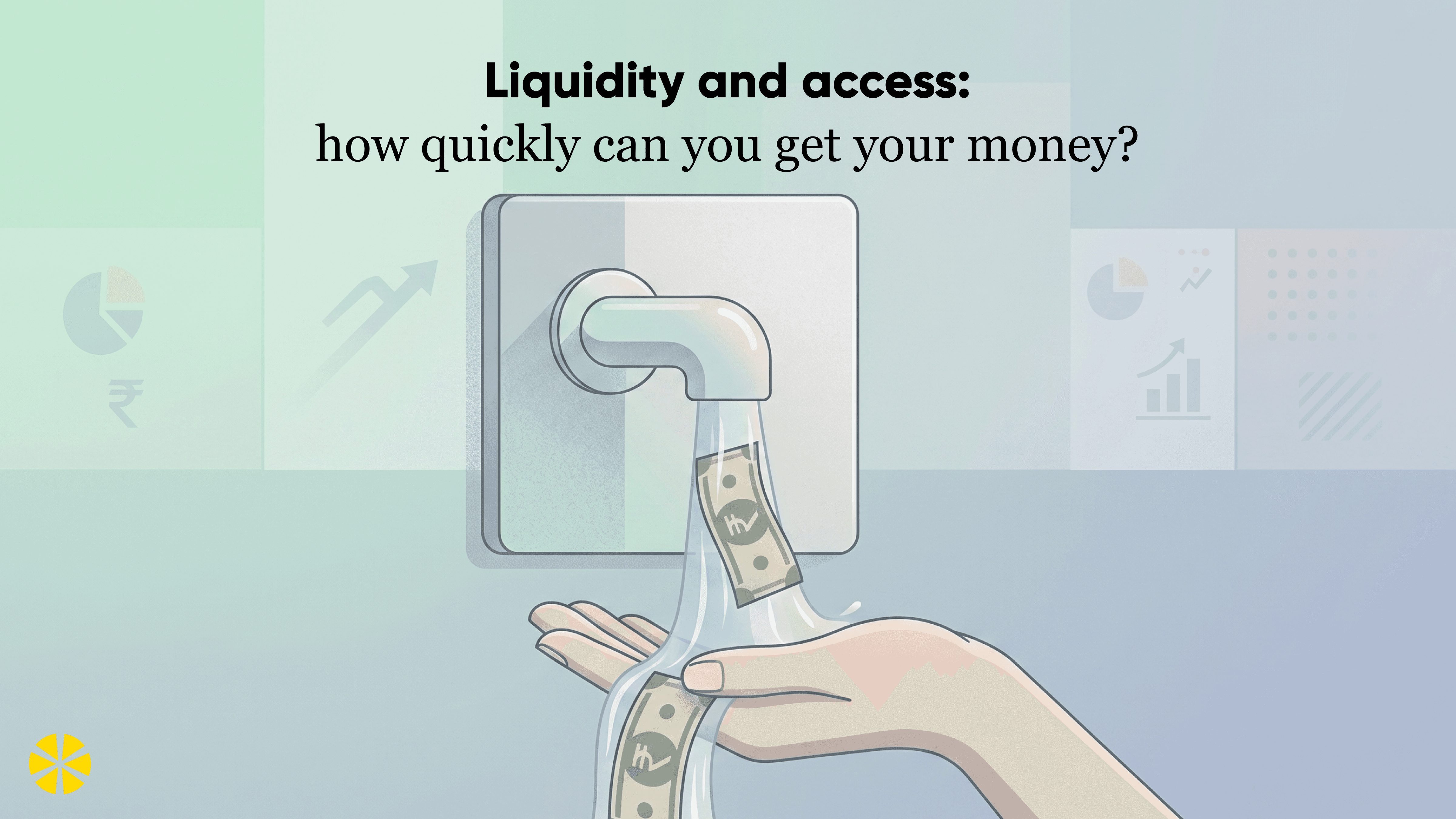
Both overnight and liquid funds are designed to be relatively accessible, but redemption timelines depend on the fund house, cut-off times, and platform processes.
For most users, the key practical takeaway is:
both are suitable for money that may be needed soon
overnight funds are psychologically and structurally better suited to ultra-short parking
liquid funds are better when your access need is near-term, but not immediate-immediate
If your priority is not just investing but also smarter usage of near-term money, What Is a Higher-Yield Spending Account (HYSA) and How Does Multipl Work? explains an approach designed to bridge spending and earning on idle cash.
Taxation: an important reality check
Taxation on debt mutual funds can change based on prevailing regulations, your holding period, and your individual tax situation. So it’s always smart to verify current rules before investing.
The key point for this comparison is that tax should not be the only deciding factor between overnight funds and liquid funds. In many real-life cases, suitability, liquidity needs, and risk tolerance matter more.
Make your first decision based on:
how soon you need the money
how stable you want the value to be
whether slightly higher return is worth slightly higher fluctuation
Then evaluate tax implications.
Real-life use cases: which fund fits which idle cash bucket?
Let’s make the decision more practical.
Use case 1: Salary credited today, bills due over the next week
Better fit: Overnight funds
Why: This is classic ultra-short money. Stability matters more than chasing extra yield.
Use case 2: Bonus parked for 2–3 months before you decide what to do
Better fit: Liquid funds
Why: You have a defined short-term horizon and can take very low levels of fluctuation for potentially better returns.
Use case 3: Emergency fund second layer
Better fit: Usually liquid funds
Why: If this is not the first-access emergency bucket, liquid funds may be more aligned with the holding period.
Use case 4: Money for a travel booking next week
Better fit: Overnight funds
Why: The timeline is too short to optimize aggressively.
Planning for travel goals? How Multipl Helps You Save on Travel Without Killing the Vibe shows how goal-based saving can reduce stress around irregular expenses.
Use case 5: Wedding payments due over the next 2–4 months
Better fit: Liquid funds
Why: This is short-term planning, not overnight liquidity.
Use case 6: Money you may or may not need anytime, but don’t want idle in a bank
Better fit: Depends
Why: If the timeline is unclear but access could be immediate, overnight funds may be safer. If it’s likely to stay untouched for weeks or months, liquid funds may be better.
You can also use Liquid Fund Apps in India: Compare Liquidity, Returns and Minimums to understand how different platforms present short-term parking options.
A simple decision framework
If you’re still unsure which is the best fund for idle cash in India, use this checklist.
Choose overnight funds if:
your money may be needed within days
you want very low volatility
the cash is temporary float money
safety and predictability matter more than extra return
Choose liquid funds if:
your money can stay parked for a few weeks or months
you want better return potential than overnight funds
you’re parking surplus cash, bonus money, or near-term goal money
you can accept small NAV fluctuations
What about HYSA-style solutions for idle cash?

Many users comparing liquid funds and overnight funds are actually asking a broader question: How do I make idle money work harder without complicating my life?
That’s where newer models like higher-yield spending experiences become relevant. Instead of separating saving and spending too rigidly, some people now want a system that helps them earn better on money that is still part of upcoming life expenses.
If that’s the problem you’re solving, The Spending Money Hack: How to Use HYSA to Earn While You Shop is worth reading.
And if you’re still deciding whether goal-based parking is right for you, 10 Key Steps to Master Goal-Based Investing offers a strong framework.
So, which is better for idle cash?
The honest answer: neither is universally better.
The better option depends on how idle the money really is.
If the cash is only resting briefly and may be used very soon, overnight funds can be smarter.
If the cash is surplus for a somewhat longer short-term horizon, liquid funds can be more efficient.
If the money is connected to specific future spending goals, a more structured approach like goal-based saving may serve you better than casual parking.
The mistake is not choosing overnight instead of liquid, or liquid instead of overnight.
The real mistake is treating all idle cash the same.
Conclusion
When comparing liquid funds vs overnight funds, the key is to match the fund to the job.
Use overnight funds for ultra-short parking, temporary float, and money you may need in just a few days.
Use liquid funds for surplus cash, near-term goals, and short-term money that can stay invested for a few weeks to months.
If you want a simple rule of thumb:
Few days = overnight fund
Few weeks to few months = liquid fund
And if you’re exploring smarter ways to manage short-term money beyond a regular savings account, start with the Multipl blog for deeper comparisons, practical guides, and modern approaches to spending-led saving.
FAQs
Is an overnight fund better than a liquid fund for idle cash?
It depends on your holding period. Overnight funds are usually better for money needed within days, while liquid funds are often better for money that can stay parked for a few weeks or months.
Which is safer: overnight fund or liquid fund?
Overnight funds are generally considered safer from an interest-rate risk perspective because they invest in one-day maturity instruments. Liquid funds are also low risk, but slightly less conservative than overnight funds.
Can I use liquid funds for surplus cash?
Yes. Liquid funds for surplus cash are a common choice when you have money that may not be needed for a few weeks or a few months.
Are overnight funds for short term parking suitable for salary float?
Yes. Overnight funds can be suitable for salary float, bill money, or temporary balances that may be needed very soon.
Where should I park idle cash safely in India?
That depends on access needs and purpose. For a few days, overnight funds may fit. For a few weeks to months, liquid funds may fit. For broader alternatives, read Savings Account vs Liquid Fund vs HYSA in India 2026.
What is the best fund for idle cash in India?
There is no one-size-fits-all answer. The best fund for idle cash in India depends on whether your money is ultra-short-term, short-term, or tied to a specific goal.