•
1 min read
Investing App vs Money-Parking App

Most articles about parking surplus cash open with a returns table. This one doesn't, because returns are the last thing that should decide where your next three months of spending money lives.
If you're comparing a money parking app with a full-blown investing app in 2026, the real question isn't "which one earns more." It's "which one is built for money I might need on a Tuesday afternoon." Two different jobs. Apps designed for one tend to be mediocre at the other.
So we'll do this backwards. First, everything that can genuinely go wrong when you park cash in mutual funds. Then a safety-first scorecard you can apply to any app before you move a rupee.
Before the Returns Conversation: What Can Actually Go Wrong With Parked Money
Parked money is the cash you've set aside for rent, EMIs, a flight in April, a phone upgrade, or just "life happening." It has a very specific failure mode. It's not that you lose 40% in a crash. It's that the money isn't there, in usable form, on the day you need it.
Here are the realistic risks, ranked by how often they actually bite people:
Access risk. You need Rs 40,000 today and the redemption lands the day after tomorrow.
Behavioural risk. The money grew, so you started treating it as "investments" and stopped spending it on what it was meant for.
Wrong-product risk. You wanted safety and ended up in a fund whose category was never designed for a three-month horizon.
Credit and duration risk. The underlying bonds in a debt fund can be downgraded, or their prices can move when interest rates move.
Tax and cost drag. Gains are taxable, and exit loads or high expense ratios quietly shave the difference.
Platform risk. The app you used isn't regulated for what it's doing, or your units aren't clearly held in your name.
Only one of those is about markets. That's the point. A money parking app should be judged on how it handles the other five.
Mutual fund investments are subject to market risks. Read all scheme-related documents carefully. No investment is zero-risk, and liquid funds are low-risk and low-volatility, not risk-free, with returns that vary with market conditions.
Objection 1: "Mutual Funds Aren't Insured Like Bank Deposits" (What DICGC Covers and What It Doesn't)
This objection is correct, and it deserves a straight answer rather than a dodge.
Bank deposits in India are covered by deposit insurance through the Deposit Insurance and Credit Guarantee Corporation, up to Rs 5 lakh per depositor per bank, covering savings accounts, current accounts, fixed deposits and recurring deposits together. Mutual funds, liquid funds included, are not covered by that scheme. There is no insurance backstop on market-linked returns.
What mutual funds have instead is a structural protection that's different in kind. Your money buys units issued by the Asset Management Company, and those units sit in your name with your PAN and folio. The AMC is the manufacturer. The fund's assets are held by a custodian, and the scheme is overseen by trustees under SEBI regulations. An app or distributor in between doesn't hold your money. It routes it.
So the honest framing is this. Deposit insurance protects you against the bank failing. Mutual fund structure protects you against the intermediary failing. Neither protects you against market movement. A higher-yield spending account powered by liquid mutual funds is a mutual-fund-powered spending account, not a bank savings account or a bank deposit, is not insured like one, and shouldn't be described as one.
Objection 2: "My Money Could Be Stuck" (Redemption Windows, Instant Limits and Non-Business Days)
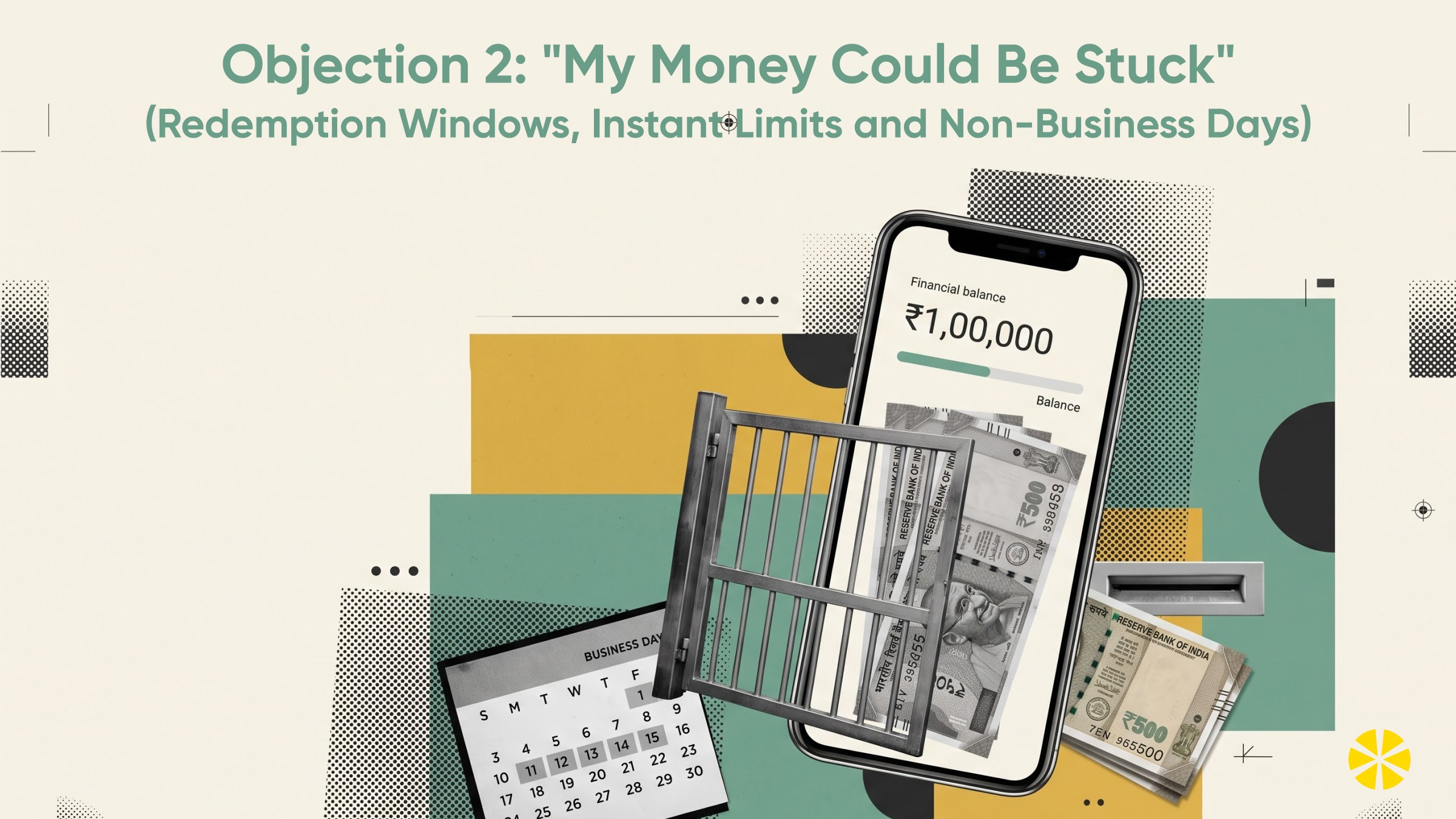
This is the risk people underestimate the most, and it's fixable purely through product choice.
A few mechanics worth knowing:
Liquid funds have no lock-in. You can redeem any business day.
Normal redemption typically credits on the next business day (commonly referred to as T+1) for liquid funds.
Instant redemption facilities exist on many liquid schemes, subject to per-day, per-scheme caps set by the AMC, often the lower of a fixed rupee limit or a percentage of your holding.
Liquid funds carry a graded exit load if you redeem within the first six days, which tapers to nil from day seven. It's small, but it exists, so liquid funds suit money you'll hold for at least a week or two, not overnight cash.
Non-business days matter. Redemption requests placed on a Saturday, Sunday or market holiday get processed on the next business day.
The practical implication: your "need it in two hours" money belongs in a bank account. Your "need it this month" money can sit in a liquid fund. Any app that blurs that line isn't giving you the full picture.
Objection 3: "Debt Funds Can Fall" (Credit Risk, Duration Risk and Why Liquid Funds Are Built Differently)
Yes, debt funds can fall. Two forces do it.
Credit risk is a borrower being downgraded or defaulting. Duration risk is the price of longer-dated bonds falling when interest rates rise. Debt funds that got into trouble historically were usually taking one or both of these risks in pursuit of higher yield.
Liquid funds are constructed to minimise both. By SEBI's category definition, they invest in debt and money market instruments with residual maturity of up to 91 days. That short maturity keeps duration risk very low, because there's simply not much time for interest rate moves to hurt prices. The category also has mandatory minimum liquid asset holdings so that redemptions can be met without distress selling.
Low is not zero. Credit events, however rare, are not impossible in a short-maturity portfolio, and yields move with the rate cycle. What you get is a category engineered for stability of capital and easy exit. Not a promise. That's exactly why liquid funds are the standard engine for short-term parking, and why comparing them to equity funds is a category error.
Objection 4: "Taxes Will Eat the Gains" (How Short-Term Debt Fund Gains Are Treated Today)
Gains from mutual funds are taxable, and pretending otherwise would be dishonest.
Broadly, for debt-oriented mutual funds bought after 1 April 2023, gains are added to your income and taxed at your slab rate, regardless of how long you held them. Arbitrage funds are treated as equity-oriented for tax purposes and follow equity capital gains rules, which differ. Tax is triggered on redemption, not while the money sits invested.
Two things to keep in perspective. Interest on a savings account is also taxable at slab, so the comparison is usually after-tax versus after-tax rather than taxed versus tax-free. And tax rules change, while your slab is personal. This is general information, not individualised tax advice. Check the current rules and speak to a qualified tax professional for your situation.
Objection 5: "An App Could Mishandle My Money" (SEBI RIA, AMFI ARN, and Units Held in Your Name)

Here's the checklist that actually separates a regulated platform from a wrapper:
Is the entity a SEBI-Registered Investment Adviser or an AMFI-registered mutual fund distributor? Registration numbers should be published, not hidden in a footer image.
Are the units issued by the AMC in your name, against your PAN? You should be able to see them in a consolidated account statement independent of the app.
Can you redeem directly with the AMC or registrar if the app disappeared tomorrow? With genuine mutual fund holdings, yes.
Are payments routed through a regulated payment gateway with bank-grade encryption?
Is fund selection unbiased, or is one fund house always the answer?
Multipl is operated by Multipl Wealth Management Private Limited, a SEBI-Registered Investment Adviser (INA200014681) and AMFI-Registered mutual fund distributor (ARN-319633), with mutual fund units held in the name of the user at the respective AMC and payments secured through Razorpay. SEBI registration and NISM certification do not guarantee performance or assure returns. They tell you who is accountable, not how the market will behave.
The Safety Ladder: Overnight → Liquid → Ultra-Short → Money Market → Arbitrage
Think of short-term debt categories as rungs, each one trading a little stability for a little yield.
Overnight funds. Invest in securities maturing in one day. Lowest volatility, lowest typical yield, no exit load. Use case: money you may need almost immediately, or corporate treasury-style parking.
Liquid funds. Up to 91-day maturities. Very low volatility, no lock-in, graded exit load for the first six days. Use case: your everyday spending pool and one-to-six-month money. This is the standard answer for money you might need soon, low-risk and low-volatility, not risk-free.
Ultra-short duration funds. Portfolio duration roughly three to six months. Slightly more rate sensitivity. Use case: three-to-nine-month money you're fairly sure you won't touch early.
Money market funds. Money market instruments up to one year. Comparable risk band to ultra-short, different instrument mix. Use case: six-to-twelve-month parking.
Arbitrage funds. Equity-hedged, taxed as equity, low but not negligible volatility. Use case: surplus cash held over six to twelve months where equity taxation helps. Not a substitute for a liquidity buffer.
Climbing the ladder for a few extra basis points on money you need in eight weeks is the single most common mistake in this space.
Emergency Fund Reality Check: How Much Belongs in a Bank vs. a Liquid Fund
A workable split for most salaried households:
Two to four weeks of expenses in your bank savings account. Instant, always on, works at 11pm on a bank holiday.
The remaining three to five months of the emergency corpus in a liquid fund. Next-business-day access is fine for medical bills, deposits, travel and job-gap cover, and instant redemption facilities cover a chunk of urgent cases.
Anything beyond the emergency corpus can move up the horizon ladder: planned goals over the next three to twelve months, and genuine long-term surplus into equity-oriented portfolios.
The bank account isn't the enemy here. It's the buffer that lets the rest of your parked money do something more useful than sitting idle.
The 8-Point Scorecard for a Money-Parking App (and Why Investing Apps Score Differently)
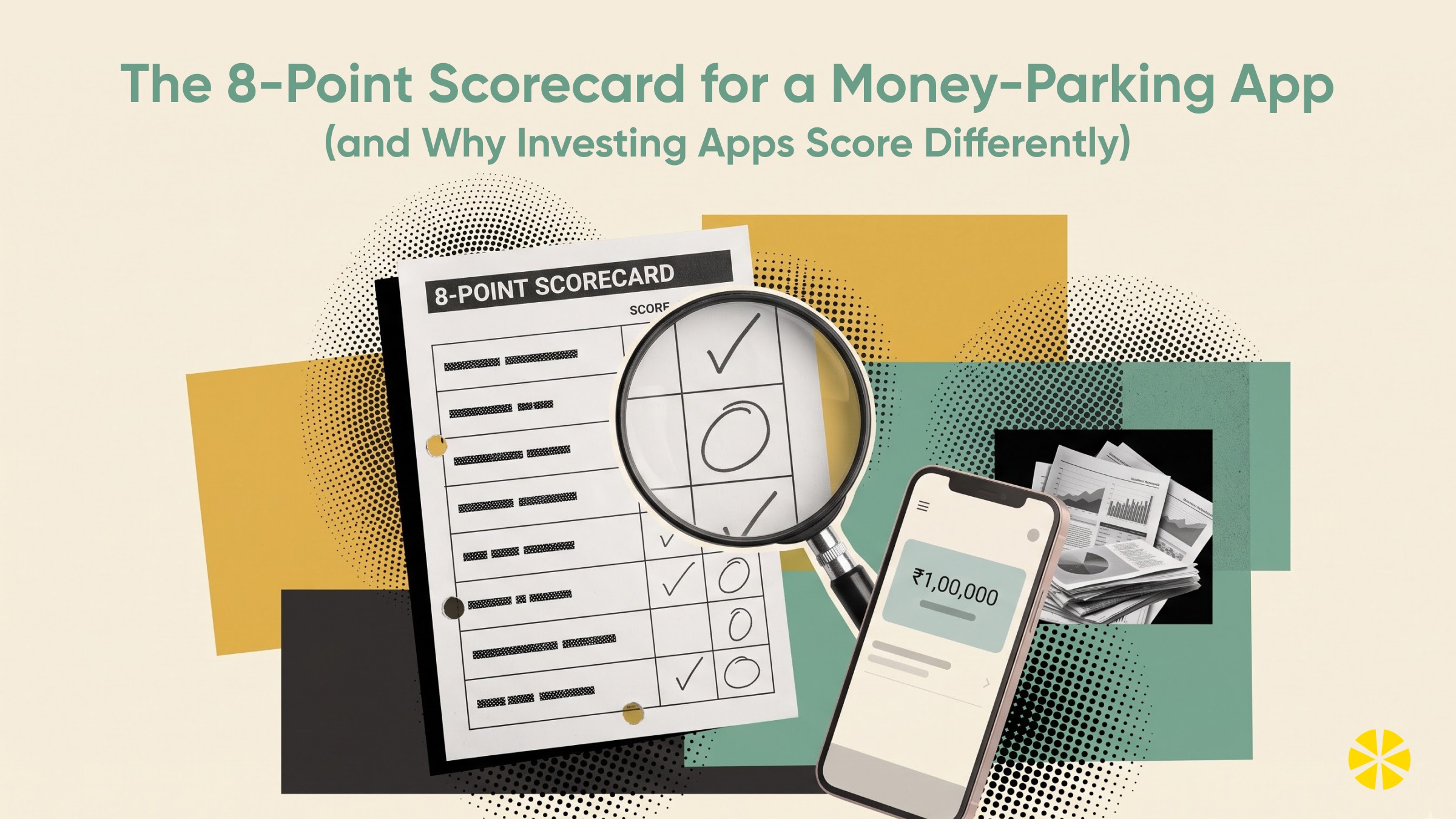
Score any app out of 8. One point each.
Regulatory identity is visible. SEBI RIA or AMFI ARN number, entity name, published clearly.
Units held in your name at the AMC, verifiable outside the app.
Default fund category is horizon-appropriate. Liquid or overnight for parking, not "top performing fund."
Withdrawal path is explicit. Normal timelines, instant limits, exit load and cut-off times stated up front.
Costs are transparent. Expense ratios, exit loads, and no surprise platform fees on redemption.
Spend-readiness. How quickly parked money converts into an actual payment.
Behavioural design suits parking, not accumulation. The app nudges you to spend the money on what you saved it for, rather than shaming you for withdrawing.
Risk communication is honest. Returns qualified as historical and market-linked, disclaimers present, no guarantees.
A full-featured investing app can ace points 1, 2 and 5 and still score lower on 3, 6 and 7, because it was built to help you accumulate and hold, not to help you spend. That's not a flaw. It's a different job.
Scoring 5 Kinds of Apps Against the Checklist in 2026
Rather than ranking brand names, score the five categories of apps people actually shortlist for parking surplus cash in mutual funds. Your own shortlist will fall into one of these.
Bank apps with an in-built mutual fund tab. Strong on trust and on the bank-account leg; horizon-appropriate defaults and instant redemption experience vary by app. Good if you want one login. Check it against the scorecard as a parking tool.
Discount broker and full-stack investing apps. Excellent regulatory clarity, wide fund choice, direct plans, holdings verifiable outside the app. Where they score lower is spend-readiness and behavioural design. The interface is built around portfolios, XIRR and long-term holding, so parked cash competes for attention with equity funds.
AMC direct apps. You buy that fund house's liquid scheme directly, often with a good instant redemption facility. Cost-efficient and clean, but single-fund-house by design, and you'll juggle multiple apps if you want unbiased selection.
Neobank-style cash management apps. Sleek withdrawal experiences and strong spend-readiness. The variable is regulatory clarity. Check whether the entity is an AMFI-registered distributor or RIA, and whether units are held in your name, before you park anything meaningful.
Spend-linked parking apps built on liquid funds. Purpose-built for the job: liquid-fund defaults, no lock-in, withdraw-anytime design, and money that's meant to be spent rather than admired. Multipl sits in this category. This is where points 3, 6 and 7 of the scorecard tend to be won.
The takeaway isn't that one category is superior. It's that categories 2 and 3 are optimised for building wealth, while categories 4 and 5 are optimised for using money.
Where a Full-Featured Investing App Still Wins, and When You Genuinely Need Both
A full investing app is the right tool when you're building a decade-long portfolio, running SIPs across equity categories, managing tax harvesting, or consolidating holdings from multiple sources. Breadth of choice, research depth and portfolio analytics matter there, and a parking-first app isn't trying to compete on any of those.
Most people are best served by both, with a clean division of labour:
Bank account. Instant liquidity buffer, two to four weeks of expenses.
Money parking app. Monthly spending money and near-term goals, running on liquid funds, spend-ready.
Investing app or wealth account. Money you won't touch for three years or more, in growth-oriented portfolios.
The mistake is using one tool for all three jobs. Cash in equity funds and long-term money in a savings account are the two ends of the same error.
Multipl Scored on the Same Checklist: Liquid-Fund Engine, Withdraw Anytime, SEBI-Registered, Spend-Ready

Applying the eight points honestly:
Regulatory identity. Multipl Wealth Management Private Limited, SEBI-Registered Investment Adviser INA200014681 and AMFI-Registered Distributor ARN-319633, headquartered in Bengaluru.
Ownership of units. Mutual fund units are issued by the AMC and held in the name of the user.
Horizon-appropriate default. The Higher-Yield Spending Account is a mutual-fund-powered spending account, not a bank savings account or deposit. It runs on expert-selected liquid mutual funds, the category built for short-term money, with no lock-in.
Withdrawal path. Withdraw anytime; balances stay liquid and spend-ready, redeemed to your bank when you need them, subject to standard mutual fund processing timelines.
Transparency and bias. Curated fund baskets selected by a team of CAs, CFAs and IIM MBAs, with no promotion of any particular fund house.
Spend-readiness. The whole premise of Spendvesting is that your spending money earns until the day you spend it, including everyday UPI spends, food delivery and travel.
Behavioural design. Planned Spends lets you set a dated goal over roughly three to twelve months, so you fund an iPhone, a wedding cost or school fees debt-free instead of on EMIs, with 70 to 100+ partner brands offering redeemable goal-linked offers of roughly 2 to 20% rather than guaranteed cashback on every spend.
Risk communication. Spending account returns are stated as up to 7%, based on historical liquid-fund performance rather than any assurance. Planned Spends targets roughly 7 to 15%, and the Wealth Account, built for horizons of three years or more, roughly 15 to 20%*, all historical, category-dependent and market-linked.
Around 1 million app downloads and 5 lakh+ Spendvesters later, the pitch remains narrow on purpose: this is a better home than idle cash for money you're going to spend, not a replacement for your long-term portfolio.
Setting It Up Safely: How Much to Park, What to Keep in the Bank, When to Review
Start with one month of discretionary spending, not your whole balance. Watch a full cycle of top-ups and withdrawals before scaling up.
Keep your instant buffer in the bank. Autopay mandates, card bills and true emergencies should never depend on a redemption clearing.
Give liquid-fund money at least a couple of weeks so the initial exit load window passes.
Date your goals. Money with a date attached gets spent on purpose; money without one drifts.
Review quarterly, not daily. Check that the horizon still matches the product, that your emergency buffer has kept pace with expenses, and that any goal you've hit gets redeemed and used.
Read the scheme documents for whichever fund your money actually sits in. It takes ten minutes and it's the only way to know what you own.
Mutual fund investments are subject to market risks; read all scheme-related documents carefully. SEBI registration and NISM certification do not guarantee performance or assure returns, and past performance is not indicative of future results.
FAQs
Which mutual fund category is safest for money I need in three months?
Liquid funds are the standard choice for a three-month horizon, because they invest in debt and money market instruments maturing within 91 days, which keeps interest-rate sensitivity very low. Overnight funds sit one rung safer with slightly lower typical yields, and are useful for money you might need within days. Neither is risk-free. They are designed for low volatility and easy exit, not guaranteed outcomes.
Can I lose money in a liquid fund?
Yes, it's possible, though historically uncommon over meaningful holding periods. Losses would come from a credit event in the underlying portfolio or, far more mildly, from short-term price movement in a rising-rate environment. The short maturity limits the damage, which is why the category is used for parking rather than for growth.
How long does it take to get money out of a liquid fund?
Normal redemptions from liquid funds are typically credited to your bank account on the next business day, provided your request is placed before the scheme's cut-off time. Many liquid schemes also offer an instant redemption facility subject to per-day caps set by the AMC. Requests placed on weekends or market holidays are processed on the next business day.
Is it better to keep surplus cash in a savings account or a liquid fund?
It depends on when you'll need it. Money you might need within hours belongs in a savings account, which typically pays around 2 to 3.5% and gives you instant access. Money you'll need over the coming weeks or months can sit in a liquid fund, which has historically delivered higher returns than that, though returns are market-linked and not assured. Both are taxable, so compare on an after-tax basis and keep a bank buffer regardless.
Do I need a separate app for parking cash if I already use an investing app?
Not necessarily, but the jobs differ enough that many people run both. Investing apps are optimised for long-horizon portfolios, research and consolidation, while parking apps are optimised for horizon-appropriate defaults, fast withdrawals and actually spending the money you saved. If your current app makes it awkward to redeem and spend short-term cash, that friction is a reason to separate the two.
Multipl is a AMFI registered Mutual Fund Distributor (ARN No. 319633).
*Based on historical returns of Liquid Fund category.
Disclaimer: Mutual Fund investments are subject to market risks, read all scheme related documents carefully.