•
1 min read
Savings Account vs Liquid Fund: Which Fits Your Idle Cash?
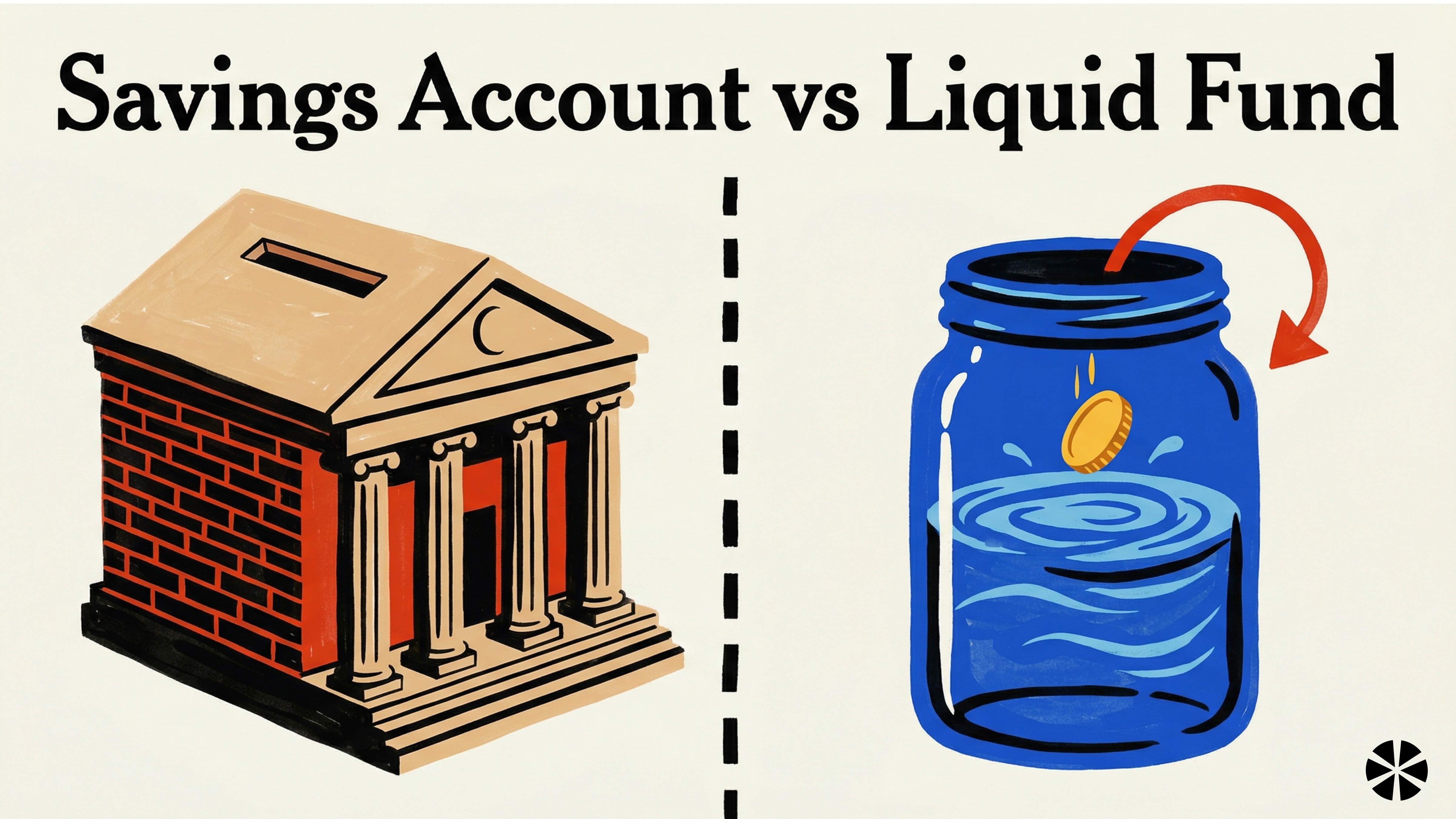
If you have money sitting in your bank account “just in case,” you’re not alone. Most people in India keep idle cash in a savings account because it feels safe, familiar, and instantly accessible.
But here’s the real question: is a savings account the best place for all your idle cash?
For day-to-day expenses, absolutely. For every extra rupee beyond that, maybe not.
This is where the savings account vs liquid fund debate becomes important. A savings account offers convenience and immediate access. A liquid fund, on the other hand, is designed to park short-term money while potentially earning better returns than a typical bank savings account.
The right choice depends on how soon you need the money, how much access you want, your tax situation, and the size of your idle.
In this guide, we’ll compare liquid fund vs savings account in simple terms, and more importantly, help you decide using real-life situations like salary buffers, emergency funds, and short-term goals.
What is a liquid fund in simple terms?
A liquid mutual fund is a type of debt mutual fund that invests in very short-term money market instruments such as treasury bills, commercial paper, and certificates of deposit. These instruments usually mature in up to 91 days.
In simple terms, a liquid fund is meant for money you want to keep relatively accessible, but don’t want lying idle in a low-interest account.
Unlike equity mutual funds, liquid funds are not meant for long-term wealth creation through market growth. They are built for capital preservation, liquidity, and modest returns.
So if you are asking, “How does a liquid fund work in India?”, the answer is straightforward:
You invest money in the fund
The fund manager deploys it into short-term debt instruments
The fund earns interest from those instruments
That gets reflected in the fund’s NAV over time
When you redeem, the money is credited based on the applicable settlement timeline, often T+1 for many funds
This makes liquid funds a practical option for parking idle money in India for short periods.
What is a savings account best suited for?
A savings account is ideal for:
Salary credit
Bill payments
ATM withdrawals
Daily spending
Maintaining cash for immediate needs
It is the most convenient form of liquidity. There is no market-linked movement in the account balance, and your money is available instantly.
But convenience has a trade-off: returns are usually low.
That is why many people begin exploring the difference between a savings account vs liquid fund once their bank balance consistently stays above what they need for regular monthly use.
Savings account vs liquid fund: the core difference
Here is the simplest way to think about it:
Savings account = money for immediate access
Liquid fund = money you may need soon, but not necessarily today
A savings account is transactional. A liquid fund is allocative.
That difference matters because a lot of people use a savings account for both purposes without realizing the cost.
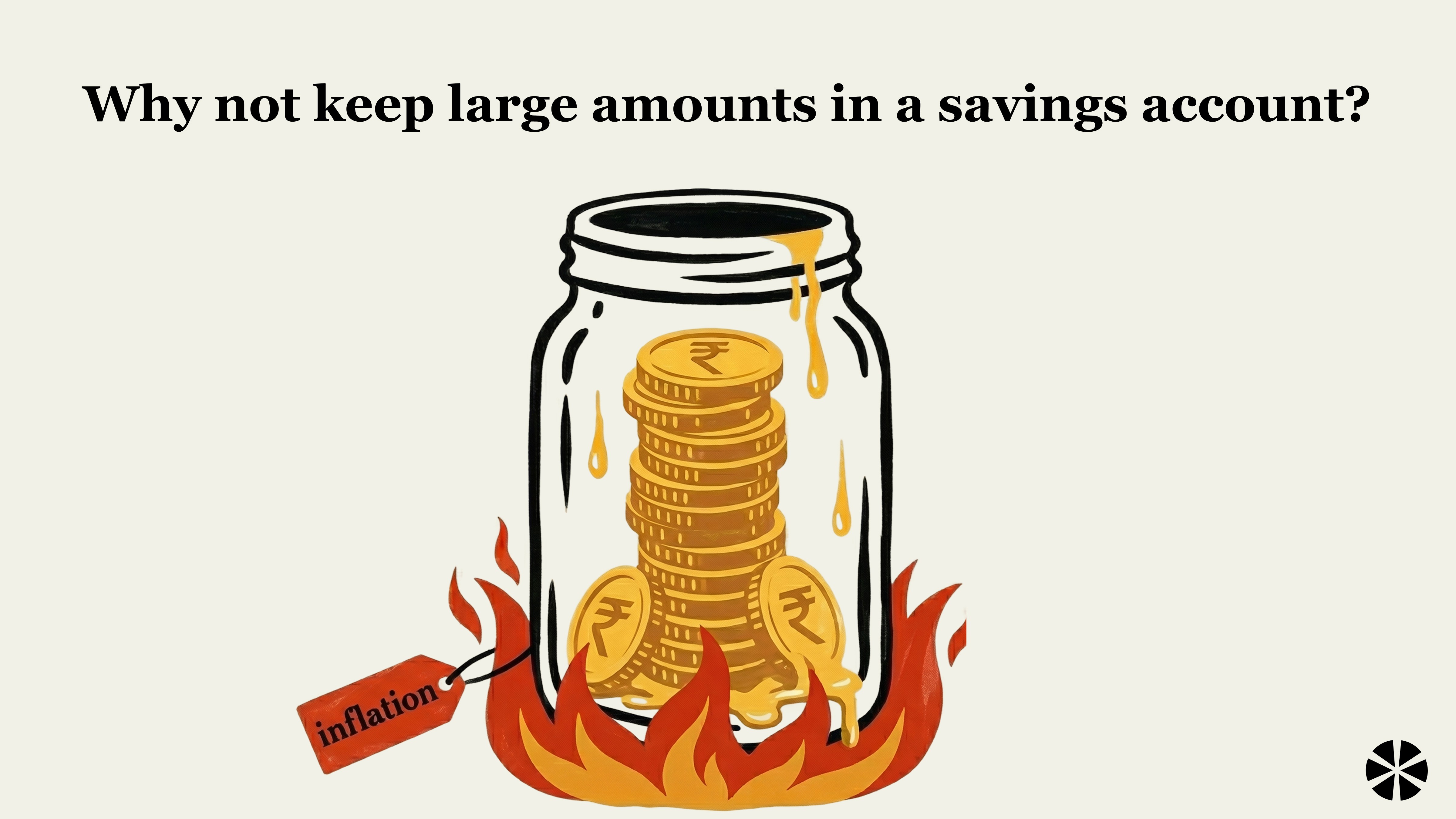
Why not keep large amounts in a savings account?
This is one of the most important personal finance questions, especially for salaried professionals and families with growing balances.
The answer is not that savings accounts are “bad.” The answer is that they may be inefficient for idle cash.
Here’s why:
1. Lower returns on idle cash
Savings accounts typically offer modest interest rates. If your balance remains high for months, the gap between what your money earns and what it could potentially earn elsewhere starts to matter.
2. Inflation quietly reduces purchasing power
If your money grows slowly while expenses rise faster, your real value declines over time.
3. You may be paying an invisible liquidity premium
When money is fully accessible every second, you’re effectively paying for that flexibility by accepting lower returns.
4. Large balances can become mentally “invisible”
Money that stays in one account often gets ignored. You may not realize how much is true emergency cash, how much is near-term goal money, and how much is simply unallocated idle.
This is the heart of the question: why not keep large amounts in savings account? Because once your immediate liquidity needs are covered, the excess could potentially work harder without taking on equity-like risk.
The opportunity cost of money in a savings account
The opportunity cost of money in a savings account is the return you give up by leaving idle cash parked in a lower-yield option instead of using a more suitable short-term instrument.
Let’s look at simple examples.
Example 1: ₹2 lakh kept idle
Suppose ₹2 lakh stays in a savings account for a year.
If that money could have been parked in an option with somewhat higher post-cost return potential, the difference may seem small in percentage terms but meaningful in rupees over time.
Even a gap of 2% means:
₹2,00,000 x 2% = ₹4,000 a year
That may cover:
a month of groceries
annual subscriptions
part of a school fee payment
a family insurance premium top-up
Example 2: ₹5 lakh maintained as “just extra cash”
Many households keep ₹5 lakh or more spread across one or two accounts without a clear purpose.
At a 2% return gap, the annual opportunity cost becomes:
₹5,00,000 x 2% = ₹10,000
At a 2.5% gap:
₹5,00,000 x 2.5% = ₹12,500
That is enough to make the “idle cash in savings account India” problem very real.
Example 3: A salaried professional keeping six months of expenses fully in savings
Let’s say monthly household expenses are ₹60,000. Six months of emergency money is ₹3.6 lakh.
Not all of this needs to be in the same level of liquidity.
If the full amount is left in savings by default, the foregone earnings over time can add up, especially if the emergency remains untouched for years.
That’s why emergency fund design matters more than just emergency fund size.
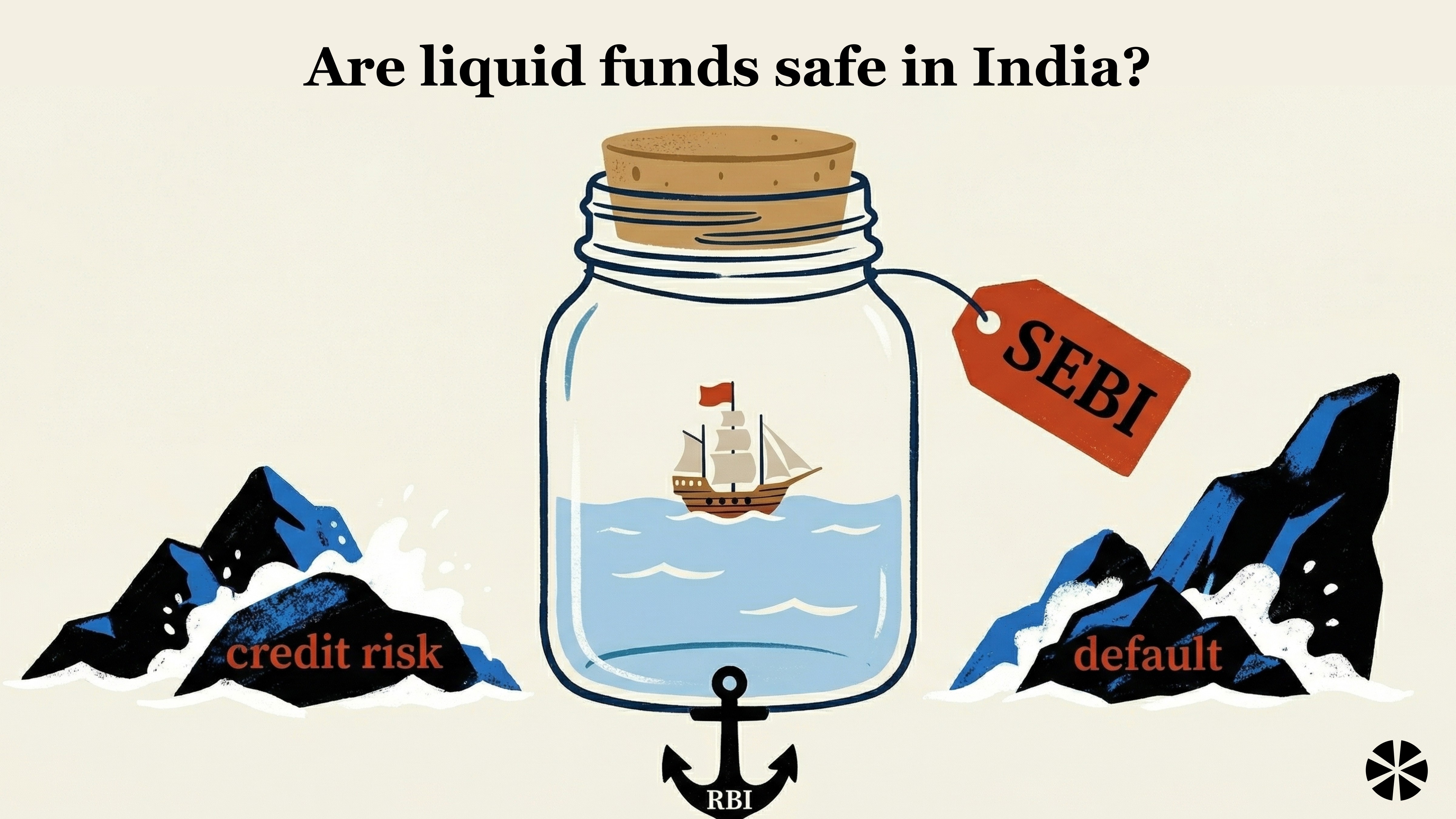
Are liquid funds safe in India?
This is usually the first concern, and rightly so.
Liquid funds are generally considered among the lower-risk categories within mutual funds because they invest in short-duration debt instruments. Their short maturity profile reduces interest-rate sensitivity, and they are designed for liquidity management rather than aggressive return-seeking.
However, let’s be precise: liquid funds are not the same as a bank savings account.
A savings account held with a bank is not market-linked in the same way. A liquid fund’s NAV can move slightly. So if you ask, “Do liquid funds ever lose value?”, the honest answer is: yes, small fluctuations are possible, although liquid funds are built to minimize volatility.
In practical terms:
They are generally lower risk than many other mutual fund categories
They are not risk-free
Credit quality and fund selection matter
They are better suited to short-term parking, not guaranteed-return expectations
So, what happens to money invested in a liquid fund? It gets deployed into short-term debt instruments, and your value changes with the underlying portfolio’s earnings and any mark-to-market impact.
For conservative users, the takeaway is simple: liquid funds can be suitable for idle cash, but they should not be mistaken for cash under the mattress or money in a bank account.
Can I withdraw money from a liquid fund at any time?
Yes, you can redeem from a liquid fund whenever needed, subject to fund rules and cut-off timing.
But unlike a savings account, where money is available instantly via UPI, ATM, or transfer, a liquid fund typically follows a settlement cycle.
This is where the T+1 trade-off matters.
If you may need money within minutes or hours, a savings account clearly wins.
If the money can wait until the next working day in many cases, a liquid fund may be acceptable.
That’s why a lot of people use a combination:
keep one layer in savings for immediate use
move the rest into a liquid fund for better efficiency
Savings account vs liquid fund: side-by-side comparison
1. Returns
A savings account generally offers fixed but low interest. A liquid fund does not guarantee returns, but historically, it has often been used by investors looking for potentially better short-term efficiency than a typical savings account.
If your question is, “where to park idle money in India?”, returns are one part of the answer, but not the only one.
2. Liquidity
Savings account: immediate access
Liquid fund: redeemable, but not instant in the same way
For same-day emergencies, your bank account is better. For money that is not required immediately, a liquid fund can still be fairly accessible.
3. Safety perception
Savings accounts feel safer because balances do not fluctuate visibly.
Liquid funds carry low but real market and credit risk. So the decision is not about “safe vs unsafe,” but about choosing the right product for the right layer of cash.
4. Tax treatment
Tax can materially change the final outcome.
Savings account interest is taxable, though individuals may get deduction benefits under applicable provisions like Section 80TTA within prescribed limits.
Liquid fund taxation depends on prevailing tax rules for debt mutual funds. Since tax regulations can change, investors should always confirm current treatment before making a decision.
This is why post-tax return, not headline return, should drive your comparison.
5. Use case
Savings account is best for:
monthly spending
autopays
upcoming utility bills
instant transfers
Liquid fund is better suited for:
temporary idle
part of an emergency corpus
near-term parking before deployment
large idle balances waiting for a goal
Under ₹5 lakh vs above ₹5 lakh: a simple decision framework
One of the easiest ways to decide is by looking at how much idle cash you usually maintain.
If your idle cash is under ₹5 lakh
Ask:
Is this money needed this month?
Do I need instant access to all of it?
Is this my salary account’s working balance?
If yes, keep the necessary monthly operating amount in savings. If a part of that money consistently remains untouched for weeks or months, that portion may be evaluated for liquid-fund parking.
If your idle cash is above ₹5 lakh
This is where reviewing your setup becomes more important.
At higher balances, the opportunity cost of keeping money in a savings account becomes harder to ignore.
A possible approach:
keep 1 month of expenses in savings
keep another portion for immediate emergencies
consider moving the rest of the idle layer into a liquid fund, depending on your access needs and risk comfort
This doesn’t mean shifting everything. It means separating:
transaction money
emergency-now money
emergency-soon or short-term idle money
Is it okay to keep one or two months salary in a liquid fund?
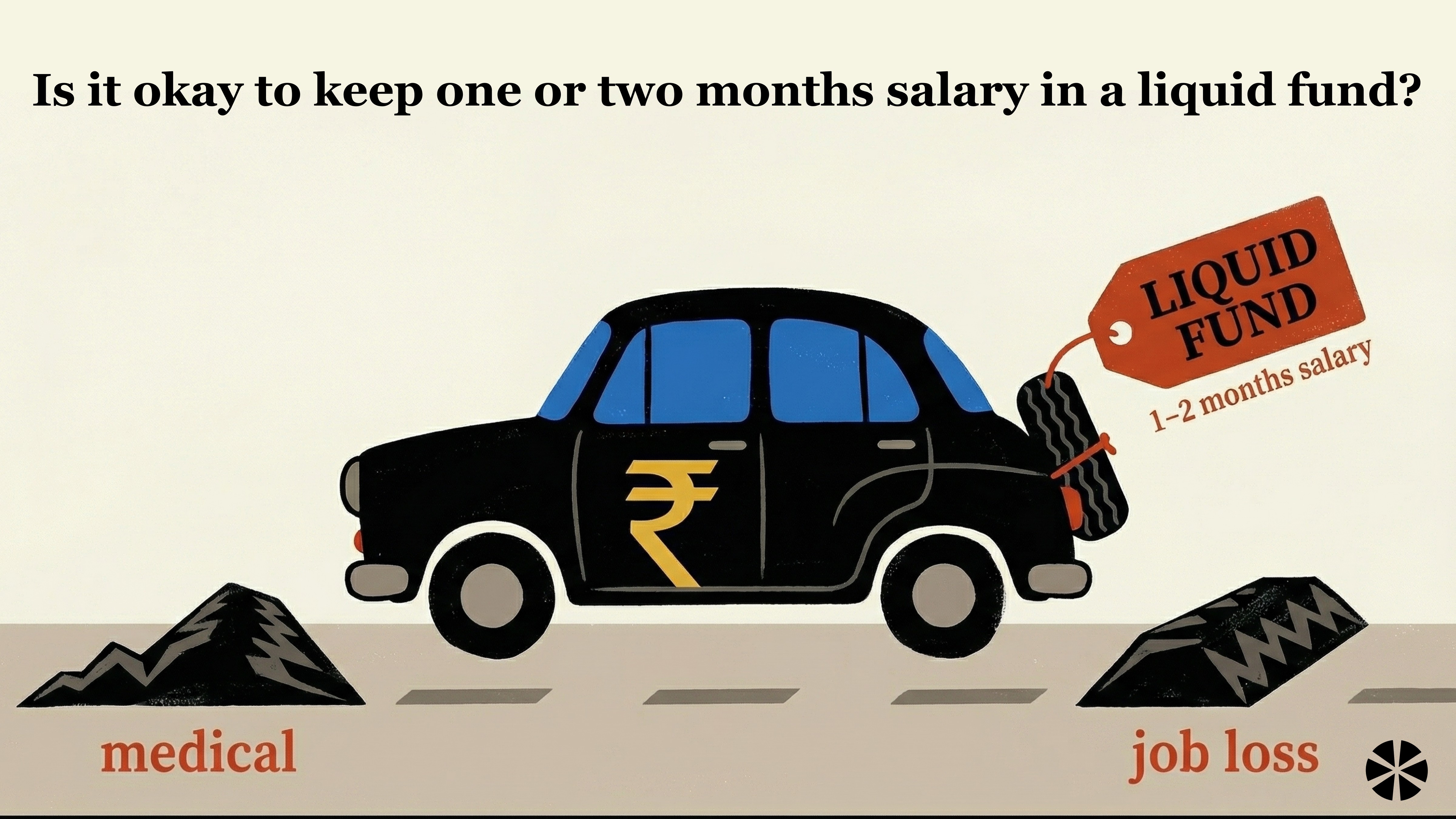
Yes, for many people, that can be a reasonable approach, provided they do not need every rupee instantly.
A practical structure could look like this:
Savings account: current month expenses + bill buffer
Liquid fund: one to two months salary or near-term reserve
Other investments: based on longer-term goals
This can work especially well for:
salaried professionals with stable cash flow
couples with dual incomes
households with predictable recurring expenses
But if your income is volatile, or you regularly need to dip into reserves at very short notice, keeping a larger immediate-access cushion in savings may be wiser.
Emergency corpus split: a smarter middle path
A common mistake is using only one bucket.
Instead of debating liquid fund vs savings account as if one must replace the other, think in layers.
A layered emergency fund may look like this:
Layer 1: Immediate cash
1 month expenses in savings
for same-day needs
Layer 2: Near-access reserve
2–5 months expenses in a liquid fund
for emergencies that can wait for redemption timelines
Layer 3: Extended safety
depending on goals and risk appetite, additional tools may be considered
This structure helps balance convenience and efficiency.
How much money do Indians lose by keeping idle cash in savings accounts?
There is no single national number because it depends on account balances, interest rates, and alternative options. But at an individual level, the amount can be larger than people assume.
If a household keeps ₹3 lakh to ₹10 lakh sitting idle year after year, even a modest return gap can lead to thousands or tens of thousands of rupees in forgone earnings over time.
That’s the real issue with idle cash in savings account India: not dramatic loss, but steady underperformance through inaction.
So, where should idle money go?

If you’re still wondering where to park idle money in India, start with this rule:
Keep money in savings if you need it instantly
Consider a liquid fund if the money is short-term idle and can wait for redemption settlement
The key is not to optimize every rupee. The key is to avoid leaving large, purposeless balances in the lowest-efficiency bucket by default.
At Multipl, this kind of money clarity matters because better cash allocation can support smarter financial planning overall. If you’re already working toward future goals, understanding how to separate spending money, emergency money, and short-term parked money can make every other decision easier.
You can also explore more practical money management ideas on Multipl, and if you’re building better habits around planning, idle allocation, and goal-based saving, browse the latest insights on the Multipl blog.
For readers comparing parking options and intent-based money management, these resources may also help:
Final verdict: savings account vs liquid fund
The answer is not “liquid funds are better” or “savings accounts are safer.”
The better answer is:
use a savings account for money that must be available instantly
use a liquid fund for money that is temporarily idle and does not need to be touched immediately
If you keep too little in savings, you may feel cash-stressed. If you keep too much, you may be accepting unnecessary opportunity cost.
So the real winner in the savings account vs liquid fund comparison is a thoughtful split.
Keep your bank account for convenience. Use a liquid fund for efficiency. And review your idle cash the same way you review your expenses: with intention.
FAQs
What is a liquid mutual fund in simple terms?
A liquid mutual fund is a debt mutual fund that invests in very short-term instruments and is used to park money for short durations while keeping relatively easy access.
How does a liquid fund work in India?
Your money is pooled with other investors and invested in short-maturity debt instruments. The fund’s NAV changes gradually based on earnings and market factors.
Are liquid funds safe in India?
They are generally considered low risk compared to many mutual fund categories, but they are not risk-free. Small fluctuations and credit-related risks can exist.
What is the difference between a liquid fund and a savings account?
A savings account gives instant access and fixed bank interest. A liquid fund offers market-linked returns, redemption-based access, and is better suited for short-term idle rather than transactions.
Can I withdraw money from a liquid fund at any time?
You can usually redeem anytime, but payout is not as instant as a savings account. Settlement often follows the fund’s redemption timeline.
Do liquid funds ever lose value?
Yes, slight NAV dips are possible. Liquid funds aim for stability, but they do not offer guaranteed returns like a fixed deposit.
Is it okay to keep one or two months salary in a liquid fund?
It can be reasonable if you already keep enough for immediate expenses in savings and do not need the full amount instantly.
Multipl is a AMFI registered Mutual Fund Distributor (ARN No. 319633). *Based on historical returns of Liquid Fund category.
Disclaimer: Mutual Fund investments are subject to market risks, read all scheme related documents carefully.