•
1 min read
Best UPI Apps in India for Cashback and Smart Spending | Multipl

Best UPI Apps in India for Cashback and Smarter Spending
Finding the best UPI apps for cashback in India users can rely on is easy if you only want to send money. It gets harder if your real goal is spending better. Cashback matters. So do acceptance, bill-pay convenience, bank compatibility, support, daily limits, and how much control you have over the money before you tap Pay.
This guide takes a different route. Instead of ranking apps on rewards alone, it starts with spender type, compares the top UPI apps in India by real use cases, and then looks at the part most cashback roundups miss: where your future spending money sits before you spend it.
What makes the best UPI apps in India for cashback and smarter spending
A good UPI app does four basic jobs well. It should work fast, connect smoothly with your bank, let you scan any QR code without friction, and make failed-payment recovery simple. Beyond that, the right choice depends on how you spend.
For most people, the best UPI app for cashback is not automatically the best app for daily life. Offers change. Reward campaigns come and go. Some apps are better for merchant payments, some work better for bill payments, and some feel cleaner for peer-to-peer transfers.
A useful way to judge upi cashback apps is to look at six factors:
Cashback And Reward Quality: Does the app give direct cashback, scratch cards, merchant coupons, loyalty points, or mostly short-term promotional offers?
Acceptance And Reliability: Does it work smoothly across QR payments, online checkouts, and bank transfers?
Bills And Recharge Experience: Can you pay electricity, broadband, FASTag, mobile recharge, gas, credit card bills, and subscriptions from one place?
Account Features And Controls: Does it support balance checks, transaction history, reminders, UPI Lite, AutoPay, and easy account management?
Customer Experience: Is the app clean, quick, and easy to use even for someone who is not very tech-savvy?
Spending Discipline: Does the app help you manage money better, or does it only make spending feel rewarding in the moment?
That last point gets ignored a lot. A cashback app can save you a little on today’s transaction. A money-smart setup helps you save on the way to the transaction too.
Choose the best UPI app in India by spender type
The easiest way to shortlist the best UPI apps in India is to start with your payment pattern.
For the cashback chaser
If you actively look for scratch cards, promo campaigns, and shopping-linked offers, you will probably prefer apps such as Paytm, PhonePe, Amazon Pay, or CRED, depending on where you spend most often. These apps often bundle UPI with merchant offers, bill-pay campaigns, and wallet-like convenience in the same interface.
This works well for users who are happy to compare offers before paying. It works less well for people who want predictable rewards every time, because UPI offers usually rotate.
For the simple daily spender
If your typical day includes chai stalls, cabs, grocery stores, chemists, and local merchants, you need fast QR scans, dependable bank linking, and a clean payment flow. Google Pay and PhonePe are usually the easiest fit for this kind of user because they are widely used and familiar.
Daily spenders care more about speed and low friction than fancy features. One extra failed transaction can wipe out the value of any small reward.
For the bill payer
People who use UPI as a utility hub need strong bill-pay support. That includes electricity, water, LPG, DTH, phone, internet, FASTag, insurance, and more. PhonePe, Paytm, Amazon Pay, and CRED usually stand out here because they have broad biller coverage and frequent offer-led nudges around due dates.
If a big share of your monthly money goes into recurring payments, the best upi app for cashback may be the one that gives you the most value on bills, not shop scans.
For the online shopper
If you shop often on marketplaces, food apps, travel sites, and subscription platforms, checkout acceptance matters more than QR experience. Apps with strong online merchant integrations and marketplace-linked offers can feel more rewarding in day-to-day use.
Amazon Pay is naturally better for users already inside that shopping setup. Paytm also tends to be useful for a wide mix of online use cases.
For the low-clutter user
Some users just want a stable UPI app that opens quickly and does not push five unrelated services. BHIM and Google Pay appeal to this group. BHIM, as the NPCI-backed app, keeps a more functional and direct experience, though it is usually not the first choice for aggressive rewards hunters.
For the credit-card maximiser
CRED appeals to a narrower but very active segment: users who already pay credit card bills regularly, like points-led experiences, and do not mind an app built around premium habits. Its UPI layer can be attractive for that audience, though its value depends heavily on whether its rewards setup matches your lifestyle.
Best UPI apps in India for cashback if you pay bills, shop online or scan QR codes daily
Here is a cashback-first shortlist for common spending patterns.
PhonePe
PhonePe is one of the strongest all-round choices for everyday UPI use. It is widely accepted, popular for QR payments, and strong on bill payments, recharges, and merchant transactions. It also publishes practical guidance around UPI usage and limits, which makes it easier for users to understand how transactions work.
For cashback seekers, PhonePe is best seen as a frequent-offers app rather than a guaranteed-cashback app. The upside is range: a lot of users can get value from bill payments, travel bookings, and merchant campaigns without needing a very niche spending pattern.
Google Pay
Google Pay remains a top choice for people who want a clean, familiar interface and easy peer-to-peer transfers. It also clearly states that UPI limits can vary by bank account and payment method, which matters if you often run into transaction caps.
In practice, Google Pay suits users who value speed and trust over offer-hunting. Rewards may appear through campaigns, but the bigger draw is reliability and ease for everyday bank-to-bank payments.
Paytm
Paytm works well for users who want one app that combines UPI payments with recharges, utilities, merchant payments, and other spend categories. It also highlights UPI features like UPI Lite and AutoPay in its user education content, which can matter if you want more flexibility across low-value recurring payments.
For many users, Paytm is among the better upi rewards apps because it layers offers across different payment use cases. The actual value depends on current campaigns, so it is strongest for active offer checkers.
Amazon Pay
Amazon Pay makes the most sense for users who already do a lot of shopping in that setup. Its UPI support is built around quick online payments linked to your bank account through a UPI ID and PIN.
If your spending leans toward online shopping, subscriptions, and marketplace-led offers, Amazon Pay can punch above its weight. If most of your spending is on local QR scans, it may not feel as rewarding day to day.
CRED
CRED tends to attract urban users who already pay credit card bills on time and enjoy points, exclusives, and polished design. It can work well if your broader financial life is already centred around premium bill pay and curated offers.
Its fit is narrower than a mass-market UPI app. Still, for the right user, it can be one of the better options among upi cashback apps because the value often comes from the wider rewards setup, not only the payment rail itself.
BHIM
BHIM is the straightforward choice for users who prefer a simpler, utility-first UPI experience. The BHIM FAQ states that users can send up to Rs. 40,000 per transaction and Rs. 40,000 per day, with a lower limit for new users in the first 24 hours. BHIM also runs offers and cashback campaigns from time to time.
BHIM usually will not top a rewards ranking. It does deserve a place in any serious list of top UPI apps in India because simplicity itself is a feature.
Best UPI apps in India for rewards, ease of use and account features
Cashback headlines get the clicks, but daily experience decides whether you keep an app as your default.
Best for broad everyday use: PhonePe
PhonePe fits people who want one app for QR scans, bills, recharges, and general merchant payments. It is a solid pick if your spending is spread across online and offline use cases.
Best for clean experience: Google Pay
Google Pay is hard to beat for users who want a near-minimal learning curve. Sending money, requesting money, and paying merchants feels simple. For many households, that matters more than flashy rewards.
Best for payment plus utility stack: Paytm
Paytm suits users who treat their UPI app as a monthly money dashboard. If you like handling bills, recharges, travel, and small payment admin in one place, it gives you that breadth.
Best for online-shopping heavy users: Amazon Pay
Amazon Pay works best for users whose spend is already concentrated in digital commerce. The rewards experience gets stronger if your shopping and subscriptions are already there.
Best for no-frills users: BHIM
BHIM is useful if you want function over persuasion. It gives you an official, direct-feeling route into UPI without trying to become your everything app.
Best for points-led premium users: CRED
CRED works for a very specific spending profile. If that is you, it can feel rewarding. If it is not, the app may feel like more environment than you need.
A simple scorecard to compare cashback, acceptance, offers and control
Here is a practical way to compare the shortlist.
App | Best For | Rewards Style | QR And Merchant Acceptance | Bill Pay Strength | Ease Of Use | Best Fit |
|---|---|---|---|---|---|---|
PhonePe | Mixed daily spending | Offers and campaigns | Strong | Strong | High | All-round users |
Google Pay | Simple transfers and QR use | Light to moderate promos | Strong | Moderate | Very High | Clean-experience users |
Paytm | Bills and utility-heavy spending | Offers and rotating cashback | Strong | Very Strong | High | Utility-first spenders |
Amazon Pay | Online shopping | Merchant and ecosystem offers | Good | Strong | High | Marketplace-heavy users |
CRED | Premium bill pay and rewards | Points, perks, curated offers | Good | Strong | High | Credit-led users |
BHIM | Basic UPI use | Limited offers | Good | Basic to moderate | High | No-clutter users |
Use this scorecard as a filter, not a final answer. The best upi apps india readers choose will differ because spending habits differ.
The hidden limit of cashback-first UPI payments
Cashback looks great in screenshots and ad copy. In real life, it has four limits.
First, most rewards are irregular. They may depend on merchant category, minimum transaction value, biller, campaign period, or account history.
Second, small cashback can distract from bigger money leaks. If Rs. 20 comes back after a payment but the money sat idle in a low-yield bank account all month, the full picture is weaker than it looks.
Third, cashback encourages transaction-by-transaction thinking. People optimise the payment moment, not the month’s spending plan.
Fourth, payment apps help after money reaches your bank account. They rarely improve what happens to that money while it waits to be spent.
This is the gap most “best upi app for cashback” lists do not cover. A good UPI app can reduce payment friction and occasionally save a little. It usually does not help your future UPI spending balance grow before you use it.
A smarter way to fund everyday UPI payments before you spend
A more useful question is this: where should your next month’s spending money sit until the day you pay?
Many people keep money aside for groceries, Uber rides, Swiggy or Zepto orders, shopping, school fees, flights, and other near-term spends in a savings account. That keeps it accessible, but it usually earns only around 2% to 3.5% at the bank level, depending on the account. Multipl’s view is that idle spending money can work harder without being pushed into long-term investing or debt-fuelled spending.
This is where a two-layer spending setup makes sense:
Layer One Is The Payment App: Use your preferred UPI app for scanning, transfers, bills, and convenience.
Layer Two Is The Money-Parking Layer: Keep future spending money in a place designed to stay liquid while aiming to earn better than idle cash.
That second layer is where smarter spending usually starts. If your payment app is the tap, the bigger gain often comes from what sits behind the tap.
How Multipl helps future UPI spending money earn up to 7%* based on historical liquid-fund returns
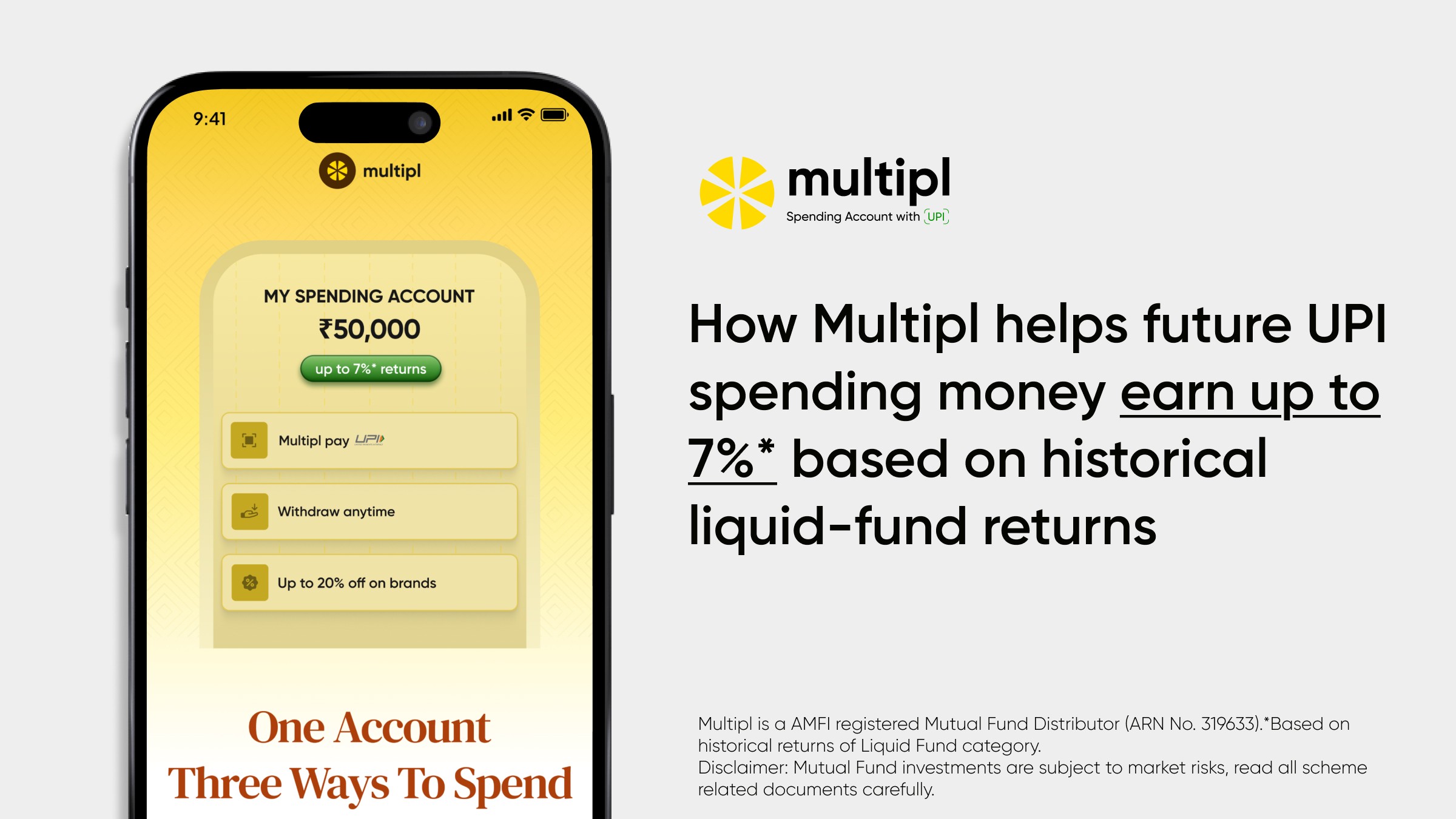
Multipl is not a UPI app. It solves a different part of the same spending journey.
Instead of focusing only on the payment moment, Multipl helps users park money meant for near-term spending in expert-selected liquid mutual funds through its Higher-Yield Spending Account. This is a mutual-fund-powered spending account, not a bank savings account or bank deposit, and it is not insured like a bank deposit. That money remains liquid and withdrawable when needed, and it can earn up to 7%* based on historical liquid-fund returns, versus the 2% to 3.5% many savings accounts typically offer. Returns are market-linked, not guaranteed. No investment is zero-risk, and liquid funds are low-risk rather than risk-free.
This matters for everyday UPI spenders because a lot of monthly spending is planned in advance, even if the exact payment dates are not. Food orders, shopping budgets, short trips, bill cycles, school payments, festival spends, and routine household purchases all involve money that often sits idle before use.
Multipl’s approach is simple in concept:
Set Aside Money For Real Spending Goals: This can be a monthly spend bucket or a specific goal such as travel, gadgets, school fees, or festive shopping.
Let That Money Stay Invested Until You Need It: The Higher-Yield Spending Account uses liquid mutual funds aimed at short-term parking with liquidity.
Withdraw When It Is Time To Spend: Funds can be redeemed back to your bank whenever needed.
Stack Brand Savings On Top: Multipl also offers partner-brand discounts, typically around 2% to 20% depending on the brand and redemption flow.
This is the Spendvesting idea that Multipl is known for. You prepare for spending in advance, let the money work while it waits, and aim to avoid EMIs or debt for planned purchases, whether that is an iPhone, a wedding expense, school fees, or flights.
For someone comparing upi apps features and limits, this is a useful shift in perspective. The UPI app still matters for execution. Multipl improves the efficiency of the money pool behind those payments.
There are also trust and structure reasons this model stands out. Multipl Wealth Management Private Limited is a SEBI-Registered Investment Adviser with registration number INA200014681 and an AMFI-Registered mutual fund distributor with ARN-319633. The company states that mutual fund units are held in the user’s own name with the AMC, and payments are secured via Razorpay with bank-grade encryption, while users can withdraw when needed. Mutual fund investments are subject to market risks, users should read all scheme-related documents carefully before investing, and mutual fund gains are taxable. SEBI registration and NISM certification do not guarantee performance or assure returns.
For people who want a practical spending system, the fit looks like this:
Use A UPI App For Transactions: Choose the app that best matches your bill-pay, QR, or online-shopping habits.
Use Multipl For Spend-Ready Parking: Keep near-term spending money earning until it is needed.
Use Goals To Avoid Debt: Fund known future purchases without defaulting to credit or no-cost EMI habits out of convenience.
That is a different value proposition from cashback. It is broader, steadier, and closer to how households actually manage money month to month.
Best UPI apps in India: the right stack for cashback, liquidity and debt-free spending
The right answer for most people is not one app. It is a stack.
Choose PhonePe, Google Pay, Paytm, Amazon Pay, BHIM, or CRED based on how you pay. That covers QR scans, online checkouts, transfers, recharges, and offers. Each has a valid place in a shortlist of the best upi apps india users might consider, depending on whether they care most about bill pay, simplicity, shopping, or reward culture.
Then solve the bigger spending problem separately. If you know you will spend that money over the next few weeks or months, keeping all of it idle in a low-yield account is usually the weakest part of the setup. Multipl fits here as the layer for future spending money, helping it earn up to 7%* based on historical liquid-fund returns until you are ready to use it, while also giving access to partner-brand discounts on select spends.
Seen this way, the best UPI app for cashback handles the transaction well. A smarter spending system handles the money well before the transaction. That combination gives you better control, better liquidity, and a more debt-free way to spend.
FAQs
Which is the best UPI app in India for cashback?
The best UPI app in India for cashback depends on where you spend most often. Paytm, PhonePe, Amazon Pay, and CRED can be attractive for rewards-led users, but offers change often, so the best pick is usually the one that matches your bill payments, shopping habits, and merchant usage.
Do all UPI apps in India have the same transaction limits?
No, UPI transaction limits can vary by bank, app flow, and transaction type. NPCI sets the framework, but app help centers such as Google Pay’s also note that limits may differ by linked bank account, while BHIM publicly lists its own user limits.
Is cashback the best way to save money on UPI payments?
Cashback helps, but it is usually a small part of total savings. A better long-term approach is to combine a good UPI app for payment convenience with a smarter place to park future spending money before you pay.
How does Multipl fit in if it is not a UPI app?
Multipl fits before the payment stage, not at the payment stage. It helps users keep near-term spending money in liquid mutual funds through its Higher-Yield Spending Account, a mutual-fund-powered spending account, that can earn up to 7%* based on historical liquid-fund returns until they need to withdraw and spend from their bank account.
Is money parked for future spending on Multipl risk-free?
No, it is not risk-free. Multipl’s Higher-Yield Spending Account uses liquid mutual funds, which are generally low-risk and designed for short-term parking, but no investment is zero-risk. Mutual fund investments are subject to market risks, returns are not guaranteed, and users should read all scheme-related documents carefully.
Multipl is a AMFI registered Mutual Fund Distributor (ARN No. 319633).
*Based on historical returns of Liquid Fund category.
Disclaimer: Mutual Fund investments are subject to market risks, read all scheme related documents carefully.