•
1 min read
Best Money Saving Apps in India (2026) | Multipl

Best Money Saving Apps in India (2026): Cashback, Budgeting and Spendvesting Compared
Most lists of the best money saving apps in India stop at the point where the money stops moving. They tell you how to track a Swiggy order, cap your shopping budget, and claw back Rs 40 of cashback. Then they go quiet about the Rs 60,000 sitting in your account, waiting to become a Goa trip in March. That gap is the real leak.
This roundup follows a single rupee through six stages of its life, from the moment it leaves your salary account to the moment it becomes a purchase. Each stage has a different kind of app doing the work: expense trackers, budgeting tools, cashback and coupon platforms, parking options for short-term money, and spendvesting apps that grow planned spending money until the spend date. Stages four to six are where most Indians quietly lose the most, and they are exactly the stages traditional lists skip.
The leaky bucket: why tracking apps alone stopped saving Indians money
Expense tracking had a good run. When SMS parsing arrived, seeing your spends categorised automatically felt like a revelation. Then UPI took over, categories got messy, and knowing you spent Rs 8,400 on food delivery last month stopped changing anything.
Tracking answers "where did it go?" It doesn't answer "where should it sit until I need it?" A household that runs a tight budget and still parks three months of planned spending in a savings account paying 2 to 3.5% is patching a small hole while a bigger one stays open. Inflation quietly does the rest.
The second problem is app fatigue. Nobody keeps eleven apps alive. If you install four and open one, the other three are just notification noise. A stack that works in 2026 has one app per job, and ideally one app doing three jobs at once.
The six stages of a spending rupee (and the app that owns each one)
Here's the full path, so you can see which stage your current setup ignores.
See it: automatic expense tracking so you know what actually leaves your account each month.
Cap it: budgets, bill reminders and limits that stop the leak before it happens.
Claw it back: cashback, coupons and card rewards on spends you were making anyway.
Park it: choosing where near-term money sits between payday and purchase day.
Grow it till you spend it: putting dated spending money into low-risk mutual funds instead of idle cash.
Spend it: paying by UPI or redeeming a goal, ideally with a brand discount attached.
Stages one to three are crowded with good options. Stages four to six are thin on the ground, and that's where a few hundred rupees of coupon savings gets dwarfed by what idle cash gives up.
Stage 1. See it: the best money saving apps in India for automatic expense tracking

What you want here is passive. If an app asks you to enter every chai manually, you'll abandon it in nine days.
Bank and UPI app statements: Most major banking apps now ship a spend analyser that categorises debits without any setup. Free, already installed, and good enough for a lot of people.
Dedicated SMS-parsing trackers such as Axio (formerly Walnut) or Money View: These read transaction alerts and build a category view across cards and accounts. Useful if you spend across three or more banks.
Account aggregator-based apps: The RBI's Account Aggregator framework lets apps pull consented data directly rather than scraping SMS. Cleaner data, and you control the consent window.
Set a low bar for this stage. One month of honest data is enough to size your true monthly spending number, which is the input everything else depends on.
Stage 2. Cap it: budgeting apps and bill reminders that actually enforce a limit
A budget that only exists as a chart is a suggestion. The cashback and budgeting apps India users stick with are the ones that put friction in the path of a spend, or at least tell you before the money's gone.
Look for category caps with alerts that fire mid-month rather than on the 30th. Look for bill and EMI reminders that catch autopay dates before penalty charges land. And check whether the app lets you separate fixed obligations from discretionary money, because that split is what makes the rest usable.
The stronger move at this stage isn't an app at all. It's separation. Move your month's discretionary spending money out of the account your salary lands in, so the balance you see is the balance you can spend. Budgeting apps help you decide the number. Physically moving the money is what enforces it.
Stage 3. Claw it back: cashback, coupon and card-reward apps worth keeping installed
This stage is genuinely useful and genuinely oversold. Cashback platforms like CashKaro and coupon aggregators return a slice of spends you were making anyway, and credit card reward apps such as CRED help you track and pay bills on time. On a Rs 25,000 monthly online spend, a 2 to 5% blended return is real money.
Two rules keep this stage honest:
Never let a discount create a spend. A 30% off notification that produces a purchase you hadn't planned is a 70% loss, not a 30% saving.
Check the payout timeline. Some cashback confirms in 60 to 90 days after the retailer settles. Money you're counting on for a March purchase shouldn't be sitting in a pending cashback wallet.
Keep one or two apps to save money in India at this stage, not five. Diminishing returns arrive fast.
Stage 4. Park it: where your next 3 months of spending money should sit
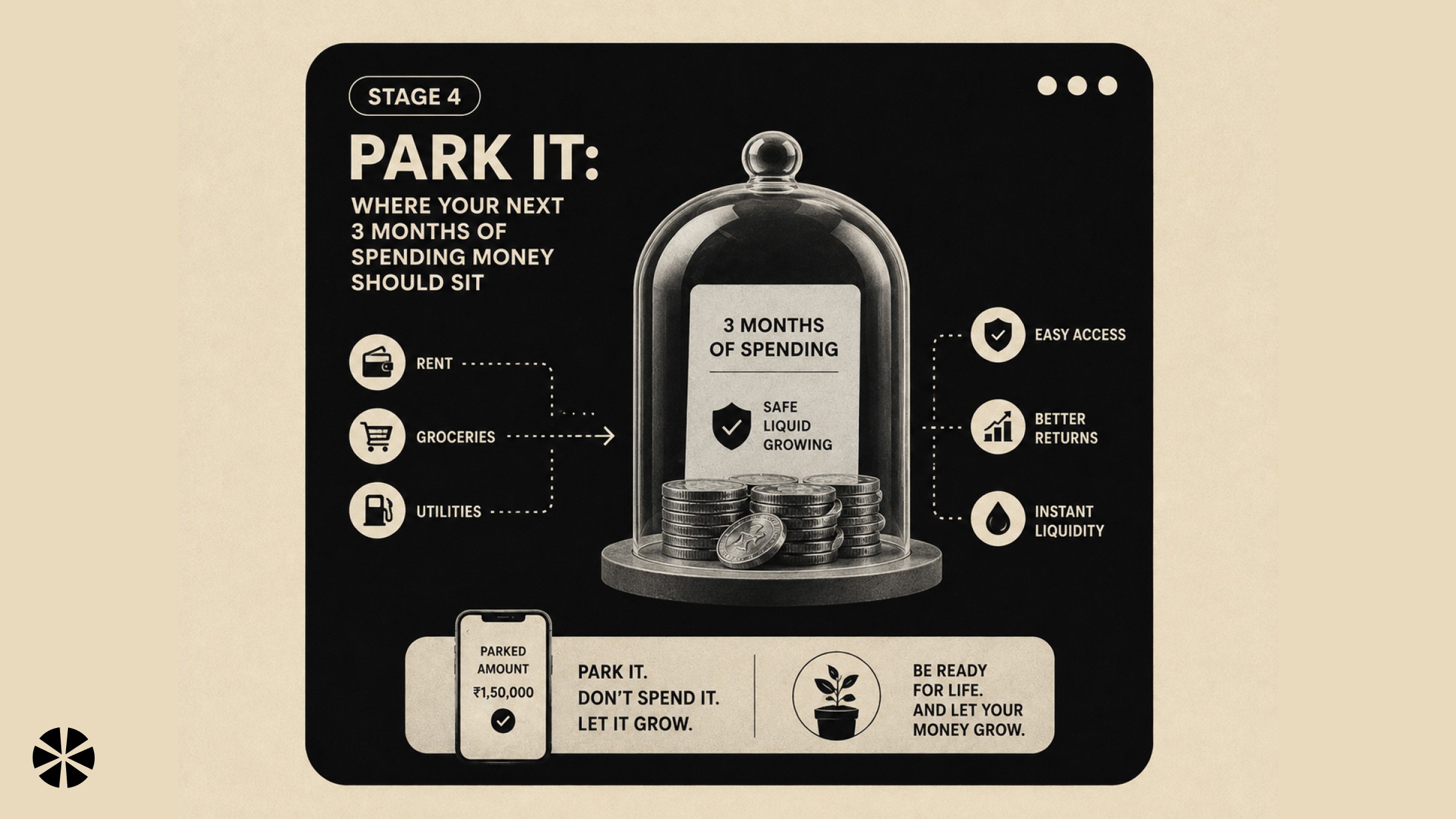
Now the interesting part. You've tracked, capped and clawed. You're left with a balance: rent buffer, next month's spends, the Rs 80,000 you're building for a laptop in April, the wedding gift fund for December.
Most of that money sits in a savings account earning 2 to 3.5%. The usual alternatives each cost you something. A fixed deposit locks it or charges a premature withdrawal penalty. Equity mutual funds carry volatility that short-term money can't absorb. A digital wallet earns nothing at all.
Liquid mutual funds were built for exactly this window. They invest in short-term money-market instruments, carry no lock-in, and are designed for low volatility rather than growth. Historically, the category has delivered returns above what a savings account pays, though liquid funds are low-risk rather than risk-free, no investment is zero-risk, and returns move with market conditions. Redemption typically hits your bank quickly, and many platforms support instant redemption up to regulatory limits.
Ask this of any of the best savings apps India offers: does it let money stay spend-ready while it earns, or does it force you to choose?
Stage 5. Grow it till you spend it: how spendvesting apps close the gap traditional lists ignore
Spendvesting is the idea that money set aside for a future spend should be invested until the day you actually spend it. Not saved and forgotten. Not locked away either. Invested with a date attached, then redeemed for the purchase it was always meant to fund.
Almost every money saving apps India roundup leaves this stage out, because it doesn't fit either bucket. A cashback app it is not, and a long-term investing app it is not. It's the layer in between, and it's where the largest amount of idle money sits for the longest time doing the least work.
Multipl was built around this. The money you'd normally leave idle for near-term spends gets invested in expert-selected liquid mutual funds and can earn up to 7%* based on historical liquid-fund performance, against the 2 to 3.5% a savings account typically pays. The units are issued by the AMC in your own name. You can withdraw anytime, subject to cut-off timings and regulatory limits on instant redemption. Mutual fund investments are subject to market risks, and those historical numbers are not a promise or guarantee of future returns.
The behavioural side matters as much as the yield. A dated goal named "Kerala, September" is much harder to raid for an impulse buy than an anonymous bank balance, which is why goal-based saving tends to survive contact with real life.
Stage 6. Spend it: paying by UPI and unlocking brand discounts at redemption
The last stage decides whether the previous five were worth anything. Money that grows for five months and then gets withdrawn into a general account tends to disappear into the noise.
Two things make this stage work. First, the money should be spendable directly, including for routine UPI payments, so the balance you built is the balance you use. Second, redemption should carry a discount. Multipl works with 70 to 100+ partner brands across travel, electronics, fashion, groceries and healthcare, offering roughly 2 to 20% off when you redeem a goal. These are redeemable offers tied to goals rather than blanket cashback on every transaction, so check what's available for your category before you plan around a specific number.
Stack it up: returns on money that would otherwise be idle, plus a brand discount at purchase where an offer is live, plus no EMI interest because you funded the thing with your own money. That third one is often the biggest.
Multipl walkthrough: Higher-Yield Spending Account, Planned Spends (3 to 12 months) and Wealth Account
Multipl splits money by time horizon, which is the cleanest way to think about it.
Higher-Yield Spending Account: For money you'll spend soon or unpredictably. Invested in liquid mutual funds, with up to 7%* based on historical liquid-fund returns rather than any assured rate, and spend-ready for food delivery, cabs, UPI payments and the trips you didn't plan. It is a mutual-fund-powered spending account, not a bank savings account or bank deposit.
Planned Spends: For dated goals roughly 3 to 12 months out. Weddings, school fees, a family trip, the next phone. These use liquid and hybrid funds with around 7 to 15%* based on historical, category-dependent performance, depending on the mix and horizon, with brand gift cards available on redemption.
Wealth Account: For surplus and goals beyond three years, with curated long-term portfolios that have historically delivered around 15 to 20%*, category-dependent and not guaranteed, built by an in-house team of CAs, CFA charterholders and MBAs with no bias toward any fund house.
Multipl Wealth Management Private Limited is a SEBI-Registered Investment Adviser (INA200014681) and an AMFI-registered mutual fund distributor (ARN-319633), headquartered in Bengaluru. Around a million app downloads and 5 lakh+ Spendvesters have used it so far. Payments run through Razorpay with bank-grade encryption, and your mutual fund units are held in your own name at the AMC.
Build your 2026 money saving app stack: three ready-made combos by income and lifestyle
The starter stack (first job, Rs 30,000 to Rs 60,000 a month)
Use your bank app's built-in spend analyser for stage one. Skip a separate budgeting app. Keep one cashback platform for online shopping. Move your month's discretionary money into a Higher-Yield Spending Account so it can earn while you spend it, and open one Planned Spend for whatever you're actually saving toward. Three apps total.
The family stack (dual income, kids, Rs 1.5 lakh+ a month)
Add a proper tracker that consolidates across four or five accounts, plus bill reminders for school fees, insurance premiums and utilities. Run parallel Planned Spends for annual fees, the summer holiday and festival shopping, each with its own date. Keep the Wealth Account for the retirement and education corpus that shouldn't be touched.
The high-spend urban stack (heavy card and travel user)
Card reward tracking earns its place here because reward rates on Rs 1 lakh+ monthly spends are material. Pair it with a spending account that can earn on the float between statement date and payment date. Then use Planned Spends for the flights and hotels you book two to six months ahead, where redeemable offers with travel partners may apply on top.
What each stage is realistically worth in rupees a year
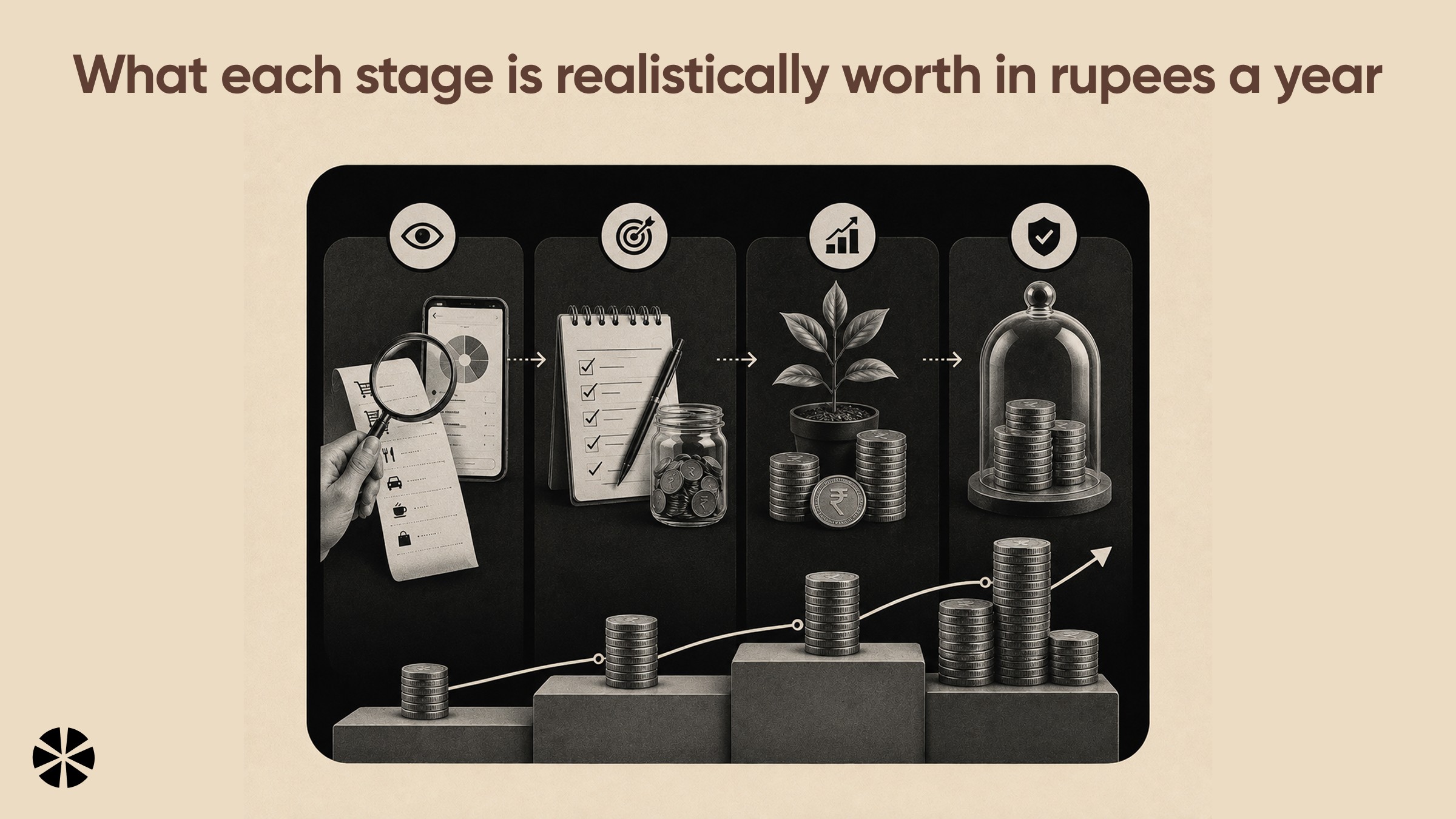
Illustrative arithmetic, not a projection. Assume a household spending Rs 60,000 a month, with an average Rs 1.5 lakh of near-term money parked at any time.
Stage | Typical annual value | Effort |
|---|---|---|
See it | Rs 0 directly, but sizes everything else | One-time setup |
Cap it | Rs 6,000 to Rs 18,000 from cutting 1 to 3% of leakage | Ongoing |
Claw it back | Rs 6,000 to Rs 15,000 at 2 to 5% on online spends | Ongoing, small |
Park it and grow it | Historically, the gap between a 2 to 3.5% savings account and liquid-fund category returns on Rs 1.5 lakh has been in the low thousands of rupees a year, with no assured outcome | One-time setup |
Spend it | Rs 2,000 to Rs 20,000 depending on how much of a big purchase carries a 2 to 20% brand discount | Per redemption |
Actual outcomes vary with market conditions, your spending pattern and which offers are live. The point of the table is the shape, not the exact figures: the last three stages compound quietly and need almost no ongoing effort, while the first three need constant attention for a capped benefit.
The fine print: market risk, liquidity, taxation and what SEBI or RBI registration does and doesn't cover
Mutual fund investments are subject to market risks. Read all scheme-related documents carefully before investing. Liquid funds are designed to be low-risk and low-volatility, and they are not risk-free or guaranteed. No investment is zero-risk, and returns vary with market conditions.
A spending account powered by mutual funds is not a bank savings account and not a bank deposit. It isn't insured the way a bank deposit is. What it does carry is your ownership: units are issued by the AMC in your name, and you can redeem whenever you want.
Gains from mutual funds are taxable, and the treatment depends on the fund category and your holding period. Rules change, and your situation is specific to you, so check the current position with a qualified tax professional rather than relying on a blog. Nothing here is individualised investment or tax advice. The tax treatment for mutual funds is explained by AMFI.
SEBI registration as an Investment Adviser and AMFI registration as a distributor mean the entity is regulated, supervised and accountable for how it advises and distributes. SEBI registration and NISM certification do not guarantee performance or assure any level of returns. Any figure marked with an asterisk in this piece reflects historical, category-dependent performance, not a forecast.
FAQs
How many money saving apps should I actually keep on my phone?
Three to four is the practical ceiling for most people. One for seeing and capping spends, one cashback or rewards app for the categories you genuinely shop in, and one place where your near-term money can earn while staying spend-ready. Anything beyond that tends to sit unopened and stops influencing your decisions.
Is a liquid fund safer than keeping money in a savings account?
They carry different kinds of risk. A savings account balance is a bank deposit with a fixed, low interest rate and deposit insurance up to the prescribed limit, while a liquid fund is a market-linked mutual fund investing in short-term money-market instruments, designed for low volatility but not guaranteed. Liquid funds have historically delivered higher returns than savings accounts, and no investment is zero-risk.
Can I withdraw money from a spendvesting app if I need it urgently?
Yes. There's no lock-in on the Higher-Yield Spending Account, and units are redeemed to your linked bank account when you ask for them. Instant redemption is subject to regulatory limits and cut-off timings, so for very large amounts plan a working day of buffer.
Are cashback apps still worth using in 2026, or have rates dropped too far?
They're still worth one slot in your stack if you shop online regularly. Blended returns of 2 to 5% on planned purchases add up over a year, and the effort is close to zero once the app is installed. The trap is letting offer notifications generate purchases you hadn't budgeted for, which wipes out the benefit several times over.
What's the minimum amount needed to start spendvesting?
You can start with small amounts, which is part of the point. The idea works for a Rs 500 weekend fund just as it works for a Rs 2 lakh wedding goal, because the mechanic is the same: money with a date attached can earn until that date instead of sitting idle. Start with one month of discretionary spending and add a dated goal once you've seen how the redemption flow works.
Multipl is a AMFI registered Mutual Fund Distributor (ARN No. 319633).
*Based on historical returns of Liquid Fund category.
Disclaimer: Mutual Fund investments are subject to market risks, read all scheme related documents carefully.