•
1 min read
Best Personal Finance Apps in India (2026) | Multipl

Best Personal Finance Apps in India (2026): Budgeting, Saving, Investing and Goal Planning
Most lists of the best personal finance apps in India rank tools against each other as if they all do the same job. They don't. A budgeting app and a mutual fund app are not competitors, any more than a fuel gauge competes with an engine. They sit at different points in the life of a single rupee, and the app that wins at one point is often useless at the next.
This guide takes a different route. It follows one rupee of your salary through five stages, from the moment it lands in your bank account to the day it becomes a wedding booking, a school fee or a flight to Da Nang. At each stage you'll see which category of app genuinely owns that job, what the wrong choice costs you, and where the biggest silent leak sits.
Why Most Rankings of the Best Personal Finance Apps in India Judge Apps at the Wrong Stage
Feature checklists reward visible things. Dashboards, charts, streaks, category pie slices. Those are easy to screenshot and easy to score, so roundups keep scoring them.
Visibility and outcome are not the same thing, though. You can categorise every rupee you spent last month with perfect accuracy and still end the year with two lakh rupees sitting in a savings account at 2 to 3.5%, waiting for a purchase that is nine months away. The tracking worked. The money didn't.
Judge apps by outcome and the ranking changes shape. Ask a simpler question of each one: what did this app actually do to the money while I held it? Some answer with information. Some answer with access. Very few answer with market-linked returns on money you are about to spend, which is exactly where most Indian households park their largest short-term balances.
The Five-Stage Rupee Journey: Track, Park, Grow, Spend, Plan
Every rupee you earn moves through some version of this sequence:
Track. You need to know what came in and where it went. This is the diagnostic stage.
Park. Money you'll spend in the next few weeks or months has to live somewhere. This is the storage stage, and it lasts longer than most people realise.
Grow. Surplus you won't touch for three years or more goes into long-horizon investments. This is the compounding stage.
Spend. The payment itself happens. Price, rewards and discounts decide how much value you keep.
Plan. A dated future expense gets funded on purpose instead of by scramble. This is where life events live.
A useful mental model: stages 1, 3 and 4 are crowded with strong Indian apps. Stage 2 is where money sits idle by default, and stage 5 is where most people improvise. The gap between those two facts is what this article is really about.
Stage | What the money is doing | App category that owns it | Typical time horizon |
|---|---|---|---|
Track | Being observed | Expense trackers, account aggregator apps | Ongoing |
Park | Waiting to be spent | Savings accounts, liquid fund and spending-account apps | 1 day to 12 months |
Grow | Compounding | Mutual fund platforms, brokers, retirement apps | 3 years and beyond |
Spend | Leaving your control | UPI apps, card and rewards apps, brand offers | Instant |
Plan | Being assembled toward a date | Goal planning apps India users set up per life event | 3 to 12 months |
Stage 1, Track: Personal Finance Apps in India That Show Where Your Money Went
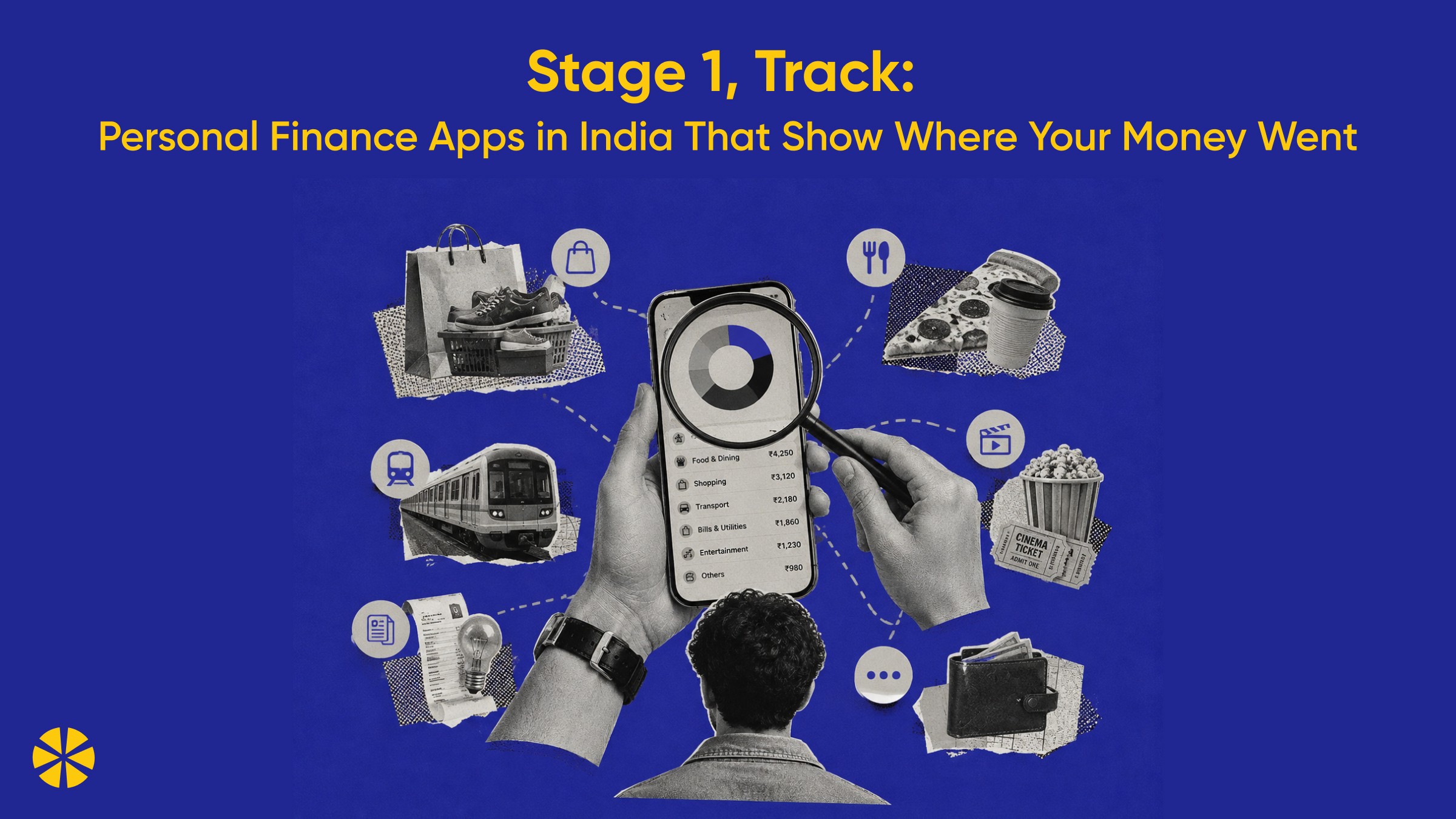
The tracking category has matured fast. Account Aggregator consent flows now let apps pull bank and investment data with your permission instead of asking you to forward SMS alerts, and the better money management apps India users install will auto-categorise spends, flag subscription renewals and show month-on-month drift.
What to look for at this stage:
Coverage of your actual accounts, including salary bank, UPI handles, and any card you use for large spends. Partial coverage produces confident, wrong numbers.
Editable categories, because the automatic guess for "PAYTM*XXXX" is often nonsense and stays nonsense unless you can fix it.
A read-only posture, meaning the app shows data but does not move money without a separate, explicit mandate.
An export option, so a year of history is not trapped if you switch apps.
What tracking cannot do: raise the yield on the balance it is describing. A budgeting app that tells you ₹85,000 is sitting idle has done its job. The rupee is still idle.
Use this stage for two or three months, then stop optimising it. Chasing the perfect category tree is a comfortable way to avoid the harder decisions further down the journey.
Stage 2, Park: The Idle-Money Gap Almost Every Personal Finance App Leaves Open
Here's the leak. Look at your own balance and split it honestly. Some of it is a real emergency buffer. Some of it is money already earmarked for something specific, a trip in April, a laptop in July, insurance premiums in November. That earmarked money is neither long-term capital nor emergency capital. It is spend-ready money, and in a standard savings account it earns roughly 2 to 3.5%.
Most budgeting and saving apps India households use will show you that balance without offering a way to improve it. Investing apps have the opposite problem. They are built for money you're locking away, so parking a wedding fund in an equity scheme is a poor horizon match for a March 2026 date.
Liquid mutual funds sit in the middle of that gap. They are a low-risk, low-volatility category designed for short-term money, investing in short-term money-market instruments, with no lock-in and high liquidity. Historical liquid-fund returns have run higher than a typical savings account rate, which is why Multipl's Higher-Yield Spending Account, a mutual-fund-powered spending account rather than a bank account, invests in liquid funds that have historically returned up to 7%* on money you are holding for near-term spends. That figure is based on historical liquid-fund performance and is market-linked, not fixed or assured. No investment is zero-risk. Liquid funds are low-risk and low-volatility rather than risk-free, and returns move with market conditions.
The practical test for any app claiming this stage:
Can you withdraw whenever you want, without a lock-in or an exit penalty on your parked balance?
Are the mutual fund units held in your own name at the AMC, rather than pooled in the platform's name?
Is the yield claim clearly labelled as historical, or is it presented as a rate?
Can you actually spend from the balance, or does every purchase need a two-day redemption detour?
Stage 3, Grow: Investing Apps for Money You Will Not Touch for Three Years or More
Long-horizon money has a different brief. Volatility over a five-year window is survivable and often necessary, so this is where equity funds, index funds, retirement products and direct stock investing belong.
The finance apps Indian investors use for this stage compete on cost, research depth and portfolio construction. Discount brokers win on execution and low fees. Direct mutual fund platforms win on regular-plan commission savings. Advisory platforms win when you want someone else to decide the allocation, which matters more than people admit once portfolios pass a few lakh rupees.
Multipl's Wealth Account sits in this stage: curated long-term mutual fund portfolios built by an investment team of CAs, MBAs and CFA charterholders, for surplus and goals beyond three years, where historical category performance has been roughly 15 to 20%*. That range is historical and category-dependent, not a promise or an assured return.
The mistake to avoid is horizon-mixing. Sending your November insurance premium into an equity SIP because the returns look better is how people end up redeeming at a loss in a bad month. Match the fund category to the date you need the money, not to the return you'd like.
Stage 4, Spend: Apps That Make the Payment Itself Cheaper (UPI, Rewards and Brand Discounts)
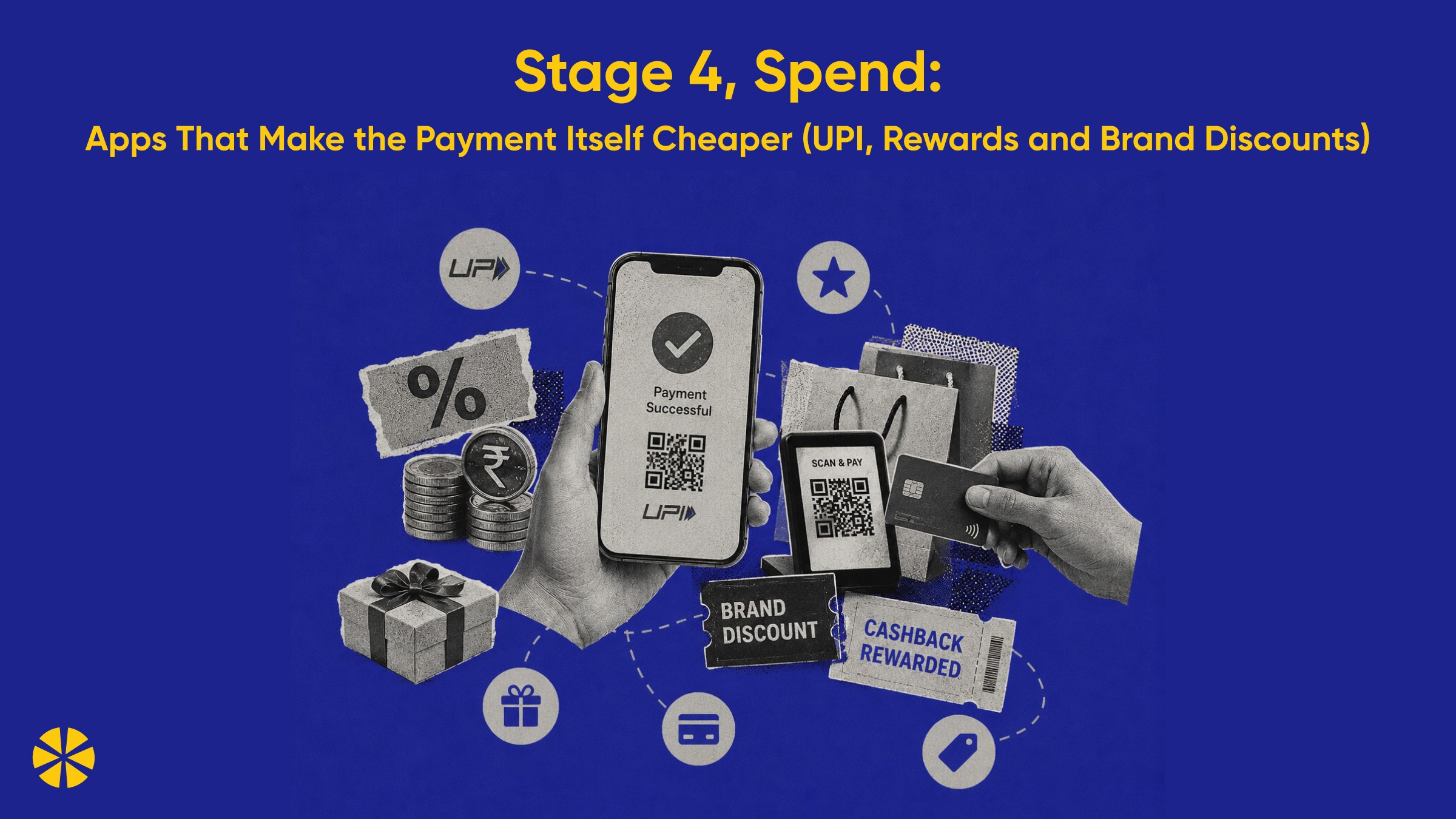
Payment apps compete on friction and on value returned per rupee spent. UPI apps have effectively won the friction race in India. What separates them now is what comes back to you: scratch cards, cashback, card-linked offers and brand-specific discounts.
Three things to weigh:
Reward reliability. A contracted 2% on a category beats a lottery-style cashback that averages far less.
Where the discount is applied. Merchant-funded brand offers at the point of purchase are usually worth more than points that expire in a wallet you forget.
Whether the payment source itself earned anything. This is the overlooked one. If a payment is funded from a balance that was sitting at 2 to 3.5% for four months, the reward on the transaction may be smaller than the yield you gave up while waiting.
Multipl stacks these two layers deliberately. Everyday spends, including routine UPI payments, can be funded from a balance that was invested until the moment you spent it, and when you redeem a goal, 70 to 100+ partner brands across travel, electronics, fashion, groceries and healthcare offer roughly 2 to 20% off. Those are redeemable offers tied to a goal, not blanket cashback on every transaction.
Stage 5, Plan: Goal and Life-Event Apps for Weddings, School Fees, Travel and the Next Phone
Life events are the reason most people search for goal planning apps India platforms offer in the first place. A wedding in eight months. A sibling's destination trip in five. School admission fees in April. A phone upgrade when the new model lands.
Generic SIP calculators handle the arithmetic and stop there. A dated goal needs four things working together: a target amount, a fixed date, an instrument matched to that date, and a spending route at the end so the money doesn't leak back into general balance.
Multipl's Planned Spends is built for exactly this window, roughly 3 to 12 months, using liquid and hybrid funds, where historical returns have been around 7 to 15%* depending on the plan and category. That range is historical and market-linked, not an assurance. Set the goal and the date, contribute monthly, and redeem with a brand gift card at the end so the discount lands on the purchase itself.
The debt-free framing matters here. A ₹90,000 phone bought on a 12-month EMI costs more than ₹90,000. The same phone funded by nine months of planned contributions, with the balance invested through those nine months and a partner discount at redemption, can cost less than ₹90,000. Same phone, two different prices, decided largely by which stage-5 tool you used.
Spendvesting: How Multipl Connects the Park, Plan and Spend Stages in One Account
Spendvesting is a simple idea with an unusual implication: invest the money you have set aside for future spends, so it has the chance to grow until the day you actually spend it.
In practice, one app covers three stages that are normally split across three. Money you'll spend this month goes into the Higher-Yield Spending Account, invested in expert-selected liquid mutual funds and staying instantly spend-ready. Money for a dated life event goes into Planned Spends. Payments, including UPI, draw from balances that were invested right up to the transaction, and goal redemptions carry brand discounts you can redeem against the goal purchase.
Know the structure behind it before you move money anywhere. Multipl Wealth Management Private Limited is a SEBI-Registered Investment Adviser (INA200014681) and an AMFI-Registered mutual fund distributor (ARN-319633), headquartered in Bengaluru and led by co-founder and CEO Paddy Raghavan. Mutual fund units are issued by the AMC and held in your name. Withdrawals are available at any time, payments run through Razorpay with bank-grade encryption, and fund selection is done by a team of CAs, CFAs and IIM MBAs with no bias toward any fund house. Around a million app downloads and 5 lakh+ Spendvesters have used it so far.
The honest caveat, stated plainly: this is a mutual-fund-powered spending account, not a bank savings account and not a deposit, so it is not insured the way a bank deposit is. No investment is zero-risk. Mutual fund investments are subject to market risks. Read all scheme-related documents carefully. SEBI registration and NISM certification do not guarantee performance or assure returns.
Stack, Don't Collapse: Two- and Three-App Combinations That Cover the Full Cycle
No single app is best at all five stages, and any app claiming otherwise is usually average at four of them. Stacking works better.
The two-app minimum. One tracker for visibility plus Multipl for park, plan and spend. This covers the diagnostic stage and closes the idle-money gap, which is the combination that tends to change outcomes fastest for salaried earners.
The three-app standard. Tracker, Multipl for short-term and dated money, and a long-term investing platform or wealth account for anything beyond three years. Most households never need more than this.
The four-app version. Add a dedicated card-rewards or offers app if you spend heavily in one or two categories and the rewards genuinely clear the annual fee.
Set a rule for where each rupee goes on payday, then let the apps enforce it. Stacking beats consolidation because each stage has different regulation, different risk and different liquidity needs, and one interface flattening all of that usually flattens the returns too.
The Debt Detour: Where BNPL, Credit-Card and EMI Apps Interrupt the Rupee Journey
Buy-now-pay-later and no-cost EMI products don't sit in the five stages. They reverse them. Instead of park, plan, then spend, you spend first and then service the obligation for months afterward, which means stage 2 and stage 5 never happen for that purchase at all.
Check two things before using them. "No-cost EMI" often means the interest is folded into the price or into the discount you'd otherwise have received, so compare the upfront cash price with the EMI total, not with the sticker price. And every rupee committed to an EMI is a rupee that cannot be parked or planned, which quietly shrinks the base your future returns are built on.
Credit cards used as a 30-day float with full statement payment are a different case and can genuinely add value through rewards. The detour starts at revolving balances, where the interest rate almost always exceeds anything a low-risk short-term fund has historically returned.
Regulation and Data Sharing: What Each Stage Is Actually Governed By
Different stages answer to different regulators, and knowing which is which tells you what a company can and cannot say about your money.
Track: Account Aggregator flows are RBI-regulated and consent-based. You can revoke access, and you should check what data an app retains after you do.
Park and grow: Mutual fund investing sits under SEBI . Look for a SEBI RIA registration number or an AMFI ARN, and confirm that units are held in your name at the AMC. Registration itself does not guarantee performance or assure returns.
Spend: UPI runs on NPCI rails through your bank. Payment gateways handling money movement should be named clearly by the app.
Plan: Goal products are only as sound as the instruments underneath them, so read which fund categories a plan actually uses before you commit to a date.
One rule cuts through all of it: any app quoting a return should tell you whether that number is historical, category-based or contractual. Anything short-term and market-linked can only ever be the first two.
A 30-Day Setup Plan to Move From Tracking to Spendvesting
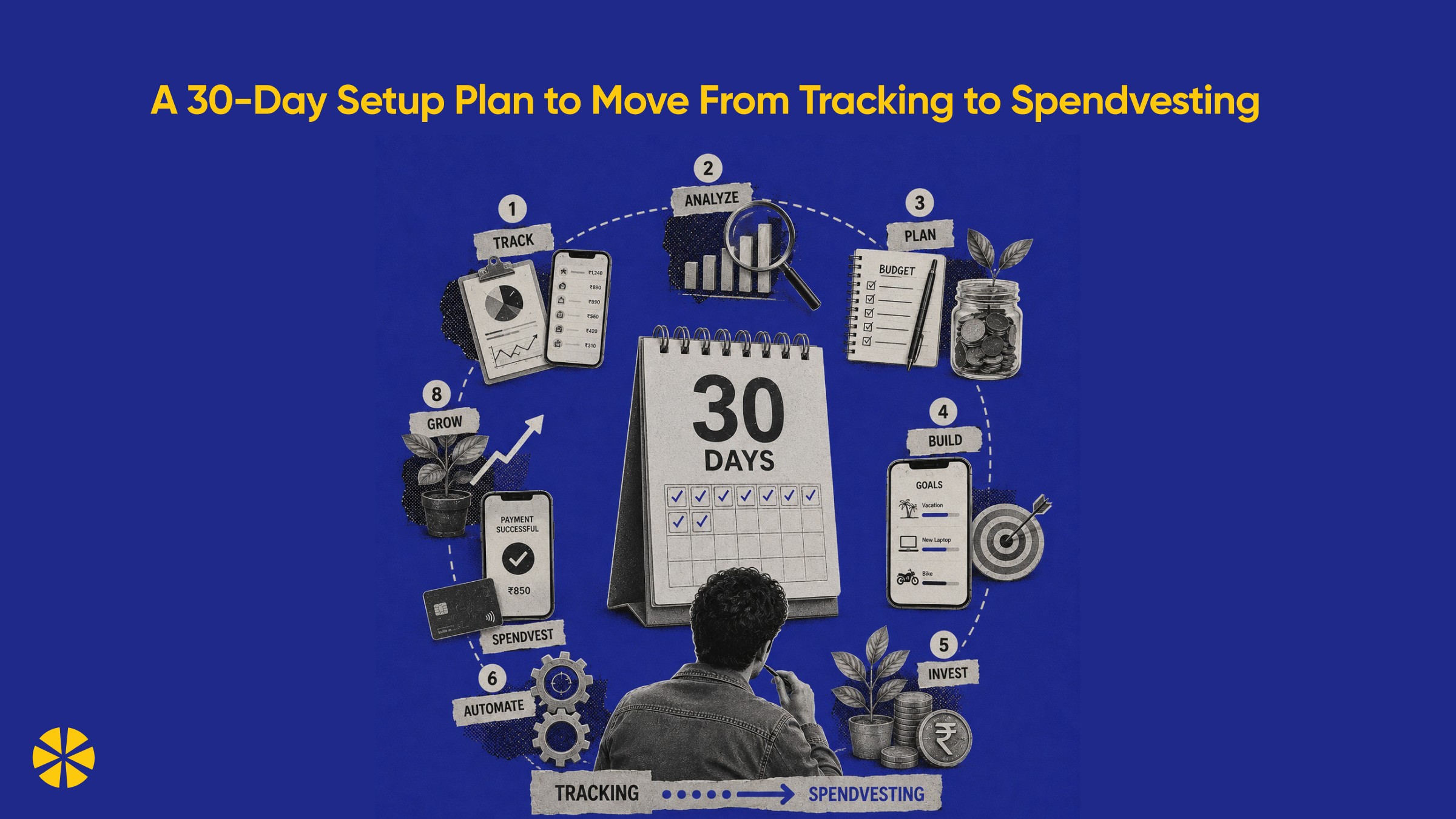
Days 1 to 7: Measure. Install one tracker, connect your salary account and main UPI handle, and let it run a full week without editing anything. Note your average end-of-day balance.
Days 8 to 14: Split the balance. Divide your bank balance into three buckets on paper: emergency buffer, spend-ready money for the next 30 to 60 days, and money earmarked for a dated expense within a year.
Days 15 to 21: Move the spend-ready bucket. Open a mutual-fund-powered higher-yield spending account and transfer a portion of that second bucket, keeping enough in the bank for autopay mandates. Make one real UPI payment from it so you can see the redemption speed for yourself.
Days 22 to 26: Set one dated goal. Pick a single life event with a real date, a wedding contribution, a school fee, a trip, and set it up as a Planned Spend with a monthly amount you are comfortable committing.
Days 27 to 30: Automate and review. Schedule the monthly transfer for the day after salary credit, then check whether a partner brand covers your goal purchase so the discount lands at redemption.
By day 31 you'll have the same visibility a budgeting app gives you, with one difference: the money waiting to be spent is invested in a low-risk, market-linked option rather than sitting idle. Read all scheme-related documents carefully before you decide what suits you.
FAQs
Is a liquid fund safer than a fixed deposit for short-term money?
They carry different kinds of risk rather than one being strictly safer. A fixed deposit gives you a contracted rate from a bank, while a liquid mutual fund invests in short-term money-market instruments and delivers market-linked returns with low volatility but no guarantee. Liquid funds usually offer easier access without premature-withdrawal penalties, which is why they suit money you may need at short notice. No investment is zero-risk, and returns vary with market conditions.
How much of my monthly spending money should I move into a mutual-fund-based spending account?
Start with the portion you can identify as genuinely spend-ready over the next 30 to 60 days, and keep enough in your bank account to cover autopay mandates, EMIs and card dues. Many people begin with 30 to 50% of their discretionary monthly budget and raise it once they've seen how quickly redemptions reach their bank. There's no need to move an emergency buffer or any money you might need within hours.
Are gains from short-term mutual funds taxable in India?
Yes, mutual fund gains are taxable, and the treatment depends on the fund category and your holding period. Debt-oriented and liquid fund gains are taxed differently from equity-oriented schemes, and rules change with Union Budget announcements. Check the current scheme documents and speak to a qualified tax professional about your own situation, since tax outcomes vary by individual circumstances.
Can one app really replace my budgeting app, savings account and investment platform?
No single app covers all five stages well, and treating one as a full replacement usually costs you somewhere. A tracker is still the best tool for visibility, a bank account is still needed for mandates and cash access, and long-horizon investing has different requirements from short-term parking. Two or three well-chosen apps, each doing the stage it's built for, tends to beat one app doing everything at 60% quality.
What happens to my money if a personal finance app shuts down?
For SEBI-regulated mutual fund platforms, the units are issued by the asset management company and held in your name, so your holdings sit with the AMC and the registrar rather than with the app. You can redeem directly through the AMC or the RTA if the platform becomes unavailable. Before investing anywhere, confirm the platform's SEBI RIA number or AMFI ARN and check that units are held in your own name rather than pooled.
Multipl is a AMFI registered Mutual Fund Distributor (ARN No. 319633).
*Based on historical returns of Liquid Fund category.
Disclaimer: Mutual Fund investments are subject to market risks, read all scheme related documents carefully.