•
1 min read
Liquid Fund vs Current Account Guide

Every freelancer and small business owner in India has had this moment. A client clears a ₹2.5 lakh invoice on the 3rd. Your GST payment is due on the 20th of next month, and your advance tax instalment lands three weeks after that. For those 40-odd days, the money sits in your current account doing absolutely nothing.
Not "growing slowly." Nothing. Zero.
This post is not about squeezing more out of your business. It is about the boring, invisible gap between the day money lands and the day it leaves, and whether that gap deserves a better home than the account it currently sleeps in.
The freelancer's real cash problem isn't earning more: it's what happens to money between invoice and spend
Independent professionals and small business owners obsess over the top line: more clients, better rates, faster collections. Fair enough. But map your bank balance over a full year and you will notice something odd. A meaningful chunk of your money is almost never at zero. There is a base layer that sits there permanently, refreshed by new invoices as old obligations get paid out.
For a freelancer billing ₹1.2 lakh a month, that base layer might be ₹2 to ₹4 lakh. For a small agency or trading business, it might be ₹10 lakh or more. It is not idle because you are careless. It is idle because it is committed: to GST, to TDS, to salaries, to rent, to that quarter when two clients go quiet.
The problem is that "committed later" and "needed today" are being treated identically. Both live in the same current account, earning the same return. One of those two categories has no business being there.
Why a current account pays 0%: the RBI rule most business owners never think about
Here is the part most people discover by accident: banks in India are not allowed to pay interest on current accounts. That is a regulatory position, not a bank being stingy. Current accounts are built as transactional accounts, with unlimited withdrawals, cheque facilities, overdraft eligibility and high transaction volumes, and the trade-off is that they carry no interest.
So the return on your business float is not "low." It is structurally nil.
Savings accounts do pay interest, typically in the 2 to 3.5% range for most large banks. Better than zero, but still often below the rate at which your costs are rising. And if you are a registered business, there are limits on what kind of entity can hold a savings account in the first place. We will get to that.
The point is not that current accounts are bad. They are essential. The point is that they were never built to store money you do not need for the next two months.
The three buckets of business cash: operating float, obligation money, and opportunity buffer
The cleanest way to think about business cash is not "how much do I have" but "when will I actually need it." Sort your balance by date, and three distinct buckets appear:
Operating float (0–15 days): Money you might touch tomorrow. Vendor payments, subscriptions, card bills, that urgent laptop repair, your own drawings.
Obligation money (15–90 days): Bills you already know are coming with a known date. GST, advance tax instalments, quarterly salaries, annual rent, insurance renewals, professional fees.
Opportunity buffer (3–12 months): The cushion. Dry-spell survival money, a planned equipment upgrade, the deposit on a bigger office, the first three months of a new hire's salary.
Each bucket has a different job and a different urgency, so each deserves a different home. Putting all three in the same account is like storing your groceries, your winter clothes and your passport in the same drawer. It works, until it costs you.
Bucket 1: Operating float (0–15 days) stays in your current account, full stop

This one is simple. Do not move it. Ever.
Your operating float exists to absorb surprises. A vendor asks for payment early. A client's cheque bounces. Your card auto-debit fires two days sooner than you planned. The value of this money is not its return. It is instant, unconditional availability at 11pm on a Sunday.
Every rupee of it belongs in your current account, and honestly, keep this bucket slightly larger than feels necessary. A comfortable rule of thumb for most freelancers is three to six weeks of fixed outflows: rent, subscriptions, EMIs, your own household transfer, plus a small padding for the unexpected.
Nothing in this article suggests you should shrink this bucket to chase returns. The whole exercise only works if bucket one is genuinely comfortable first.
Bucket 2: Obligation money (15–90 days), the GST, advance tax, salaries and rent you already know are coming
This is the bucket that changes the maths.
Obligation money has a strange property. You know exactly how much it is and exactly when it leaves. Your GST liability for a quarter is calculable. Advance tax instalments fall on fixed dates: 15 June, 15 September, 15 December, 15 March. Salaries go out on the 1st. Rent on the 5th.
You are, in effect, running a small time deposit for the government and your landlord, for free.
This is precisely the window liquid mutual funds were designed for. They invest in very short-term money market instruments such as treasury bills, commercial paper and certificates of deposit, with residual maturities of up to 91 days. Short instruments, minimal interest-rate sensitivity, no lock-in. Historically, the liquid fund category has delivered returns in the region of up to 7%*, though these are historical, category-dependent, market-linked and not guaranteed.
If you know money is leaving on the 20th of next month, parking it somewhere that has historically done better than 0% for those 45 days is not aggressive. It is just tidy.
Bucket 3: Opportunity buffer (3–12 months), dry-spell cushion, equipment upgrades, hiring runway
The third bucket is money with a purpose but no invoice yet. The camera body you will buy after the festive season. The three months of runway you keep because January is always slow. The deposit you will need if you move to a bigger space.
Because the horizon is longer, you have more options here, including modestly diversified short-duration or conservative hybrid combinations. That is broadly the territory Multipl's Planned Spends addresses for dated goals over roughly three to twelve months, with historical returns in the ~7 to 15%* range depending on the mix, category-dependent and not assured.
Two cautions, though. A longer horizon does not mean higher risk is automatically appropriate; this is survival money for many freelancers, and capital stability matters more than an extra percentage point. Second, be honest about the date. "Sometime next year" is not a horizon. "March, for the new workstation" is.
What is the difference between a liquid fund and a savings account (and a current account)?
The three sit on a spectrum from pure convenience to a bit more yield potential.
A current account gives you unlimited transactions, cheque books, overdraft access and zero interest. It is a plumbing product.
A savings account gives you interest, usually 2 to 3.5%, credited quarterly, with transaction limits and monthly free-withdrawal caps at some banks. Deposits up to ₹5 lakh per bank per depositor carry DICGC insurance cover. The return is not market-linked, and the money is a liability of the bank.
A liquid fund is a mutual fund scheme. Your money buys units of a scheme, and those units are held in your name at the AMC, not on any intermediary's balance sheet. The NAV moves daily with the value of underlying instruments. There is no lock-in, no interest rate promise, and no deposit insurance. What you get instead is exposure to short-term money market yields, which have historically been higher than savings account rates, plus daily liquidity.
The honest framing: a savings or current account offers certainty and convenience. A liquid fund offers the potential for better returns on money you will not need this week, with low volatility but not zero risk. No investment is risk-free, and returns vary with market conditions.
The opportunity cost, in rupees: what ₹3 lakh of obligation money earns at 0% vs 2 to 3.5% vs historical liquid-fund returns
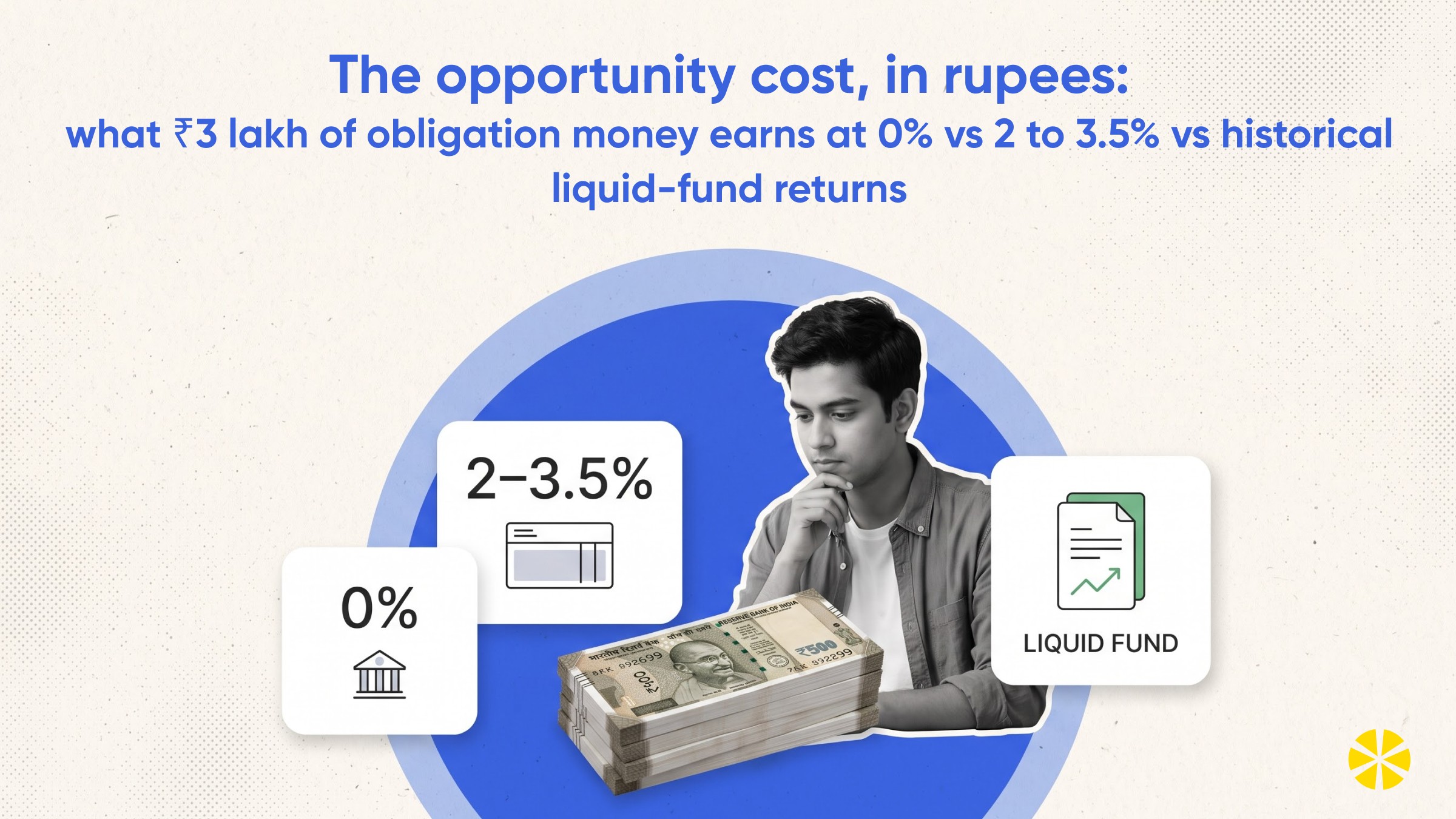
Abstract percentages are easy to shrug at. Rupees are not.
Take ₹3 lakh of obligation money held for an average of 60 days at a time, rolling continuously through the year:
Current account at 0%: ₹0. All year. Every year.
Savings account at 3%: roughly ₹9,000 a year, before tax.
Liquid fund at historical category returns of up to 7%*: up to roughly ₹21,000 a year, before tax and expenses, based on how the category has performed historically. Not a promise of what it will do next.
The gap between the first and third row is not life-changing money. But it is a month of a freelancer's software stack, or a decent laptop every three years, earned from cash you were already holding. And it compounds quietly, because the bucket refills every month.
Scale it up. A small business rolling ₹15 lakh of obligation money could see a difference measured in lakhs over five years on the same historical basis, an illustration rather than an assured outcome, from a decision that takes one evening to set up.
Why you should not keep large amounts idle in a savings or current account: inflation, sweep traps, and lost compounding
Three separate things erode idle business cash.
Inflation. If your costs rise 5 to 6% a year and your cash earns 0 to 3%, your buying power shrinks even as the balance stays flat. A ₹5 lakh equipment fund today does not buy ₹5 lakh of equipment in three years.
Sweep and balance traps. Many current accounts carry average monthly balance requirements, sometimes ₹25,000 to ₹1 lakh depending on the variant, with penalties for shortfalls. Some banks offer sweep-in fixed deposits, which do help, but sweeps often break in fixed slabs, may carry premature withdrawal terms, and the rate is fixed at booking. Worth using, worth understanding, not a substitute for thinking about buckets.
Lost compounding. The most invisible cost. Money that earns nothing does not just fail to grow. It fails to generate the base on which future growth would have compounded. Over a working life, the difference between a permanently idle ₹3 lakh and a working ₹3 lakh is meaningful.
None of this is an argument against banks. It is an argument against parking all three buckets in the same place by default.
Can I withdraw money from a liquid fund at any time? Cut-offs, T+1 credit, and the instant-redemption limit explained
Yes. Liquid funds have no lock-in, and you can place a redemption request on any business day. But the mechanics matter, and this is where business owners get caught out.
Standard redemption. Place a request before the applicable cut-off, typically 3pm for liquid schemes on a business day, and you generally get that day's NAV, with money credited to your bank account on the next business day (T+1). Request after cut-off, or on a non-business day, and it rolls to the following business day's processing.
Instant redemption. SEBI permits instant access facilities on liquid schemes, capped at ₹50,000 or 90% of the folio value, whichever is lower, per day per scheme. That money typically hits your account within minutes, including on weekends and holidays, subject to the AMC's and bank's systems working.
What this means practically. A liquid fund can fund a Tuesday payment if you redeem on Monday. It cannot fund an unexpected payment at 9pm on Saturday beyond the instant-redemption cap. Weekends, bank holidays and long festive stretches genuinely extend the wait, which is exactly why bucket one never leaves your current account.
Are liquid funds safe in India? Low risk is not no risk: credit risk, mark-to-market, and SEBI's liquidity rules
Liquid funds sit at the conservative end of the mutual fund spectrum, but they are market-linked instruments, and no investment is zero-risk.
The risks worth understanding:
Credit risk. The fund holds paper issued by companies, banks and the government. If an issuer defaults or is downgraded, NAV can fall. This has happened in India, which is why SEBI tightened norms sharply.
Mark-to-market risk. All securities are valued at market prices, so NAV can move slightly day to day. Because holdings mature within 91 days, this movement is usually small. "Usually small" is not "never negative."
Liquidity risk. In a severe market event, redemption pressure can strain a fund. SEBI mandates that liquid schemes hold at least 20% of assets in liquid instruments such as cash, government securities and treasury bills as a buffer.
Additional safeguards: liquid schemes cannot invest in instruments with residual maturity above 91 days, are barred from investing in structured obligations or credit-enhanced debt, and carry a graded exit load in the first seven days.
The honest summary: liquid funds are low-risk and low-volatility, not risk-free, and they aim for high liquidity rather than guaranteed outcomes. Read the scheme information document, check the portfolio quality and the fund house, and understand that market risk applies. Mutual fund investments are subject to market risks.
The graded exit load: why liquid funds are built for 7+ day money, not for tomorrow's vendor payment
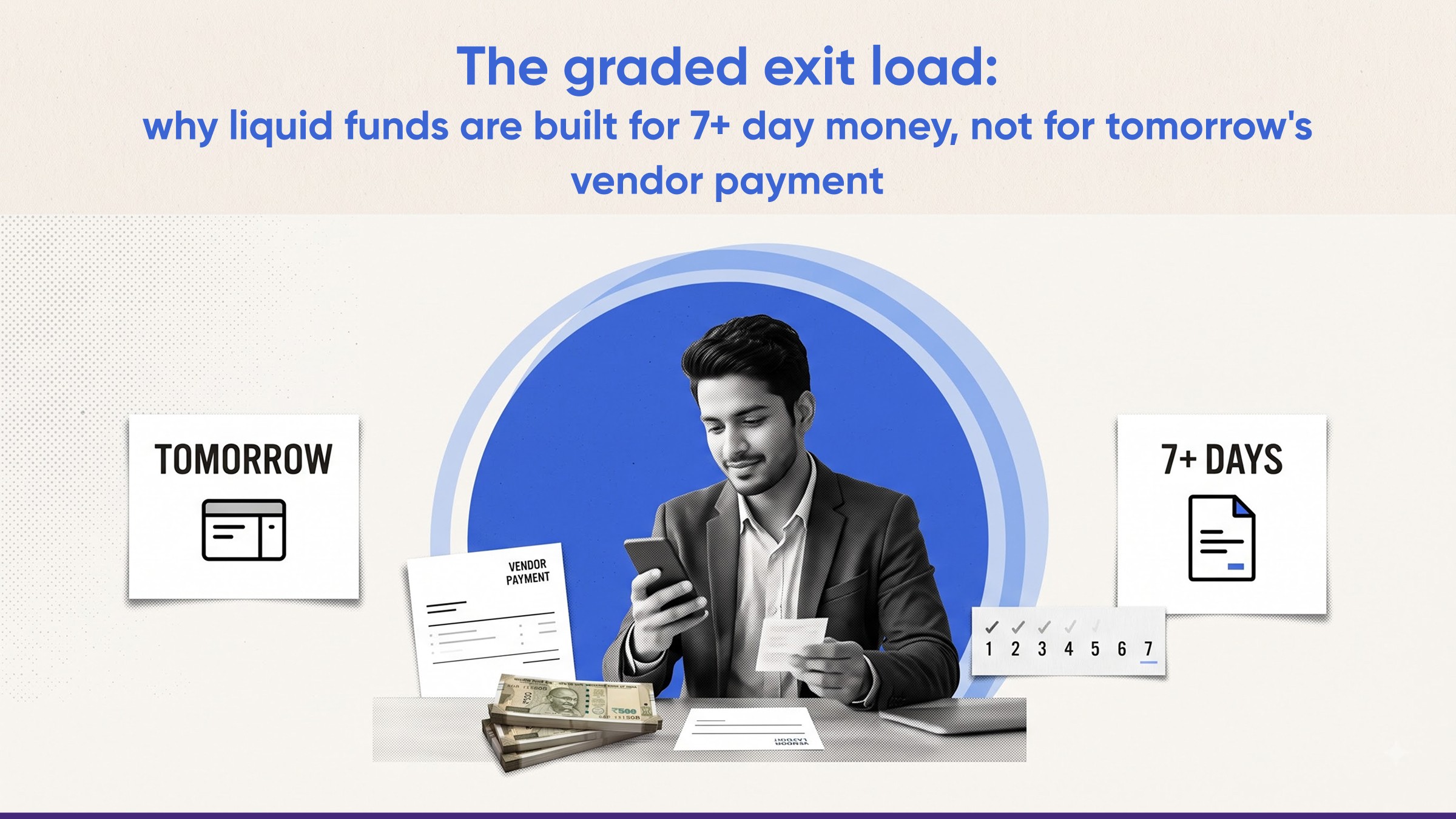
SEBI introduced a graded exit load on liquid funds specifically to discourage ultra-short parking. Redeem on day one and you pay around 0.0070% of redemption value. It steps down each day and disappears entirely from day seven onwards.
The amounts are tiny in absolute terms, a few rupees on a lakh. But the signal is the important bit: liquid funds are designed for money you will not touch for at least a week.
This is a clean operating rule. If a payment is happening within seven days, leave it in the current account. If it is 15, 30, 60 or 90 days out, that is liquid fund territory.
Tax reality check: how liquid-fund gains are taxed for freelancers vs how savings interest is taxed
Mutual fund gains are taxable, and so is savings interest. The difference is in the timing and the treatment.
Savings account interest is taxed as income from other sources, added to your total income and taxed at your slab rate. It accrues and is taxable each year whether or not you withdraw it. Individuals can claim a deduction under Section 80TTA on savings interest up to ₹10,000 under the old tax regime. This does not apply to current accounts, which pay no interest anyway.
Liquid fund gains are capital gains, realised only when you redeem units. Following the changes to debt-oriented mutual fund taxation, gains on such schemes are generally added to your income and taxed at slab rates regardless of holding period, with no indexation benefit for units acquired after the applicable cut-off date.
Two practical consequences for freelancers. Tax is triggered on redemption, not on accrual, which gives you some control over the year in which gains are recognised. And if you file as a business or profession, the treatment may differ depending on whether investments are held on personal or business books.
This is general information, not individualised tax advice. Talk to your CA, especially if you have a registered entity.
Sole proprietor vs Pvt Ltd vs LLP: who can invest business cash, and in whose name
This is the operational detail that decides how you actually do any of this.
Sole proprietors and freelancers. There is no legal separation between you and the business. Your professional income is your income. Practically, most freelancers invest in their personal name, using their individual PAN and KYC. This is the simplest path, and it is the one consumer investing apps are built for.
Partnership firms and LLPs. These are separate entities with their own PAN. They can invest in mutual funds in the firm's or LLP's name, but this requires entity-level KYC, the partnership deed or LLP agreement, authorised signatory details and a board or partner resolution. The process is heavier and usually routed through a distributor or the AMC directly.
Private limited companies. Companies can invest surplus in mutual funds, subject to the Companies Act and a board resolution authorising it. Non-individual KYC, ultimate beneficial ownership declarations and FATCA documentation apply. Do not move company cash into a director's personal folio. That creates accounting and compliance problems far more expensive than the return you were chasing.
The general rule: keep entity money in entity names and personal money in personal names. If you are a sole proprietor, that distinction collapses conveniently in your favour.
A simple bucket rule you can run every month (with a worked example for a ₹1.2 lakh/month freelancer)
Here is a routine that takes ten minutes on the 1st of each month.
List every outflow for the next 90 days with its date. Rent, subscriptions, EMIs, GST, advance tax if the quarter is close, household transfer, insurance.
Ring-fence the next 15 days of outflows plus a buffer. That is bucket one. It stays in the current account. Do not touch this step.
Total the 16-to-90-day outflows. That is bucket two, and it goes to a liquid fund.
Whatever remains and has no claim on it for 3+ months is bucket three, the opportunity buffer.
Redeem bucket two obligations 3–5 working days before each due date. Never on the due date, never on a Friday evening.
Worked example, freelancer earning ₹1.2 lakh a month:
Monthly fixed outflows: ₹65,000 (household transfer, rent, subscriptions, internet, insurance)
Bucket one: ~₹50,000 kept as current account float
Bucket two: quarterly GST of ~₹45,000 plus an advance tax instalment of ~₹35,000 plus a ₹30,000 annual renewal due in two months = ₹1.1 lakh moved into a liquid fund
Bucket three: ₹2 lakh dry-spell cushion, of which ₹1.5 lakh is earmarked for a laptop upgrade in eight months
Before: ₹3.6 lakh sitting at 0%. After: ₹50,000 doing its job in the current account, and ₹3.1 lakh at least trying to earn something, with returns that are market-linked and not assured. Same money, same access horizon, different outcome.
Where Multipl fits: a spending account that keeps near-term money in liquid funds until you spend it

Most of the above is standard financial hygiene. The friction is operational: moving money in, tracking which chunk is for GST versus the laptop, and getting it out in time.
That is the gap Multipl was built around. The Higher-Yield Spending Account holds your near-term spending money in expert-selected liquid mutual funds, where the category has historically returned up to 7%*, historical, category-dependent and not assured, versus the 2 to 3.5% a savings account pays and the zero a current account pays, while staying spend-ready, with no lock-in and withdrawals to your bank whenever you need them. It is a mutual-fund-powered spending account, not a bank savings account or a bank deposit, and it is not insured like a bank deposit. We call it Spendvesting: your money keeps working right up to the day you spend it, instead of sitting idle or pushing you toward debt.
For dated commitments over three to twelve months, say a planned equipment purchase, a family event or school fees, Planned Spends lets you set the goal and the date, with curated liquid and hybrid baskets whose historical returns have been roughly 7 to 15%*, category-dependent and not assured, plus redeemable brand offers of around 2 to 20% across 70 to 100+ partner brands in travel, electronics, fashion, groceries and healthcare when you redeem a goal. These are offers you can redeem against a goal, not guaranteed cashback on every spend.
The compliance basics, since this is your money: Multipl Wealth Management Private Limited is a SEBI-Registered Investment Adviser (INA200014681) and AMFI-registered mutual fund distributor (ARN-319633). Mutual fund units are issued by the AMC and held in your name. Payments run through Razorpay with bank-grade encryption. Fund selection is done by a team of CAs, CFAs and IIM MBAs, with no bias toward any fund house. Over 5 lakh Spendvesters use it.
To be clear about scope: Multipl serves individuals. If you are a sole proprietor or freelancer investing in your personal name, this fits directly. If you run a private limited company or LLP and need to invest in the entity's name, that is a different documentation route. Speak to your CA or an AMC directly.
The honest summary: a liquid fund does not replace your bank account, it gives the idle part of it a job
You will always need a current account. It handles your receivables, your vendor payments, your cheques, your overdraft line and your 9pm emergencies. Nothing here replaces that.
What a liquid fund does is take the portion of your balance that has a known date attached to it, the GST money, the advance tax money, the salary money you already know is going out on the 1st, and stop it from sitting at zero for weeks at a stretch. How much you move stays entirely your call.
Bucket one for the next fortnight. Bucket two for the known obligations. Bucket three for the cushion. Three homes, three jobs, one balance sheet that finally makes sense.
Mutual fund investments are subject to market risks. Read all scheme-related documents carefully. Returns referenced are historical, category-dependent and market-linked; they are not assured or guaranteed, and no investment is zero-risk. SEBI registration and NISM certification do not guarantee performance or assure returns. This article is general information, not individualised investment or tax advice.
FAQs
What is the minimum amount needed to start investing in a liquid fund?
Most liquid funds in India accept lump-sum investments starting from ₹100 to ₹5,000, depending on the scheme and platform. There is no upper limit, and no requirement to maintain a minimum balance the way current accounts often demand. That makes them practical even for freelancers testing the approach with a single month's GST provision before committing more.
What KYC do I need as a freelancer to invest business surplus in a liquid fund?
If you are a freelancer or sole proprietor investing in your personal name, standard individual KYC is enough: PAN, Aadhaar-based verification, a bank account in your name and a video or in-person verification step, all of which are usually completed digitally in a few minutes. You do not need GST registration, business proof or entity documents for personal-name investments. Separate entity-level KYC applies only if you are investing in the name of an LLP, partnership firm or private limited company.
What happens if a client payment gets delayed and I need my liquid fund money sooner than planned?
You can place a redemption request on any business day with no lock-in, and money is typically credited the next business day. For urgent shortfalls, the instant redemption facility gives you up to ₹50,000 or 90% of your folio value, whichever is lower, usually within minutes, including on weekends. This is exactly why the 0–15 day operating float should stay in your current account, so a delayed client payment never depends on redemption timing.
Is a liquid fund better than a fixed deposit for parking short-term business cash?
They solve different problems. A fixed deposit gives you a contracted rate known upfront and deposit insurance up to ₹5 lakh per bank, but breaking it early usually attracts a penalty and a reduced rate. A liquid fund offers no rate guarantee and no deposit insurance, but it has no lock-in beyond a small graded exit load in the first seven days, historically low volatility, and returns that adjust with prevailing short-term rates rather than being fixed at booking.
Do I need a demat account to invest in liquid mutual funds?
No, a demat account is not required for mutual fund investments. Units can be held in statement-of-account form directly with the AMC or its registrar, issued in your name against your PAN and folio number. Most app-based platforms, including Multipl, use this route, which is why onboarding usually needs only KYC and a linked bank account.
Multipl is a AMFI registered Mutual Fund Distributor (ARN No. 319633).
*Based on historical returns of Liquid Fund category.
Disclaimer: Mutual Fund investments are subject to market risks, read all scheme related documents carefully.