•
1 min read
Best Wealth Tech Apps in India (2026) | Multipl

Best Wealth Tech Apps in India (2026): Investing, Saving and Goal-Based Money Management
Most listicles about the best wealth tech apps in India rank tools as if you only need one. You don't. The money in your account right now is doing at least three different jobs, and each job has a different deadline. Rent and Swiggy money leaves this month. Your sister's wedding contribution leaves in seven months. Retirement money does not leave for decades.
Match the app to the deadline. The whole "which platform is best" question gets much easier after that.
India's wealth-tech market in 2026: demat accounts, SIP flows and the app land-grab
Two numbers have shaped the Indian wealth-tech category over the last five years: demat account openings tracked by CDSL and NSDL, and monthly SIP contributions reported by AMFI. Both have climbed steadily, and both are published monthly if you want to check the current figure yourself. That growth pulled in discount brokers, direct mutual fund platforms, neobanks, portfolio aggregators and goal-planning apps, all fighting for space on the same home screen.
The result is a crowded map with a strange hole in it. There are excellent apps for buying stocks. There are excellent apps for running a 20-year SIP. There are decent apps for tracking where your salary went. What almost nobody built for is the money in between: cash you have already earmarked for a specific spend that is coming in three, six or nine months.
That gap matters, because it is exactly where most middle-class Indian households feel the squeeze. School fees, a wedding contribution, a Bali trip, a laptop upgrade, festival shopping. This money is too soon for equity and too important to gamble with, so it sits in a savings account earning roughly 2 to 3.5 percent while the price of the thing you are buying keeps moving.
Pick the horizon before you pick the app: the three timelines your money lives on
Before comparing wealth management apps in India feature by feature, sort your money into three buckets by when you will spend it.
Horizon 0, this month. Rent, groceries, UPI spends, EMIs, fuel, subscriptions. This money needs to be reachable the same day, so capital stability and instant access matter far more than returns.
Horizon 1, three to twelve months. Dated life events and planned purchases. You know roughly the amount and roughly the date. You cannot afford a 30 percent drawdown two weeks before the wedding.
Horizon 2, three years and beyond. Retirement, a house down payment, a child's higher education. Volatility is survivable here because time is on your side.
Each horizon rewards a different product. Liquid funds and low-duration funds suit Horizon 0. Conservative hybrid and short-duration allocations suit Horizon 1. Diversified equity, index funds and long-term portfolios suit Horizon 2. Mix them up and you end up selling equity in a bad month to pay for a holiday.
Horizon 0: spending money for this month, and the apps for idle cash

Most money management apps in India ignore this layer. There is no glamour in a float. Your options broadly fall into four groups.
Bank and neobank apps. Traditional bank apps and newer digital banking apps such as Jupiter and Fi handle payments, UPI and card control well. Rates on the underlying savings balance stay modest, typically in the 2 to 3.5 percent band for large banks, with sweep-in FDs offering a step up in exchange for some friction.
Liquid fund platforms. Direct mutual fund apps and broker platforms let you buy liquid funds yourself. Zerodha's Coin, Groww and Kuvera all give access to the category. You get the fund, but you design the workflow yourself: when to buy, when to redeem, how to time redemption against a bill date.
Instant-redemption liquid schemes. Several AMC apps offer instant redemption on liquid schemes up to the regulatory limit per day per scheme. Good tool. Slightly clunky if your money is spread across fund houses.
Spending accounts powered by mutual funds. This is where Multipl's Higher-Yield Spending Account sits. Your monthly spending money is invested in expert-selected liquid mutual funds and can earn up to 7 percent* based on historical liquid-fund returns, which are not assured, while staying spend-ready and withdrawable whenever you need it.
Compare four things at Horizon 0: redemption speed, cut-off timings, whether the app supports UPI spends from the invested balance, and whether exit loads apply in the first week. Liquid funds are a low-volatility category, not a risk-free one, and returns move with short-term rates.
Horizon 1: life events 3 to 12 months away
Goal based finance apps in India usually mean one of two things. Either the app lets you name a long-term SIP ("Retirement", "Child's education") and shows a progress bar, or it works much like a recurring deposit with a cleaner interface. Neither is built for a dated eight-month spend where the amount is fixed and the date is non-negotiable.
The realistic shortlist for this window:
Recurring deposits and short-tenure FDs through bank apps. Predictable, taxed at slab rate, penalised if you break early. Fine if certainty beats yield for you.
Conservative hybrid and short-duration fund SIPs on direct MF platforms. Kuvera and ET Money both support goal tagging on mutual fund investments, so you can at least keep the money mentally separate.
Multipl's Planned Spends. Built specifically for this horizon. You set the amount and the date, the money goes into a mix of liquid and hybrid funds whose categories have historically returned roughly 7 to 15 percent*, category-dependent and not assured, and when you redeem the goal you can take a brand gift card from a partner network of 70 to 100 plus brands, with redeemable offers of roughly 2 to 20 percent tied to that goal.
The test for a Horizon 1 app is simple. Does it change the allocation as the date gets closer, and does it help you actually spend the money on the thing you saved for? A progress bar does neither.
Horizon 2: money you won't touch for 3+ years
This is the most competitive slice of the market and the one most "best fintech apps for investing India" lists already cover well.
Discount brokers. Zerodha, Upstox and Angel One for direct equity, ETFs and derivatives, with charting and order types built for people who want to place their own trades.
Direct mutual fund platforms. Groww, Kuvera, Coin and ET Money for zero-commission direct plans, where the expense ratio saving compounds meaningfully over a decade.
Curated portfolio products. smallcase for thematic and factor baskets, plus various managed portfolio offerings for people who want someone else to decide the weights.
Multipl's Wealth Account. Curated long-term mutual fund portfolios for surplus money and goals beyond three years, built by an in-house team of CAs, MBAs and CFA charterholders, drawing on underlying categories that have historically returned roughly 15 to 20 percent*, category-dependent and not assured.
Judge apps here on cost, portfolio construction quality, tax reporting and whether the interface tempts you into churn. Historical returns are exactly that, and equity outcomes vary widely by period.
The horizon nobody builds for: why 'PlanSpends' money falls between savings accounts and SIPs
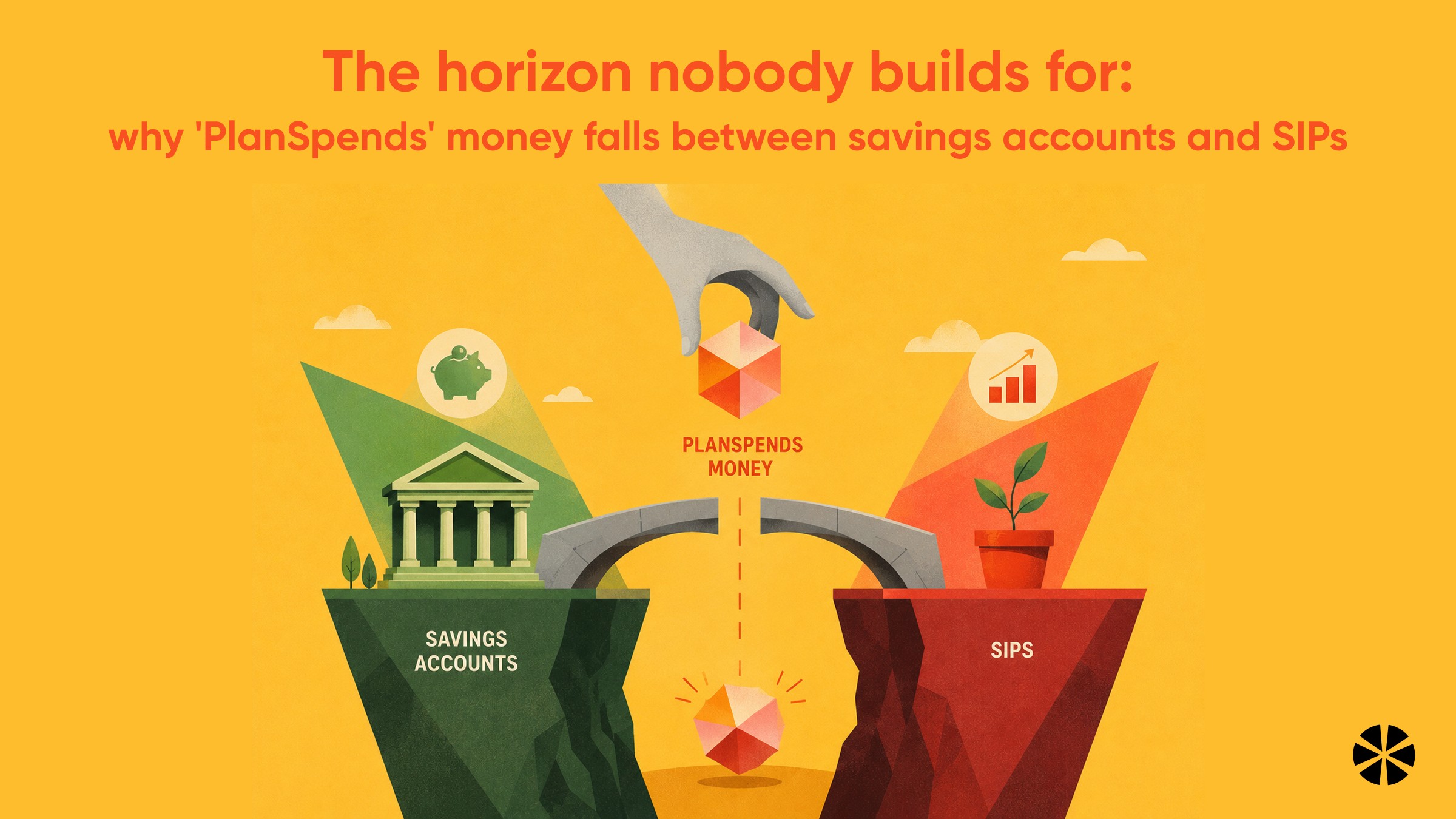
Consider a couple planning a ₹3 lakh wedding contribution nine months out. They set aside ₹33,000 a month. In a savings account, that money earns 2 to 3.5 percent, so the last rupee they deposit earns almost nothing and the first earns very little. In an equity SIP, nine months is short enough that a bad quarter forces them to either delay the event or dip into other savings.
So the money defaults to the bank. That is the quiet cost most households never calculate. Multiply it across school fees in April, a summer holiday in May, festival spends in October and insurance premiums in December, and a family can be carrying a sizeable float year-round.
The other cost is behavioural. Money sitting undifferentiated in a savings account gets spent on something else, and the shortfall gets patched with a credit card or a consumer loan. Debt-free planning is less about willpower and more about having a separate, named, dated place for goal money.
How Multipl's Spendvesting model covers Horizon 0 and Horizon 1
Multipl calls this approach Spendvesting: investing the money you have set aside for a future spend so it keeps working until the day you actually spend it. The app layers accounts by time horizon rather than by asset class.
Higher-Yield Spending Account (Horizon 0). Monthly spending money in expert-selected liquid mutual funds, up to 7 percent* based on historical liquid-fund returns and not assured, spend-ready and withdrawable anytime, usable for routine UPI spends.
Planned Spends (Horizon 1). Dated goals over roughly three to twelve months across liquid and hybrid funds, roughly 7 to 15 percent* historically, category-dependent and not assured, with brand gift cards redeemable as offers tied to a completed goal.
Wealth Account (Horizon 2). Long-term curated portfolios for money you will not touch for three years or more.
The operating entity is Multipl Wealth Management Private Limited, a SEBI-Registered Investment Adviser (INA200014681) and AMFI-registered mutual fund distributor (ARN-319633), headquartered in Bengaluru. Mutual fund units are held in the name of the user at the respective AMC, payments run through Razorpay with bank-grade encryption, and fund selection carries no bias toward any fund house. Roughly one million app downloads and more than five lakh Spendvesters use the platform.
Two honest caveats. The Higher-Yield Spending Account is a mutual-fund-powered spending account, not a bank savings account or a bank deposit, so it is not insured the way a bank balance is. And every return figure above is historical and category-dependent, never assured. Mutual fund investments are subject to market risks; read all scheme-related documents carefully.
Cross-horizon tools: tracking, budgeting and portfolio aggregation apps
Some apps do not hold your money at all. They tell you where it went and what it is worth.
Portfolio aggregators. INDmoney and similar tools pull mutual funds, stocks, EPF and bank balances into one view, which is genuinely useful once you hold assets across four platforms.
CAS-based trackers. Consolidated Account Statement imports from CAMS and KFintech let most MF apps show your full mutual fund holdings regardless of where you bought them.
Budgeting and expense apps. Walnut-style SMS parsers and manual budget apps help you find the float in the first place, which is the input to every horizon decision.
Account Aggregator-enabled apps. The RBI's Account Aggregator framework lets you share bank data with consent, which several wealth tech apps in India now use for faster onboarding and cash-flow analysis.
Aggregators are diagnostic tools. They do not improve returns by themselves.
Best wealth tech apps in India, mapped by horizon: the master table
Horizon | Timeline | Job of the money | App categories that fit | What to check before you commit |
|---|---|---|---|---|
Horizon 0 | 0 to 3 months | Spend-ready float, UPI, bills | Bank and neobank apps, liquid fund platforms, Multipl's Higher-Yield Spending Account | Redemption speed, cut-off times, exit load in first 7 days |
Horizon 1 | 3 to 12 months | Dated life events, travel, fees | Multipl's Planned Spends, RDs and short FDs, conservative hybrid SIPs | Does allocation de-risk near the date, is redemption tied to the goal |
Horizon 2 | 3+ years | Compounding, wealth creation | Discount brokers, direct MF platforms, curated portfolios, Multipl's Wealth Account | Direct vs regular plans, total cost, portfolio logic, tax reports |
Cross-horizon | Always | Visibility and control | Aggregators, CAS trackers, budgeting apps | Data permissions, refresh frequency, coverage of your assets |
Liquidity, exit loads and taxes: what each horizon actually costs you
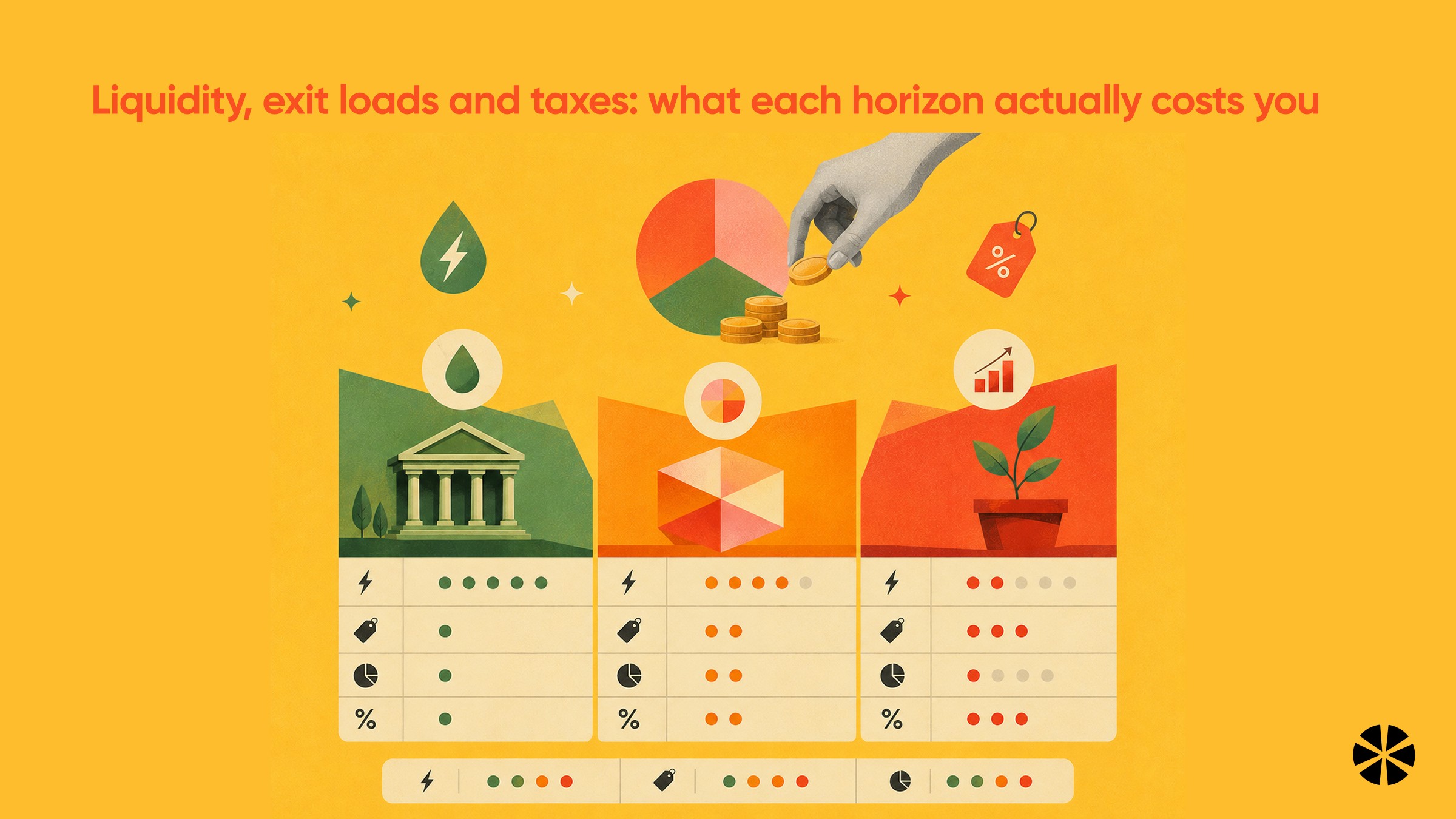
Returns are the headline. Access rules and tax treatment quietly decide your real outcome.
Liquidity. Liquid funds typically credit redemptions to your bank on a T+1 basis, with instant redemption available on many schemes up to the SEBI-specified limit per day per scheme. Most liquid funds carry a graded exit load for redemptions within the first seven days, which is why parking a bill payment there for four days can be pointless. Equity funds settle in a few working days. Breaking a bank FD early usually costs you a penalty on the interest rate.
Taxes. Mutual fund gains are taxable, and the rules differ by scheme category and holding period, with debt-oriented schemes taxed differently from equity-oriented ones. Bank interest is taxable too, and TDS may apply. Tax outcomes depend on your individual situation, so check the current rules or speak to a qualified tax professional rather than relying on a blog post.
Risk. No investment is zero-risk. Liquid funds are low-risk and low-volatility rather than risk-free, hybrid funds carry more variability than liquid funds, and equity carries the most. Returns vary with market conditions. SEBI registration and NISM certification do not guarantee performance or assure returns.
Three ready-made 2026 stacks: first-jobber, young family, freelancer
The first-jobber, ₹60,000 a month take-home. Salary lands in the bank app. About ₹25,000 of monthly spending money moves into a mutual-fund-powered spending account so it can earn while waiting to be spent, and UPI spends draw from there. A ₹5,000 dated goal runs for a Goa trip in eight months. A ₹10,000 monthly index fund SIP handles Horizon 2. One aggregator app to see it all.
The young family, two incomes, one child. Bank app for salary and EMIs. Spending account for the household float, roughly two months of variable expenses. Three Planned Spends goals running in parallel: April school fees, a July trip, October festival shopping, each with its own date and amount so nothing gets funded by a credit card. A long-term portfolio for the child's education, plus term and health insurance handled outside the app stack.
The freelancer with lumpy income. The core problem is timing, not amount. Invoice receipts land in a spending account so the buffer can earn while it waits, quarterly advance tax gets its own dated goal so the money is never accidentally spent, and only genuine surplus flows into a long-term portfolio. Expense tracking matters more here than anywhere else, because deductible costs and personal spends run through the same accounts.
Build the stack in that order and you rarely need to argue with yourself about which app is best. The deadline picks it for you.
*Returns mentioned are historical, category-dependent and not assured. Mutual fund investments are subject to market risks. Read all scheme-related documents carefully.
FAQs
Is a liquid fund safer than a savings account for my spending money?
Liquid funds are a low-risk, low-volatility mutual fund category, but they are not risk-free and are not insured the way a bank deposit is. They invest in short-term money market instruments and are designed for capital stability with high liquidity, which is why they are used for parking short-term money. A savings account offers deposit insurance up to the DICGC limit and instant access, while a liquid fund has historically offered higher returns without any guarantee of doing so in future.
How much of my monthly income should sit in a Horizon 0 spending account?
A common approach is to keep roughly one to two months of variable spending in your Horizon 0 layer, with fixed obligations like EMIs and rent timed to be available on their due dates. Anything beyond that buffer is usually better matched to a dated goal or a long-term portfolio. The right number depends on how predictable your income and bills are, so freelancers typically hold a larger float than salaried earners.
Can I use one app for all three horizons, or should I spread across platforms?
You can use one app if it genuinely offers products for all three horizons, and consolidation makes tracking and tax reporting easier. Many people end up on two or three platforms because their broker, their direct mutual fund platform and their spending layer came from different providers. What matters more than the number of apps is that no single pot of money is doing two jobs with two different deadlines.
What happens to my goal money in Multipl if I need it before the goal date?
Money in Multipl stays in your name as mutual fund units held at the AMC, and you can withdraw before the goal date by redeeming those units to your bank account. There is no lock-in on the spending account, though standard scheme rules such as exit loads and settlement timelines apply depending on the fund. Brand discount offers are redeemable against a completed goal, so an early withdrawal means you take the money rather than the gift card.
Do I need a demat account to use goal-based finance apps in India?
Not for mutual funds. Mutual fund units can be held in statement-of-account form with the AMC through the registrars CAMS and KFintech, so a demat account is optional for most goal-based finance apps. You do need one if you plan to buy stocks, ETFs or hold mutual funds in demat form through a broker.
Multipl is a AMFI registered Mutual Fund Distributor (ARN No. 319633).
*Based on historical returns of Liquid Fund category.
Disclaimer: Mutual Fund investments are subject to market risks, read all scheme related documents carefully.